10 Facts About John Paul Jones You Need to Know
When exploring the origins of the United States military, few figures loom as large or as fiercely as John Paul Jones. Often remembered as the "Father of the American Navy," his audacity on the high seas helped shape the outcome of the American Revolutionary War. Whether you are a history buff or simply curious about early American military leaders, these 10 facts about John Paul Jones reveal the complex, driven, and often controversial man behind the naval legend.

10 Fascinating Facts About John Paul Jones
John Paul Jones was far more than a textbook hero. His life was a whirlwind of international travel, high-stakes combat, legal trouble, and royal recognition. Let's dive into the details of his extraordinary life.
1. He Was Born in Scotland, Not America
Despite becoming one of the most celebrated heroes of the American Revolution, John Paul Jones was not American by birth. He was born John Paul on July 6, 1747, in Kirkbean, in the south of Scotland. He only added the surname "Jones" later in life after fleeing to America to escape criminal charges in the British West Indies.
2. He Started His Maritime Career at Age 13
The sea called to Jones at a very young age. In 1760, when he was just 13 years old, he signed on as a cabin boy aboard the merchant ship Friendship, bound for Fredericksburg, Virginia. This early apprenticeship exposed him to the harsh realities of transatlantic trade and laid the technical foundation for his future naval brilliance.
3. He Committed Homicide Before the Revolution
Before joining the American cause, Jones's life was nearly derailed by violence. In 1773, while commanding the merchant brig Betsy in Tobago, he struck a mutinous crew member named Mungo Maxwell with a sword during a dispute. Maxwell died a few weeks later. Though Jones claimed self-defense, local authorities advised him to flee before facing trial, leading to his self-imposed exile in America.
4. He Raised the First American Naval Flag
Following the outbreak of the American Revolution, Jones offered his services to the Continental Congress. Commissioned as a senior lieutenant in 1775, he was assigned to the newly purchased flagship Alfred. On December 3, 1775, Jones had the distinct honor of hoisting the Grand Union Flag (the precursor to the Stars and Stripes) aboard the vessel—making him the first man to fly an American naval flag.
5. He Brought the War to British Shores
Video: John Paul Jones: The Man Who Created the US Navy and Terrified the British | Forgotten History
Jones was an aggressive tactician who believed the best defense was a strong offense. In 1778, commanding the USS Ranger, he sailed directly into British waters. He executed a surprise nighttime raid on the port of Whitehaven, England, spiking the cannons of the local fort and briefly capturing a British warship, the HMS Drake. This sent shockwaves through the British public, who had previously felt immune to the conflict.

6. "I Have Not Yet Begun to Fight!"
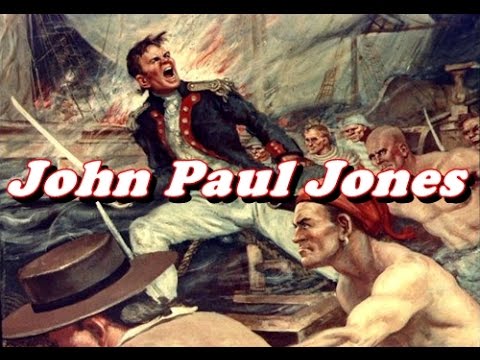
Jones is most famous for his defiant words during the Battle of Flamborough Head on September 23, 1779. Commanding the heavily battered USS Bonhomme Richard against the formidable British warship HMS Serapis, Jones found his ship sinking and on fire. When the British captain, Richard Pearson, called out to ask if Jones was ready to surrender, Jones famously replied: "Sir, I have not yet begun to fight!" He went on to board and capture the Serapis as his own ship sank beneath him.
7. He Was Awarded a French Noble Title
Due to his immense success against the British, Jones became an international celebrity, particularly in France, which was allied with the American colonies. King Louis XVI presented him with a gold-hilted sword and made him a Chevalier (Knight) of the Military Order of Merit. He was also granted the title of "Knight of the Realm," allowing him to use "de Jones" if he wished.
8. He Served as a Rear Admiral in the Russian Navy
After the American Revolution ended, the Continental Navy was essentially disbanded, leaving Jones without a command. Seeking further military action, Jones accepted an appointment in 1788 as a Rear Admiral in the Imperial Russian Navy under Empress Catherine the Great. Using the Russified name Pavel Ivanovich Dzons, he commanded a squadron in the Black Sea and helped defeat the Ottoman Empire in the Battle of Liman, though court intrigue eventually led to his dismissal.
9. He Died Alone in Paris at Age 45
Jones's post-Russian years were marked by declining health and financial uncertainty. He moved to Paris, France, where he was appointed as U.S. agent to negotiate the release of American hostages in Algiers. Unfortunately, he never fulfilled the mission. He died alone in his Paris apartment on July 18, 1792, at the age of 45, from interstitial nephritis (kidney disease).
10. His Body Was Lost and Then Found Over a Century Later
Because he died in France during the chaotic early days of the French Revolution, his exact burial site was eventually forgotten, and his lead-lined coffin was buried in an unmarked Parisian cemetery that was later turned into a dump. Driven by a personal obsession, U.S. Ambassador to France Horace Porter launched a meticulous search in 1899. After six years of digging, Porter located Jones's remarkably well-preserved body in 1905. His remains were subsequently exhumed, transported back to the United States with full military honors, and finally laid to rest in a grand bronze and marble crypt at the U.S. Naval Academy Chapel in Annapolis, Maryland.
Conclusion
John Paul Jones was a volatile mix of ambition, vanity, and unmatched tactical brilliance. From his Scottish roots to his final resting place in Annapolis, his life reads like an epic adventure novel. These 10 facts about John Paul Jones highlight why his legacy endures as the spiritual bedrock of the modern United States Navy.