1977 Penny Error List: Top Varieties Worth Money
In 1977, the United States Mint produced over 8 billion Lincoln cents across the Philadelphia and Denver facilities. Because billions of these coins entered circulation, standard specimens pulled from pocket change are typically worth face value or their base copper melt value. However, the high-speed stamping presses of the 1970s frequently suffered mechanical failures, producing fascinating mint mistakes. If you are examining pocket change or inherited rolls, this definitive 1977 penny error list highlights the most valuable varieties and anomalies collectors look for today.

Understanding the 1977 Lincoln Cent Baseline
Before hunting for errors, it helps to understand the specifications of a normal 1977 cent:
- Composition: 95% copper, 5% zinc
- Weight: 3.11 grams (with an official tolerance of ±0.13 grams)
- Diameter: 19.05 mm
- Edge: Plain (smooth)
- Mints: Philadelphia (no mint mark) and Denver ("D" mint mark below the date)
Any coin departing significantly from these physical benchmarks warrants a closer look under magnification.
The Definitive 1977 Penny Error List and Values
1. 1977 Cent Struck on a 10-Cent (Roosevelt Dime) Planchet
Among the most coveted wrong-planchet errors of the 1970s is a Lincoln cent struck on a blank intended for a Roosevelt dime. This error occurred when a dime planchet was accidentally fed into a cent hopper at the mint.
How to identify it:
- The coin will look silvery instead of copper-colored.
- It will weigh approximately 2.27 grams rather than 3.11 grams.
- Because a dime planchet is only 17.9 mm in diameter, the coin will be visibly smaller, cutting off portions of outer legends like "LIBERTY" or the rim lettering.
Estimated Value: $300 to $1,000+ depending on the strike quality, visible date, and certified grade.
2. 1977 Off-Center Strikes
An off-center strike happens when the planchet does not seat correctly between the upper and lower dies before the press cycles. When the dies strike, only a portion of the coin design is impressed, leaving an unstruck crescent of blank metal.
The value of an off-center strike hinges on two factors: the percentage of displacement and the visibility of the date.
- 5% to 15% Off-Center: Minor misalignment. Often trades for $5 to $20.
- 40% to 60% Off-Center with Full Date: Highly desirable to collectors. A 1977 penny struck 50% off-center with "1977" fully legible can fetch between $50 and $150.
- Off-Center without Date: Unidentifiable by year, reducing value to roughly $10 to $25.
3. 1977 Die Break / Die Cud Errors
Working dies endure tremendous hydraulic pressure. Over time, micro-fractures develop on the die face. When a chunk of metal chips away from the edge of the die, the resulting empty space fills with metal during striking, creating a smooth, raised, unstruck lump along the coin's rim. Numismatists call this a "cud."
How to identify it: Look along the rim on either the obverse or reverse. A true cud will appear as a raised, blank mound connected directly to the rim, often flattening the design directly opposite it due to uneven strike pressure.
Estimated Value: $15 to $100 depending on the size and location of the cud.
4. 1977 Clipped Planchet Errors
During the manufacturing of coin blanks, sheets of metal are fed into a machine with cylindrical punches that punch out round discs. If the metal strip fails to advance at the correct pace, the punch may overlap a previously punched hole, producing a curved clip. Less commonly, straight clips occur when the punch overlaps the straight leading or trailing edge of the strip.

How to spot an authentic clip: Genuine clips display the "Blakesley Effect"—the rim opposite the clip will appear weak or missing due to a lack of metal flow during the upset rimming process.
Estimated Value: $10 to $40 for standard curved clips; up to $75 for dramatic double or straight clips.
5. 1977 Broadstrike Errors
When a coin is struck, it sits inside a steel ring called a retaining collar. The collar prevents the metal from expanding outwards and forms the finished rim. If the collar fails to engage or jams beneath the anvil die, the metal expands outward beyond standard dimensions.
How to identify it: A 1977 broadstruck cent is thinner than normal, has a significantly wider diameter than 19.05 mm, completely lacks an upset rim, and retains full design details on both sides.
Estimated Value: $15 to $35.
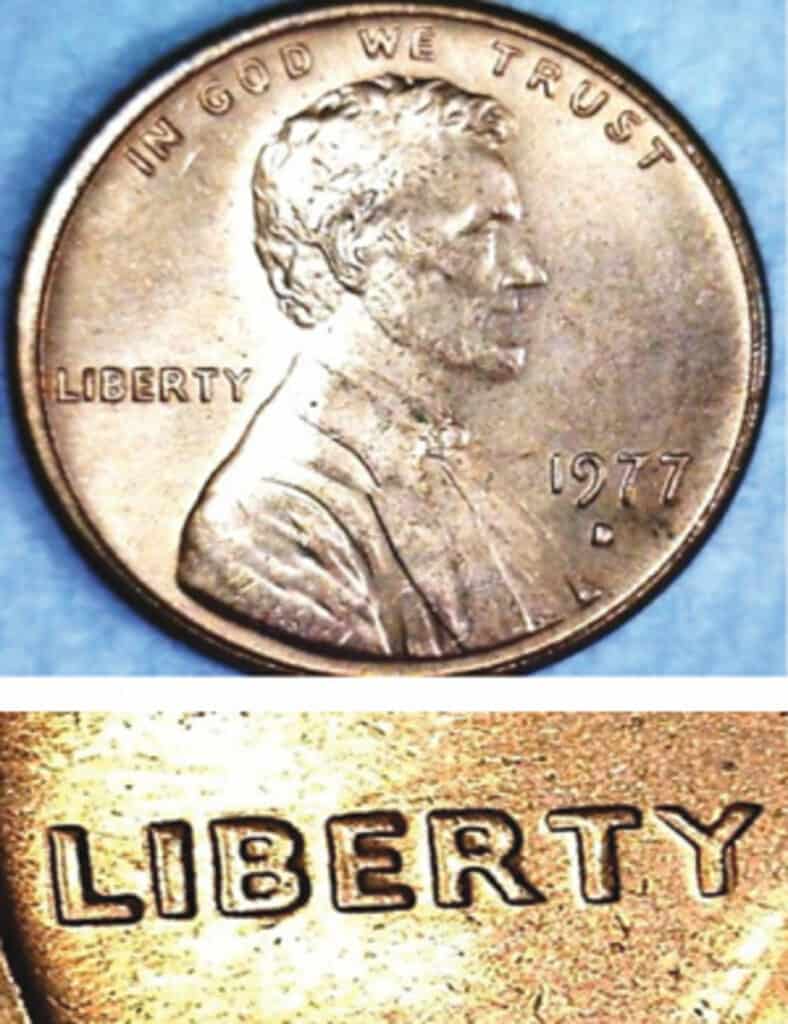
6. 1977 "BIE" Die Break Variety
A classic, accessible variety popular among Lincoln cent enthusiasts is the "BIE" error. As the obverse die aged, small stress cracks consistently formed between the letters "B" and "E" of the word "LIBERTY." The resulting vertical die crack resembles the capital letter "I," making the word look like "LIBEIRT."
While not technically an official mint error (it is classified as a minor die variety), dedicated collectors pay a small premium for pronounced examples.
Estimated Value: $3 to $15 depending on condition.
True Doubled Die vs. Mechanical Doubling on 1977 Pennies
A frequent point of confusion for beginners is doubling. Many searchers mistake machine doubling (also known as strike doubling or mechanical doubling) for a valuable Doubled Die Obverse (DDO).
- Mechanical Doubling: Caused by loose dies vibrating or shifting slightly as they retract. The doubling looks flat, shelf-like, or scraped, and reduces the size of the original device. This is extremely common on 1970s cents and carries no collector premium.
- Doubled Die (Hub Doubling): Caused when the die itself is mistakenly impressed twice with mismatched hub alignments. The doubling is crisp, rounded, shows clear split serifs on lettering, and spreads the image. While no major, high-value DDO (such as the famous 1972 DDO) is recorded for 1977, minor doubled dies exist on Lincoln's eye, ear, and the date inscriptions, worth between $10 and $50.
How to Inspect Your 1977 Pennies
To accurately identify whether you hold an authentic mint error or ordinary pocket change damage, follow these inspection steps:
- Weigh the coin with a digital scale: A scale accurate to two decimal places (0.01g) quickly detects wrong-planchet errors. A normal copper 1977 penny must weigh around 3.11 grams. If it weighs around 2.27 grams, you may have a dime planchet strike.
- Use a 10x or 15x jeweler's loupe: High magnification reveals whether doubling has shelf-like shelf steps (damage/machine chatter) or rounded contours with notched corners (true hub doubling).
- Rule out Post-Mint Damage (PMD): Dents, gouges, chemical acid baths, and garage-tool alterations mimic genuine errors. Genuine errors show metal flow patterns consistent with high-pressure striking inside the mint press.
1977 Penny Error Quick Reference Table
| Error Type | Key Visual Feature | Typical Price Range |
|---|---|---|
| Struck on Dime Planchet | Silver color, 2.27g, smaller diameter | $300 – $1,000+ |
| Off-Center Strike (50% w/ Date) | Blank crescent, full "1977" visible | $50 – $150 |
| Die Cud (Rim Break) | Smooth, raised lump connecting to rim | $15 – $100 |
| Clipped Planchet | Missing curved edge, Blakesley effect | $10 – $40 |
| Broadstrike | Expanded diameter, flat/absent rim | $15 – $35 |
| BIE Die Variety | Raised bar between 'B' and 'E' | $3 – $15 |
Final Thoughts
While the vast majority of 1977 pennies are common pocket change, anomalous strikes slip through inspection bins every year. Keep an eye out for off-color coins, unusual weights, and missing rim sections. If you discover a promising candidate matching this error list, preserve it in an acid-free 2x2 coin holder to protect its surfaces and value.