2002 Dime Value: Coin Prices, Errors, and Varieties
If you have recently found a Roosevelt dime in your change jar and wondered about the 2002 dime value, you are not alone. While billions of modern US coins are struck every year, numismatists (coin collectors) and casual hunters alike are always on the lookout for pieces that carry a higher value due to mint marks, condition, or rare manufacturing errors.

In circulated condition, most 2002 dimes are only worth their face value of ten cents. However, uncirculated specimens, special proof strikes, and coins with distinct mint errors can command significantly higher prices on the secondary market. This guide breaks down everything you need to know about evaluating a 2002 dime.
Understanding the 2002 Roosevelt Dime
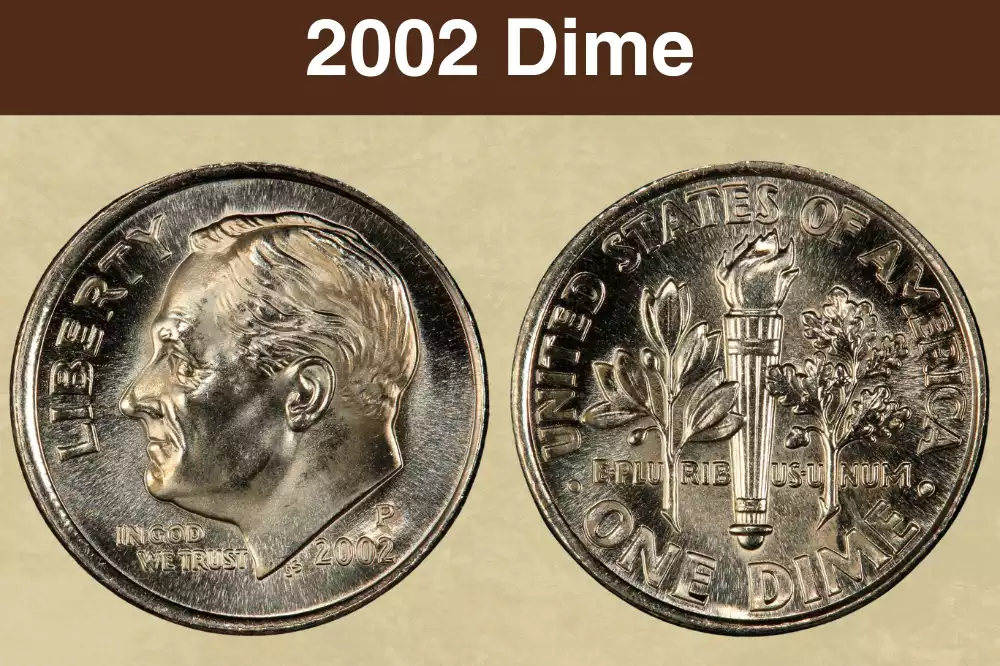
The Roosevelt dime has been a staple of United States currency since 1946, honoring President Franklin D. Roosevelt for his leadership and his association with the March of Dimes. The obverse (front) features a profile of Roosevelt, while the reverse (back) displays an olive branch, a torch, and an oak branch symbolizing peace, liberty, and strength.
By 2002, the composition of the dime was well-established as a clad metal: an outer layer of 75% copper and 25% nickel bonded to a pure copper core. Because the United States Mint produced these coins in massive quantities at both the Philadelphia and Denver facilities, millions of them remain in circulation today.
General 2002 Dime Value Breakdown
The financial worth of a 2002 dime depends heavily on three main factors: where it was minted, its physical condition, and whether it is a business strike or a special collector edition.
1. Philadelphia Mint (No Mint Mark)
Dimes struck at the Philadelphia Mint do not feature a mint mark. The Mint produced over 1.4 billion dimes at this facility in 2002. Because of this enormous mintage, circulated 2002 dimes from Philadelphia are extremely common and trade strictly for face value (10 cents).
Even in pristine, uncirculated condition—graded MS65 or higher by a third-party grading service—a Philadelphia 2002 dime typically only sells for $2 to $5.
2. Denver Mint ('D' Mint Mark)
Dimes struck at the Denver facility feature a small "D" mint mark located just to the left of the date on the obverse side. Denver produced a similarly massive quantity (over 1.3 billion coins).
Just like their Philadelphia counterparts, circulated Denver dimes are worth 10 cents. High-grade uncirculated examples (MS65 to MS68) range from $3 to upwards of $15 depending on the exact grade and eye appeal.
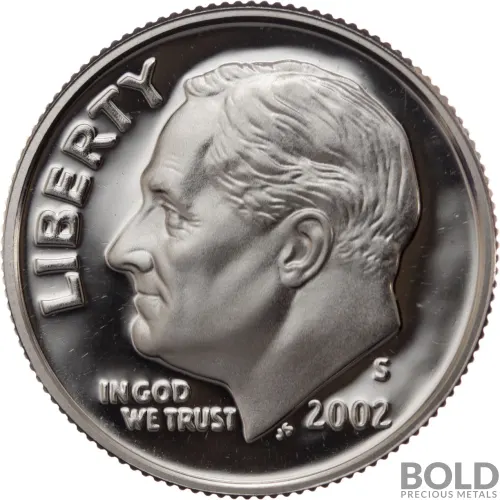
3. San Francisco Mint ('S' Mint Mark Proofs)
Video: HOW MUCH IS A 2002 DIME WORTH? RARE ROOSEVELT DIMES WORTH MONEY!!

The San Francisco Mint did not produce business-strike dimes for general circulation in 2002. Instead, they struck proof coins exclusively for collectors packaged in annual Mint Sets. These coins feature mirror-like finishes and sharply defined details.
- Standard Copper-Nickel Proof: Typically valued between $3 and $7.
- 90% Silver Proof: Struck in a traditional 90% silver and 10% copper composition for special silver proof sets, these are worth considerably more—generally between $10 and $25 depending on the condition and packaging.
What Makes a 2002 Dime Worth More?
If you want to find a 2002 dime worth more than pocket change, you need to look past standard circulated coins and focus on high-grade specimens or mint errors.
Full Band Designations
For modern Roosevelt dimes, collectors look closely at the horizontal bands across the central portion of the torch on the reverse. If the lines separating the bands are fully struck, complete, and uninterrupted, the coin may receive a "Full Bands" (FB) designation from services like PCGS or NGC.
A 2002-P or 2002-D dime graded MS67 with Full Bands is relatively scarce and can command prices between $25 and $50, whereas a non-FB coin in the same grade would fetch significantly less.
Mint Errors
Errors that occur during the manufacturing process at the mint can dramatically increase a coin's value. When hunting through rolls of 2002 dimes, keep an eye out for these rare anomalies:
- Doubled Die Errors: Doubling visible on the lettering or date (though rare for this specific year).
- Off-Center Strikes: Occurs when the planchet is not properly aligned under the dies, resulting in a portion of the design missing.
- Struck Through Errors: Debris or grease getting trapped between the die and planchet, leading to a blurred or missing design element.
- Cuds and Rim Dents: Breakage on the die edge that transfers a raised blob of metal to the coin.
Depending on the severity of the error, a verified mint error on a 2002 dime can easily sell for anywhere from $20 to over $100 to specialized error coin collectors.
How to Inspect Your Dimes
If you are planning to sort through a collection or a box of coin-roll-hunting finds, use the proper tools to avoid damaging the coins:
- Use a Magnifying Glass or Loupe: A 5x or 10x jeweler's loupe is essential for inspecting mint marks, torch details, and potential doubling errors.
- Handle by the Edges: Oils from your fingers can tarnish or damage modern clad coin surfaces, lowering their potential grade.
- Check the Weight: A standard 2002 clad dime weighs 2.26 grams. If you suspect a mint error involving the wrong planchet (such as a foreign coin blank or a silver planchet meant for a proof), a precision digital scale is invaluable.
Conclusion
Ultimately, the 2002 dime value for the vast majority of coins found in circulation is simply 10 cents. Because the US Mint produced well over two billion business-strike dimes that year, they are far too common to be considered rare treasures.
However, coin collecting is a hobby of precision and patience. Finding a pristine, high-grade specimen with Full Bands or discovering a legitimate mint error makes sorting through modern change an exciting pastime. Always examine the mint mark, check the condition under magnification, and keep your eyes open for unusual manufacturing anomalies.