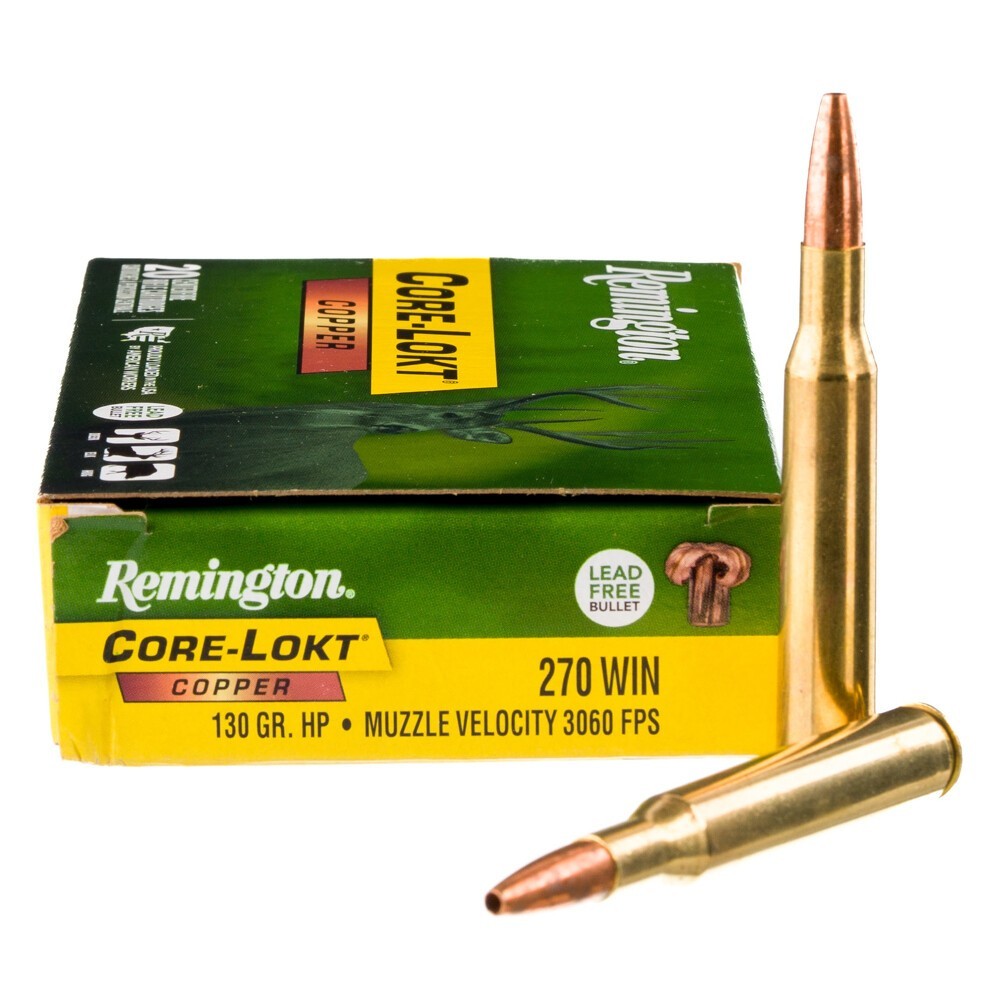
.270 130 Grain Core-Lokt Ballistics Guide
When hunters discuss legendary whitetail deer cartridges, the .270 Winchester paired with a 130-grain bullet invariably enters the conversation. For generations, this combination has filled freezers and performed reliably across North America. At the heart of this enduring legacy is Remington's iconic ammunition line. Understanding the 270 130 grain core lokt ballistics is essential for any hunter looking to maximize their accuracy, ethical lethality, and effective range in the field.

Remington's Core-Lokt is often called "The Deadliest Mushroom in the Woods." Its design is simple yet remarkably effective, featuring a tapered copper jacket mechanically locked to a solid lead core. This ensures controlled expansion and high weight retention upon impact. But how does this classic soft-point round actually perform downrange in terms of velocity, energy, and trajectory? Let's take a close look at the numbers.
Understanding .270 130 Grain Core-Lokt Ballistics
To evaluate how this round flies, we must look at manufacturer-published ballistic data. Factory loads for the .270 Winchester pushing a 130-grain Core-Lokt Pointed Soft Point (PSP) typically leave the muzzle at a brisk velocity, making it a remarkably flat-shooting cartridge for traditional hunting distances.
Muzzle Velocity and Energy
Out of a standard 24-inch test barrel, the factory Remington Core-Lokt 130-grain loading achieves a muzzle velocity of approximately 3,060 feet per second (fps). At the muzzle, this generates roughly 2,700 foot-pounds (ft-lbs) of kinetic energy.
This high initial velocity is what gives the .270 Winchester its renowned flat trajectory. A flatter trajectory reduces the margin of error when estimating distance on a trophy buck across a wide-open cut line or agricultural field.
Trajectory and Bullet Drop
Most big game hunters zero their .270 rifle at 100 or 200 yards. When sighted in 2.5 inches high at 100 yards (which yields a 200-yard zero), the Core-Lokt trajectory generally follows this pattern:
- Muzzle: -1.5 inches (height over bore)
- 100 Yards: +2.5 inches
- 200 Yards: 0.0 inches (Zero)
- 300 Yards: -7.2 inches
- 400 Yards: -20.5 inches
- 500 Yards: -41.0 inches
- 100 Yards: ~2,140 ft-lbs
- 200 Yards: ~1,680 ft-lbs
- 300 Yards: ~1,305 ft-lbs
- 400 Yards: ~1,000 ft-lbs
- Affordability: Core-Lokt ammunition is remarkably cost-effective, allowing hunters to practice frequently at the range without breaking the bank.
- Proven Reliability: It has decades of field-tested history. It simply works on whitetails, mule deer, pronghorn, and feral hogs.
- Standard Twist Rates: The 130-grain weight is the weight that Jack O'Connor popularized. It stabilizes exceptionally well in virtually every standard 1:10 twist .270 barrel ever manufactured.
Because the bullet drops sharply past 300 yards, the 130-grain Core-Lokt is best utilized as a point-blank range option inside 300 to 350 yards for most shooters. Beyond that distance, wind drift and rapid energy loss become significant factors.
Downrange Energy Retention
Ethical hunting requires sufficient energy to disrupt vital organs and ensure a quick, humane harvest. Wildlife biologists generally recommend a minimum of 1,000 ft-lbs of energy for deer-sized game, and around 1,500 ft-lbs for larger animals like elk.
The 130-grain Core-Lokt retains energy reasonably well for a traditional soft-point projectile:

As these numbers show, the round drops below the 1,000 ft-lbs threshold right around 400 yards. Combined with the steep trajectory drop at that range, keeping shots within 300 yards ensures optimal performance.
Field Performance and Terminal Ballistics
Numbers on a chart only tell half the story. How a bullet behaves when it strikes flesh and bone defines its true utility in the field.
Controlled Expansion
The Core-Lokt design is engineered to expand reliably across a wide velocity window. When it hits game at close range—where velocities are high—the thick mid-section of the copper jacket prevents the bullet from fragmenting violently, ensuring deep penetration into the chest cavity. At longer ranges where velocity drops, the soft-point tip is pliable enough to expand fully even upon lower-velocity impacts.
Wound Channels
Upon impact, the 130-grain projectile typically mushrooms to roughly double its original diameter, creating a devastating wound channel. The combination of hydrostatic shock from the high-velocity .270 caliber and the wide frontal area of the expanded lead core results in short tracking jobs and quick harvests.
Comparison: Core-Lokt vs. Modern Premium Ammo
In an era dominated by high-BC (ballistic coefficient) polymer-tipped boat-tail bullets designed for extreme long-range shooting, why do hunters still buy Core-Lokt?
While modern bonded or monolithic bullets (like the Barnes TTSX or Hornady ELD-X) offer higher retained weights and better wind-bucking profiles at 400+ yards, they often cost twice as much per box and are frequently overkill for standard timber and field hunting distances.
Conclusion
The .270 Winchester shooting a 130-grain projectile is arguably one of the most balanced hunting setups ever devised. When you examine the 270 130 grain core lokt ballistics, you find a cartridge that marries high muzzle velocity, manageable recoil, and reliable terminal performance. While it may not be optimized for precision target shooting past 400 yards, it remains an absolute gold standard for North American big game hunters looking for dependable, affordable, and lethal performance.