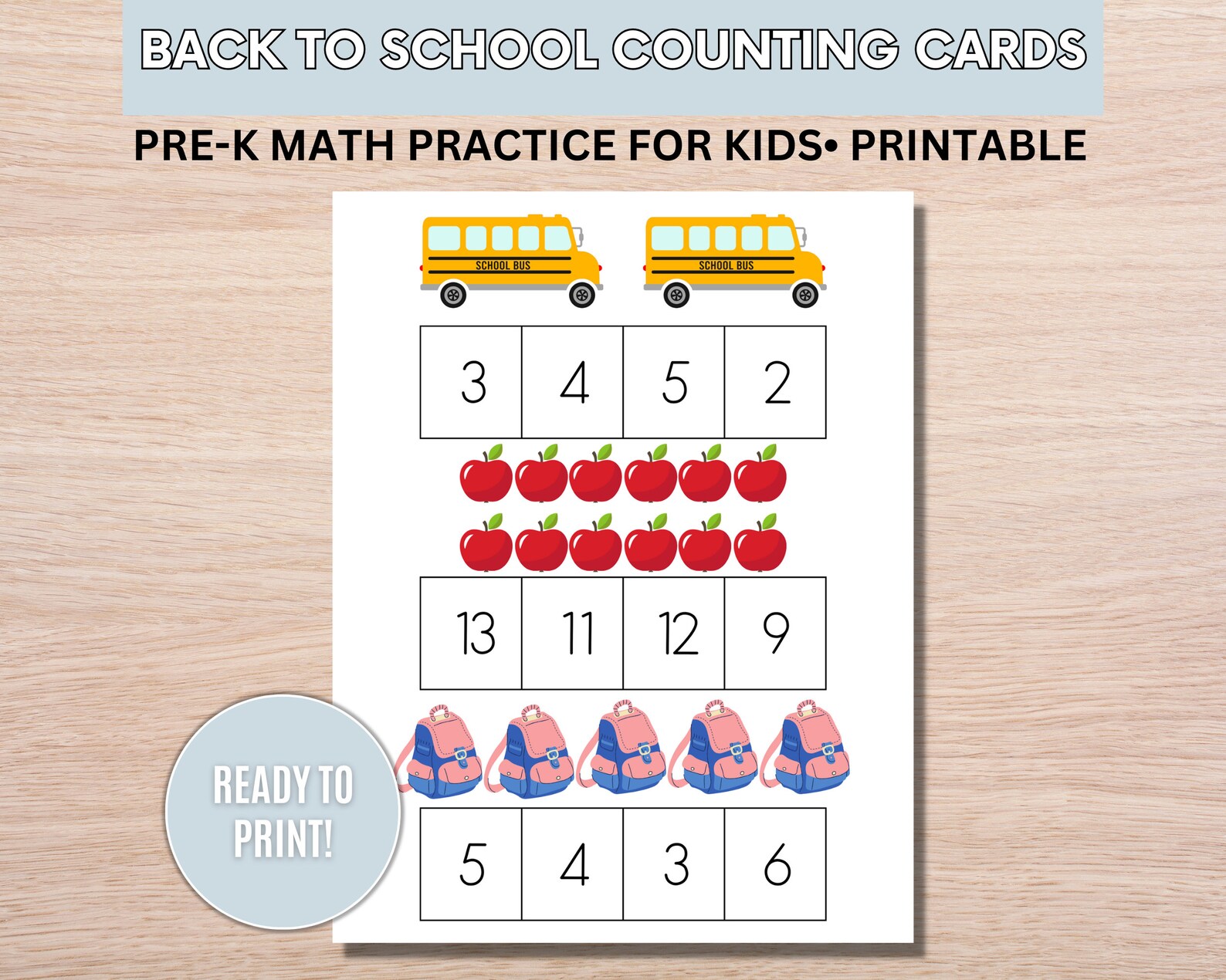
9 Fun Back to School Counting Games for Young Minds
The start of a new academic year brings excitement, nervous energy, and the vital task of establishing foundational routines. For preschoolers and early elementary students, easing into formal learning requires experiences that feel more like play and less like drills. Incorporating back to school counting games for young minds transforms abstract numerical concepts into tactile, joyful discoveries, ensuring children start their educational journey with confidence.

Why Playful Math Matters in Early Childhood
Young children rarely learn math through rote memorization or dry worksheets. Brains at this developmental stage thrive on sensory input, movement, and context. When math is gamified, several key early numeracy skills develop naturally:
- One-to-One Correspondence: Understanding that each number name corresponds to one, and only one, physical object.
- Subitizing: Instantly recognizing small quantities (like the dots on a die) without counting them one by one.
- Cardinality: Grasping that the last number counted represents the total quantity of the set.
- Number Conservation: Recognizing that the count remains the same regardless of how items are arranged.
By connecting these foundational concepts to relatable back-to-school themes, teachers and parents create a low-pressure environment where making mistakes is just part of the game.
Active Back to School Counting Games for Young Minds
Young learners have boundless physical energy. Channeling that energy into kinesthetic math games helps develop gross motor skills alongside number fluency.
1. The School Supply Scavenger Hunt
Transform your classroom or living room into a search-and-find math lab. Give each child a picture checklist featuring common school supplies alongside a target numeral (for example: 3 erasers, 5 pencils, 2 glue sticks).
Children move through the room collecting the exact number of items indicated on their cards. Once gathered, have them line their items up on a desk and point to each one as they count aloud. This reinforces one-to-one correspondence while introducing purposeful organization.
2. Hopscotch Number Line
Use painter's tape on the carpet or sidewalk chalk outdoors to create a 1-to-10 number line shaped like a row of school buses or notebooks. Instead of standard hopping, call out situational challenges:
- "Hop forward 4 spaces to pick up your backpack!"
- "Step back 2 spaces—you forgot your lunchbox! What number are you on now?"
This gross-motor activity introduces counting forward and backward, early addition, and positional language in an intuitive, physical format.
3. Musical Desk Spots
Place numbered cards (1 through 10 or 1 through 20) on the floor in a large circle. Play upbeat music while children march around the circle. When the music stops, each child freezes on a number.
Call on volunteers to perform that number of movements: "Liam is on number 6—everyone do 6 jumping jacks!" This connects the visual numeral to an audible count and a physical sensation.
Hands-On Tabletop Counting Activities
Fine motor development is equally critical during the back-to-school window. These tabletop activities build hand strength while reinforcing quantity recognition.
4. Playdough Crayon Box Match
Provide empty crayon boxes or small plastic containers labeled with numbers 1 through 10. Give children colorful playdough and invite them to roll out "crayons" to fill each box with the corresponding amount.
Rolling the dough builds the intrinsic hand muscles needed for pencil grip, while counting out individual logs ensures deep engagement with physical quantities.
5. Ten-Frame Eraser Fill

Ten-frames are among the most effective visual tools for early numeracy because they build an intuitive foundation for the base-ten number system. Print simple blank ten-frames and provide a bowl of thematic mini-erasers (such as apples, school buses, or stars).
Children roll a dot die, subitize or count the dots, and place that exact number of erasers onto the ten-frame, filling the top row from left to right before starting the bottom row. Ask questions like: "How many spots are filled? How many are still empty?"
6. Paper Clip Linking Chains
Cut cardboard strips into ruler shapes and write a number (1-10) on each card, punching a small hole at the bottom. Provide large, colorful plastic paper clips.
Learners link the correct number of paper clips through the hole to create a dangling chain. This activity demonstrates comparative length alongside numerical quantity: children can visually see that the chain for "8" is visibly longer than the chain for "3."
Group & Circle Time Counting Games
Circle time games promote social-emotional learning, turn-taking, and collaborative problem-solving.
7. The Mystery Pencil Box
Place a collection of unsharpened pencils inside a solid pencil case or cloth bag. Have a child reach inside without looking, grab a handful, and place them on a tray. As a group, count the pencils together using rhythmic claps or finger taps.
To extend the challenge for older or advanced learners, ask: "We have 4 pencils on the tray. How many more do we need to make a full box of 5?"
8. Roll, Build, and Compare
Pair children up with a bowl of interlocking counting cubes and a standard die. Each partner rolls their die, identifies the number, and builds a tower using that many cubes. Once both towers are built, they place them side by side.
Guide them to use comparative vocabulary: greater than, less than, taller, and shorter. If both roll the same number, introduce the concept of equal.
9. The Line-Up Counting Train
Transitions between activities can often become chaotic. Turn line-up time into an ongoing counting game. Assign each child an ordinal position as they line up for recess or lunch.
Sing a simple counting chant: "Car number 1 pulls out of the station, who is car number 2?" Children call out their number in sequence, building sequential counting skills during everyday classroom transitions.
How to Adapt Games for Diverse Learners
Every child enters the classroom with a different level of mathematical exposure. Effective games can be adjusted instantly to meet varying developmental stages:
- For Beginners: Restrict number ranges to 1–5. Use real, distinct objects rather than abstract tokens, and model counting by physically touching each object.
- For Learners Needing a Challenge: Expand numbers up to 20 or 30, introduce two dice to encourage early addition, or practice counting backward from 10.
- For Tactile/Sensory Learners: Integrate textured materials like sand trays for numeral tracing or heavy counting stones that give distinct weight feedback.
Building Lifelong Number Confidence
Mathematical fluency does not start with equations on a board; it begins with curiosity, physical interaction, and playful repetition. By introducing intentional counting games during the first weeks of school, you remove intimidation and replace it with genuine excitement. When young minds view numbers as friendly puzzles rather than tests, they build the resilient foundation needed for a lifetime of successful math learning.