A^2 + B^2 = (A + ?): Formula, Proof & Rules
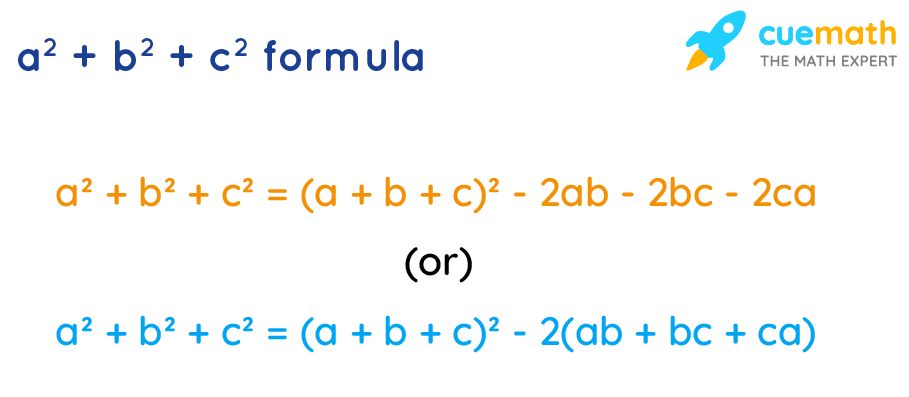
When studying introductory or intermediate algebra, you will frequently encounter problems where you need to rewrite the sum of two squares. Many students begin searching with the expression A^2 + B^2 = (A +, trying to recall what comes next inside and outside the parentheses. The complete algebraic identity is a2 + b2 = (a + b)2 − 2ab.
While this relationship seems simple, it represents one of the most frequently tested concepts in high school math, standardized tests (like the SAT, ACT, and GRE), and introductory calculus. Below, we break down why this formula works, how to derive it, and how to avoid the most common algebraic pitfalls associated with it.
Solving the Identity: What Follows A^2 + B^2 = (A + ?
If you have written down a2 + b2 = (a +, the full expression depends on your mathematical goal. In elementary algebra over real numbers, the identity is completed as follows:
- Sum-and-Product Form: a2 + b2 = (a + b)2 − 2ab
- Difference-and-Product Form: a2 + b2 = (a − b)2 + 2ab
- Complex Factoring Form: a2 + b2 = (a + bi)(a − bi)
The first form is by far the most common. It allows you to calculate the sum of two squares whenever you know the sum of two terms (a + b) and their product (ab), without having to calculate individual values for a and b.
The "Freshman's Dream": Why A^2 + B^2 ≠ (A + B)^2
The single most pervasive mistake in elementary mathematics is assuming that exponentiation distributes over addition. In other words, many students believe:
a2 + b2 = (a + b)2 (INCORRECT)
Mathematicians jokingly call this fallacy the Freshman's Dream. To see why this equation fails, expand the right-hand side using the FOIL method or basic polynomial multiplication:
(a + b)2 = (a + b)(a + b) = a2 + ab + ba + b2 = a2 + 2ab + b2
Notice the middle term, 2ab. When you write (a + b)2, you are introducing an extra 2ab that does not exist in a2 + b2. Therefore, to make the two sides equal, you must subtract that cross-term:
a2 + b2 = (a + b)2 − 2ab
A Concrete Numerical Counterexample
Let a = 3 and b = 4:
- Left side (a2 + b2): 32 + 42 = 9 + 16 = 25
- Incorrect assumption ((a + b)2): (3 + 4)2 = 72 = 49
- Correct identity ((a + b)2 − 2ab): 49 − 2(3)(4) = 49 − 24 = 25
The numbers verify that (a + b)2 exceeds a2 + b2 by exactly 2ab.
Can You Factor A^2 + B^2 Over Real Numbers?
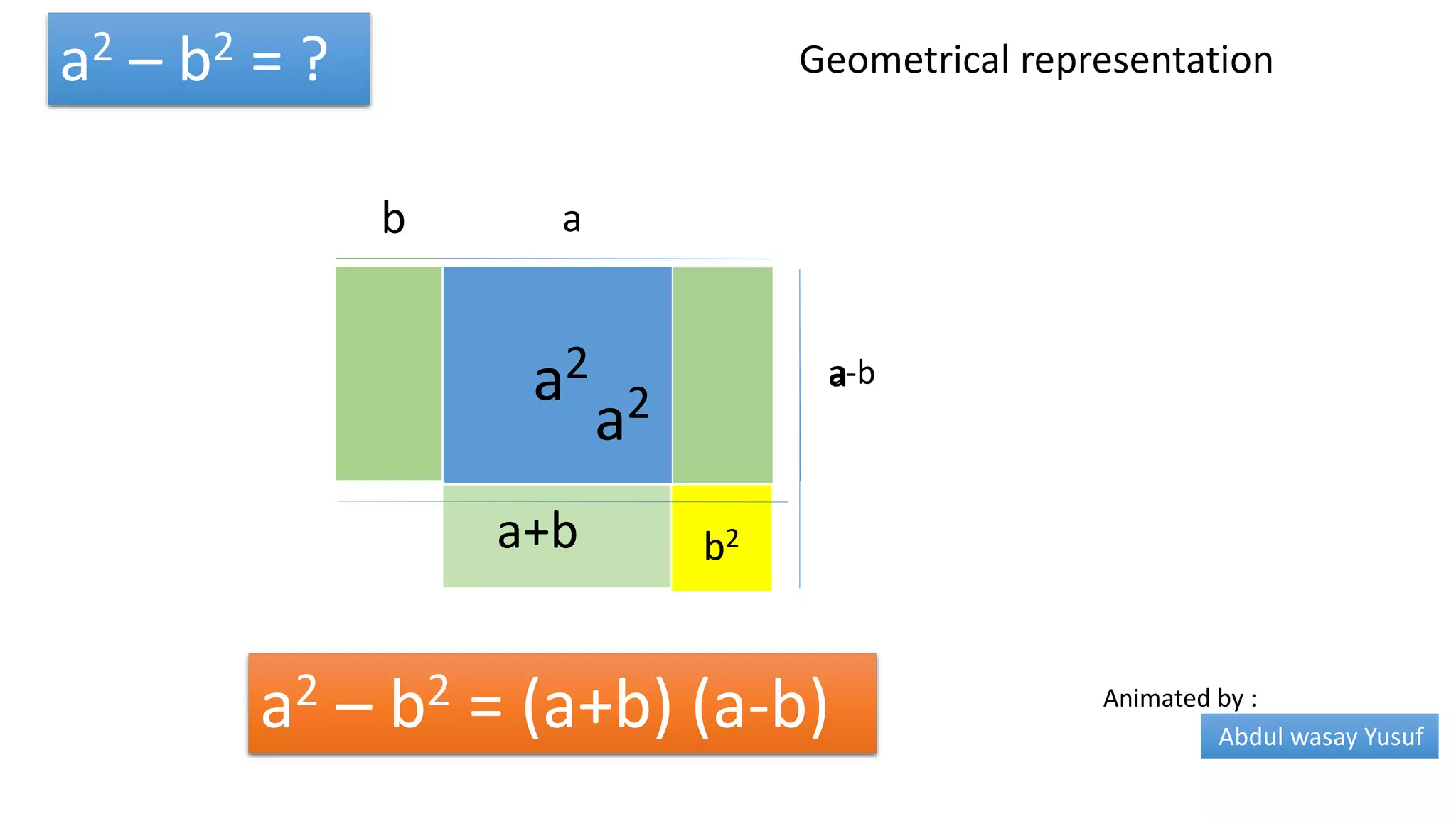
Another common query is whether the sum of squares can be factored into linear factors like the difference of squares can. Recall the difference of squares formula:
Video: KDPR 29 Why the Quadratic Equation Formula 𝒂^𝟐 - 𝒃^𝟐 = ( 𝒂+𝒃 ) ( 𝒂−𝒃 ) Basic Concepts of Mathemat...
a2 − b2 = (a − b)(a + b)

Unlike the difference of squares, the sum of squares cannot be factored into non-trivial real polynomials. In mathematical terms, a2 + b2 is an irreducible polynomial over the field of real numbers ℝ.
Factoring Over Complex Numbers
If you expand your number system to the complex numbers (&complex;), you can factor the expression. Recall that the imaginary unit i is defined such that i2 = −1. We can rewrite the sum as a difference:
a2 + b2 = a2 − (−b2) = a2 − (bi)2
Now apply the difference of squares rule:
a2 + b2 = (a + bi)(a − bi)
This complex factorization plays a foundational role in complex analysis, electrical engineering, and quantum physics.
Worked Examples: How to Apply the Formula
Here are three standard scenarios where rewriting a2 + b2 is necessary.
Example 1: Finding Sum of Squares from Sum and Product
Problem: If x + y = 10 and xy = 21, determine the value of x2 + y2 without solving for x and y directly.
- State the formula: x2 + y2 = (x + y)2 − 2xy
- Substitute the known quantities: x2 + y2 = (10)2 − 2(21)
- Simplify: 100 − 42 = 58
Example 2: Working with Reciprocals
Problem: Given that x + (1/x) = 5, find the value of x2 + (1/x2).
- Set a = x and b = 1/x. Notice that ab = x × (1/x) = 1.
- Use the identity: x2 + (1/x2) = [x + (1/x)]2 − 2(x)(1/x)
- Substitute the known value: (5)2 − 2(1) = 25 − 2 = 23
Example 3: Using the Alternative (Difference) Form
Problem: If a − b = 6 and ab = 7, find a2 + b2.
- Use the difference identity: a2 + b2 = (a − b)2 + 2ab
- Substitute values: (6)2 + 2(7) = 36 + 14 = 50
Quick Reference Summary
| Expression | Equivalent Form | Domain |
|---|---|---|
| a2 + b2 | (a + b)2 − 2ab | Real Numbers |
| a2 + b2 | (a − b)2 + 2ab | Real Numbers |
| a2 + b2 | (a + bi)(a − bi) | Complex Numbers |
| (a + b)2 | a2 + 2ab + b2 | Real / Complex Numbers |
Remember: whenever you write (a + b)2, always account for the 2ab product. Keeping that middle term in mind ensures you will never misapply this identity again.
^3[/math]? Quora, 60% OFF](https://cdn.numerade.com/ask_images/018dfd744c9d4ffbb58b722eede7208c.jpg)