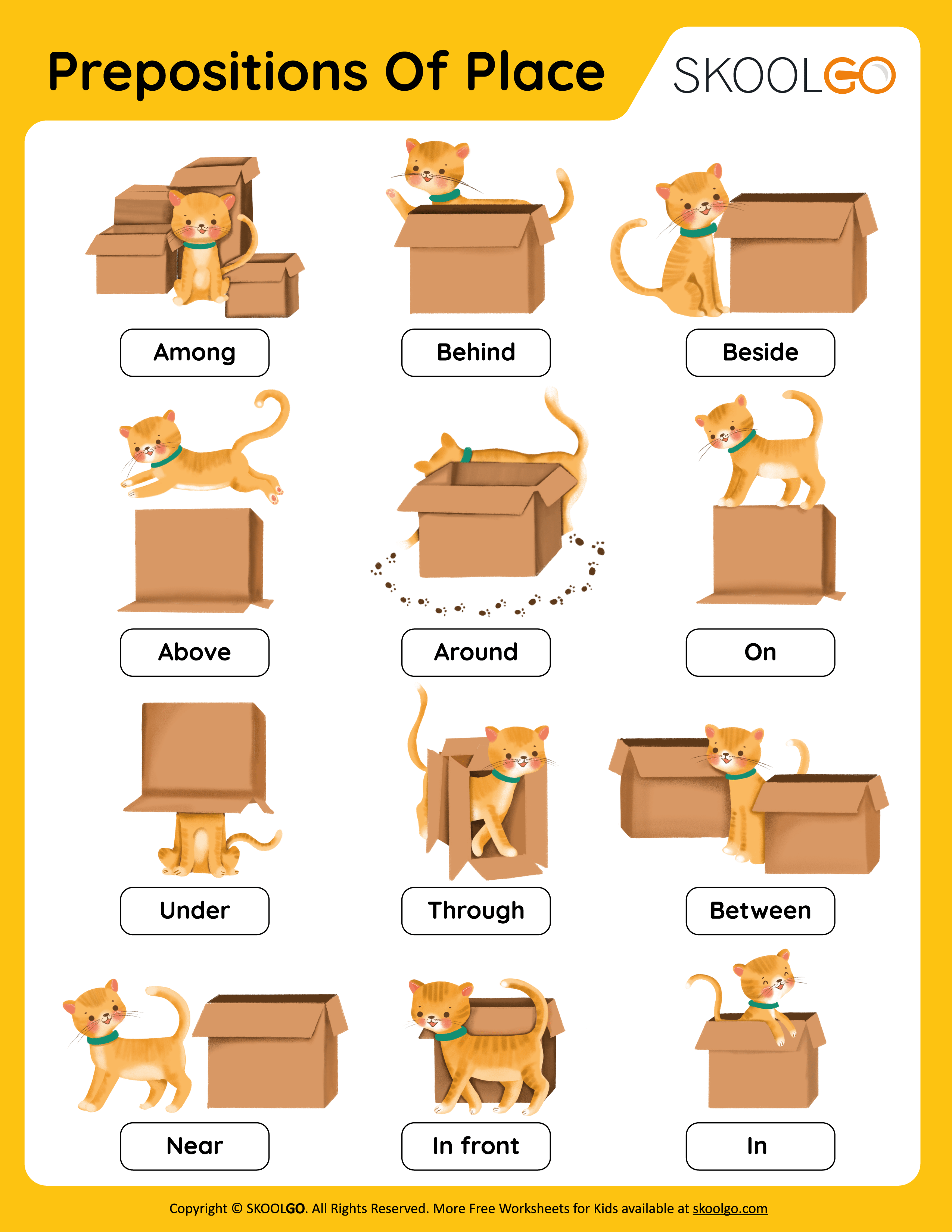
A4 Printable Preposition Tables for Students (Guide)
English prepositions pose a notorious challenge for learners of all ages. Because words like in, on, and at rarely translate word-for-word across languages, students often struggle to remember which preposition pairs with a specific noun, time frame, or location. Using A4 printable preposition tables for students provides an organized, visual reference that eliminates guesswork and accelerates grammar retention.

Whether you are an ESL educator, an elementary English teacher, or a student looking to polish your academic writing, having a compact, well-structured cheat sheet can transform abstract grammar rules into intuitive habits. This guide breaks down the core tables every student needs, explains why the standard A4 format works so well, and outlines practical ways to use these references in the classroom or at home.
The Core Preposition Categories Every Table Must Cover
Prepositions fall into distinct functional groups. Cramming every preposition into a single alphabetical list overwhelms students and obscures the underlying logic. An effective printable table divides prepositions into four primary categories:
1. Prepositions of Time (The Pyramid Method)
The relationship between at, on, and in is best taught using an inverted pyramid structure, moving from specific to general:
- AT (Precise Times): Used for clock times, specific moments, and holiday periods without the word "day." Examples: at 5:30 PM, at noon, at midnight, at Christmas.
- ON (Days and Dates): Used for specific days of the week, calendar dates, and named holidays. Examples: on Tuesday, on October 14th, on New Year’s Day.
- IN (Broader Timeframes): Used for months, years, decades, centuries, and non-specific times of day. Examples: in July, in 2024, in the morning, in the 21st century.
2. Prepositions of Place and Position
Spatial prepositions clarify where an object rests relative to another point. A functional table pairs these words with simple illustrative contexts:
- In: Enclosed spaces or boundaries (in the classroom, in France, in a box).
- On: Surfaces or linear paths (on the desk, on the wall, on Main Street).
- At: Specific points or locations (at the bus stop, at the front door, at the library).
- Under / Below: Lower than an object (under the bridge, below sea level).
- Between / Among: Intermediate positions (between two chairs, among the crowd).
3. Prepositions of Direction and Movement
Unlike stationary place prepositions, directional prepositions involve motion. These should always be grouped together so students do not confuse them with static positions:
- Into: Entering an interior space (She walked into the room).
- Onto: Moving toward a surface (The cat jumped onto the counter).
- Through: Moving within a three-dimensional space from end to end (They drove through the tunnel).
- Across: Moving from one side of a surface to the other (He swam across the river).
- Toward: Moving in the direction of a target (They walked toward the exit).
4. Common Dependent Prepositions
Some of the most persistent errors occur with dependent prepositions—words tied permanently to specific verbs, adjectives, or nouns. An advanced A4 table should include a quick-lookup column for these common pairings:
- Adjective + Preposition: interested in, afraid of, good at, famous for, similar to.
- Verb + Preposition: depend on, listen to, apologize for, belong to, suffer from.
Why A4 Printable Preposition Tables for Students Boost Retention
Digital reference tools have their place, but physical desktop references offer clear cognitive benefits for language learners. The standard A4 format (210 × 297 mm) is universally accessible and fits neatly into binders, desk folders, and clipboards.
Reduced Cognitive Load During Writing Tasks

When students draft an essay or complete a creative writing prompt, pausing to search an online dictionary interrupts working memory. A printed A4 sheet sitting flat beside their notebook allows students to glance over, verify a preposition, and return immediately to their sentence structure without losing their train of thought.
Tactile Engagement and Spatial Memory
Physical pages engage spatial awareness. Learners quickly remember that time prepositions sit in the top-left quadrant of the sheet, while directional prepositions sit in the bottom right. This physical layout helps anchor rules in long-term memory far more effectively than scrolling through vertical web pages.
How to Design and Print the Tables for Maximum Utility
If you are formatting your own printable sheets or selecting a template to download, follow these design standards to ensure usability:
- Use Color-Coding Sparingly: Assign subtle pastel hues to each category (e.g., light blue for time, soft green for place, warm amber for movement). High-contrast, clean colors help visual learners navigate sections without visual clutter.
- Include Visual Diagrams: A simple 2D sketch—such as a circle inside a square for in, or an arrow crossing a line for across—clarifies meaning instantly for beginner and ESL students.
- Contrast Exceptions Clearly: Always add a small "Watch Out!" callout box. For example, highlight that while we say in the morning, we say at night; or that we ride on a bus, but sit in a car.
- Print on Cardstock and Laminate: Standard 80 gsm copy paper wrinkles and tears quickly in a student backpack. Print your tables on 160–200 gsm cardstock and run them through a laminator. Laminated tables can double as reusable write-on mats for dry-erase marker activities.
Classroom Activities Using Printable Preposition Sheets
A reference table should be an active learning tool, not just passive binder filler. Here are three practical ways to integrate an A4 preposition table into your lesson plans:
The Silent Proofreading Challenge
Distribute a short passage containing 8 to 10 deliberate preposition errors (e.g., *"He arrived on night and sat in the desk"*). Give students five minutes to locate and correct the mistakes using only their laminated A4 table as a guide. This activity builds self-editing habits and teaches students how to cross-reference their own work.
Describe the Scene (Speaking Pairs)
Pair students up and give each pair an engaging illustration showing a busy street or an untidy room. One student describes an object's location using a preposition from their chart, while the other student attempts to point to or sketch the item. This bridges the gap between written grammar charts and spoken fluency.
Sentence Expansion Warm-Ups
Write a basic subject-verb sentence on the board, such as *"The student walked."* Challenge students to add three distinct prepositions from different sections of their table to expand the sentence into a descriptive narrative (e.g., *"At dawn, the student walked through the park to the library."*).
Final Thoughts
Prepositions may be short words, but their misuse can significantly weaken a student's writing clarity. Providing learners with clear, well-structured A4 printable preposition tables removes the frustration of memorization through trial and error. By keeping a tangible reference within arm's reach, students gain the confidence to construct accurate, articulate sentences across every writing assignment.