Achieve 3000 Answers: How to Score 75%+ Every Time
Finding accurate Achieve 3000 answers can feel like an uphill battle for students trying to raise their Lexile scores. Because Achieve3000 adapts text difficulty to each individual reader, two classmates sitting next to each other often see completely different passages and question sets for the exact same lesson title. Memorizing static answer keys rarely works, and rushing through the activities often leads to low first-try scores that hurt overall progress.

To consistently earn high scores, you need to understand how the platform measures your comprehension, why online answer sheets fail, and what proven reading strategies will help you identify the correct choice on your first attempt.
How Achieve3000 Scoring Actually Works
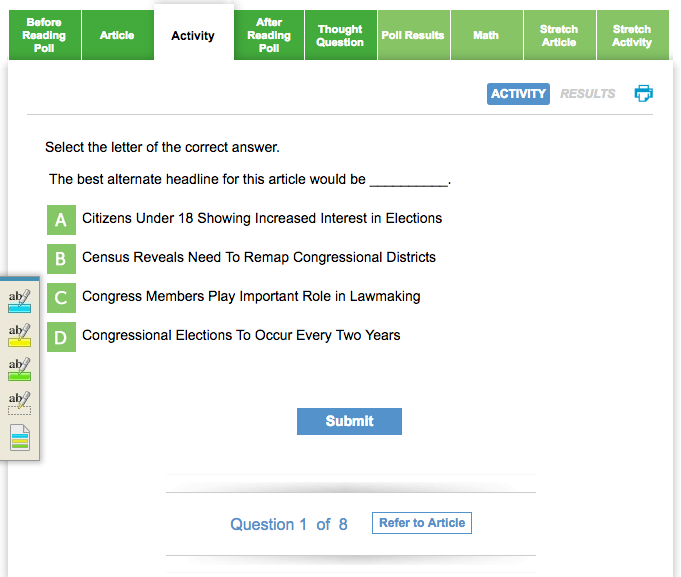
Achieve3000 is built around a patented literacy methodology that dynamically adjusts reading levels based on performance. The core of every lesson is the multiple-choice activity, which usually consists of four to eight questions designed to test standard-aligned reading skills.
The Power of the First-Try Score
The single most critical metric on the platform is your First-Try Score (FTPS). When you select an answer and submit it:
- First Try Correct: You receive 100% credit for that item, contributing to an overall lesson score of 75%, 88%, or 100%. Scoring 75% or higher on your first attempt is the threshold required to demonstrate reading growth and trigger Lexile gains during monthly platform updates.
- Second Try Correct: If you miss a question on the first try, the system gives you a second chance. While getting it right on the second attempt provides partial credit toward your grade in some classroom gradebooks, it does not count toward your Lexile advancement calculation.
- Both Tries Incorrect: You receive zero credit for the question.
Because the platform prioritizes independent reading growth, guessing or relying on quick hints usually backfires by keeping your Lexile level stagnant.
Why Searching for Achieve 3000 Answers Online Fails
Many students search search engines and video platforms hoping to find a master list of Achieve 3000 answers. In almost every case, this strategy leads to lower grades and wasted time for three clear reasons:
- Differentiated Lexile Tiers: A single article (such as one about renewable energy or ancient history) is written at up to 12 different Lexile levels. A question asked at a 650L level focuses on basic recall, while the question for an 1150L reader analyzing the same paragraph evaluates nuanced inference or tone. An answer key built for one level will be completely incorrect for another.
- Randomized Options: Even when two students receive the identical question text, Achieve3000 regularly shuffles answer choices (A, B, C, D) and rotates specific question variants within its database.
- Platform Auditing: The platform tracks reading speed and time spent per screen. If a student submits an 8-question activity in under 45 seconds with perfect accuracy, teachers receive automated flags indicating potential academic dishonesty.
How to Master Achieve 3000 Answers on Your First Try
Earning a 75% or 100% on your activity does not require hours of extra studying. It requires a disciplined approach to the five-step routine. Follow these steps to systematically pinpoint the correct response every time.
1. Use the Before Reading Poll to Prime Your Brain
The initial poll question is not graded for accuracy; it is designed to activate prior knowledge. Take 60 seconds to read the prompt and write a thoughtful justification. Thinking about the topic beforehand primes your brain to recognize key themes and vocabulary once you open the main article.
2. Chunk the Text and Use the Highlighting Tool
Never read the entire article in one uninterrupted pass without interacting with it. Break the text into smaller sections (two to three paragraphs each) and utilize the built-in highlighting and note-taking tools:
- Highlight dates, names, and bold vocabulary words in yellow.
- Highlight the main claim or thesis of the author in blue.
- Use the margin notes to summarize each section in five words or fewer.
3. Read the Question Stem Before the Options
When you advance to the activity screen, read only the question stem first. Cover or ignore the four answer choices. Determine what the question is genuinely asking for: Is it a central idea? A vocabulary definition? An inference? Formulate your own answer in your mind before reading the choices. This prevents you from being tricked by "distractor" answers that look plausible at a glance.

4. Return to the Text (The Split-Screen Advantage)
Achieve3000 provides a side-by-side view where the article remains accessible while answering questions. High-scoring students rarely answer from memory. For every single question, locate the exact paragraph that addresses the topic and confirm that your chosen answer has direct textual evidence supporting it.
Decoding the Most Common Question Types
Most Achieve3000 questions fall into predictable categories. Recognizing the anatomy of these questions allows you to eliminate wrong choices quickly.
Main Idea and Summarization
These questions ask: "Which of these is the best summary of the article?" or "What is this article mainly about?"
- Eliminate choices that are too narrow: An option might state a factual truth from paragraph three, but if it only covers one detail, it is not the main idea.
- Eliminate choices that are too broad: If the text is specifically about the migration habits of monarch butterflies, an answer discussing "the life cycle of all insects" is overly broad.
- Look for the umbrella: The correct answer must encompass the beginning, middle, and end of the text.
Vocabulary in Context
These questions direct you to a specific paragraph: "In paragraph 4, what does the word 'reluctant' mean?"
Replace the target word in the sentence with each of the four answer choices. Read the sentence aloud quietly or in your head with the substitution. Choose the word that preserves the original meaning and tone of the passage without changing the grammatical flow.
Inference and Author's Purpose
Inference stems often read: "The reader can infer from the article that..."
An inference is an educated guess based on facts present in the text, not your personal opinion. If an answer requires assumptions that the article never mentions or implies, eliminate it immediately. The correct choice will always be a short, logical step directly from the written text.
The Ideal Lesson Workflow
To secure a score of 75% or higher on at least 40 lessons per academic year—the standard target recommended to achieve significant reading gains—follow this consistent timing pattern:
- Before Reading Poll: 2–3 minutes.
- Article Reading & Annotation: 8–12 minutes. Read thoroughly once, then review your highlighted margins.
- Activity Questions: 8–10 minutes. Spend at least one minute per question, verifying your selection against the open text tab.
- After Reading Poll & Thought Question: 5–8 minutes to close the loop.
Final Thoughts
Relying on shortcut searches for pre-made answer sets leads to inconsistent grades and missed Lexile benchmarks. The most efficient way to handle Achieve3000 is to treat the platform as an open-book exercise: dissect the questions, rely on direct paragraph citations, and prioritize getting answers right on the first try.