Achieve Your Goals with the PRTS Army System
Elite performance is rarely the product of random effort or fleeting motivation. In demanding operational environments, success requires a repeatable, standardized framework that builds physical durability, mental resilience, and mission capability. Whether you are a service member preparing for field demands or an athlete seeking tactical discipline, learning to achieve your goals with the PRTS Army system provides a reliable blueprint for sustainable performance.

Originating from U.S. Army doctrine codified in Field Manual 7-22 (FM 7-22), the Physical Readiness Training System (PRTS)—now integral to the Holistic Health and Fitness (H2F) system—was engineered to transform individuals into combat-ready tactical athletes. By breaking physical development into progressive phases and emphasizing movement quality over raw exertion, this methodology offers actionable lessons for reaching any ambitious milestone.
Understanding the PRTS Army System
The PRTS Army system is a scientifically grounded, standardized physical training curriculum designed to prepare personnel for the physical challenges of operational duty and combat. Unlike commercial workout fads that chase short-term exhaustion, PRTS aims for long-term physical readiness, injury reduction, and operational capability.
At its core, the system shifts the focus from merely passing a fitness test to developing balanced physical capacity across several functional components:
- Muscular Strength and Endurance: The ability to exert force against resistance repeatedly without premature fatigue.
- Cardiorespiratory Endurance: Sustained aerobic and anaerobic output to endure prolonged foot marches and tactical maneuvers.
- Mobility and Agility: Joint flexibility, core stability, balance, and the capacity to change directions quickly under load.
The Three Foundational Principles of PRTS
To implement the system effectively, one must understand the three doctrine-backed principles that govern every drill and training cycle within the Army framework.
1. Precision
Precision emphasizes execution quality over speed or load. In the Army system, performing an exercise with poor mechanics increases injury risk and reinforces dysfunctional movement patterns. Proper form ensures optimal muscular recruitment and builds the structural integrity needed to carry heavy gear across uneven terrain safely.
2. Progression
Systematic overload prevents stagnation and reduces overuse injuries. PRTS dictates that intensity, volume, and complexity increase incrementally. You do not begin with advanced, loaded combat conditioning drills; you first master bodyweight mechanics and baseline stability.
3. Integration
Integration bridges the gap between isolated gym movements and real-world tasks. Workouts incorporate multi-joint, functional movements across all planes of motion—pushing, pulling, lunging, rotating, and sprinting—mirroring the unpredictable demands of military operations and everyday physical challenges.
The Three Phases of the Training Framework
The PRTS framework divides progression into three distinct phases. Understanding where you sit in this progression allows you to tailor your routine to your current capacity.
- The Initial Conditioning Phase: Designed for novices or those returning from a prolonged layoff, this phase establishes foundational movement patterns, corrects muscle imbalances, and restores baseline cardiovascular fitness.
- The Toughening Phase: This phase develops fundamental fitness and movement skills. It introduces core conditioning drills, basic military movement drills, and structured running schedules to build functional strength and joint resilience.
- The Conditioning Phase: Focused on sustained physical readiness and tactical performance, this phase integrates higher resistance, tactical foot marches, speed intervals, and complex task execution under physical stress.
How to Achieve Your Goals with the PRTS Army System

Adopting military training principles does not require an active-duty contract. You can apply the exact architecture of the PRTS model to conquer your personal fitness benchmarks, prepare for tactical testing like the Army Combat Fitness Test (ACFT), or conquer ambitious athletic events.
Establish an Uncompromising Baseline
The PRTS relies heavily on objective metrics. Before starting, establish an honest baseline across standard markers: push-up volume, plank hold duration, a timed two-mile run, and loaded movements such as deadlifts or kettlebell carries. Without an accurate starting point, systematic progression is impossible.
Incorporate Standardized Preparation and Recovery
One defining element of the PRTS is its strict warm-up and cool-down protocols. Skipping these components undermines joint longevity and performance.
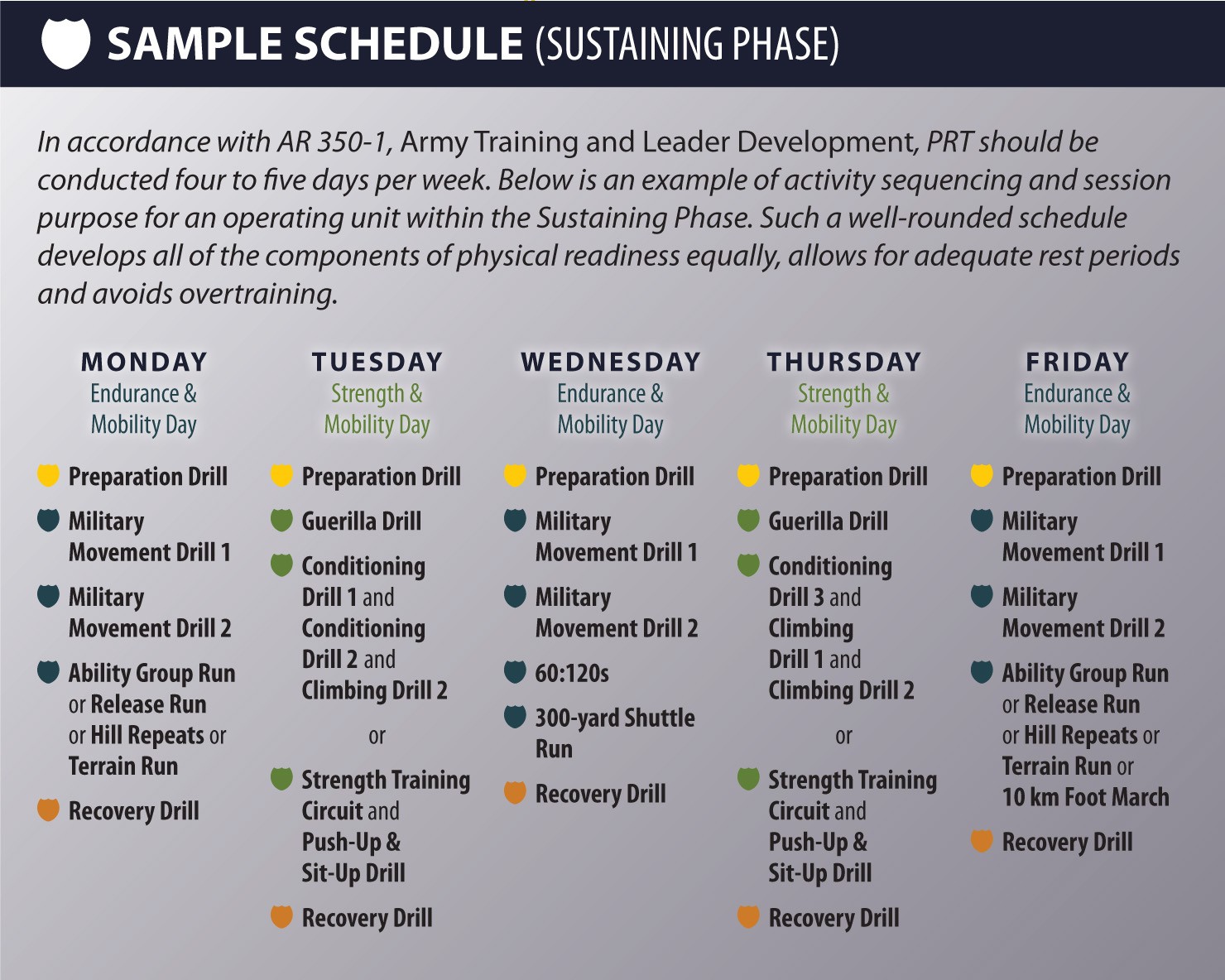
- The Preparation Drill (PD): A dynamic warm-up sequence of ten exercises (including the bend and reach, rear lunge, high jumper, and squat bender) designed to elevate heart rate, lubricate joints, and activate primary movers before intense exertion.
- The Recovery Drill (RD): A standardized series of static stretches executed post-training to reset resting muscle length, prevent stiffness, and stimulate parasympathetic nervous system recovery.
Implement Periodization and Variety
Do not perform maximum-effort workouts every day. The Army model alternates between endurance training days (aerobic capacity, interval runs) and strength-mobility days (calisthenics, free-weight training, core stabilization). Scheduling dedicated low-intensity active recovery days ensures continuous progress without leading to central nervous system burnout.
Translating Tactical Discipline to Non-Physical Milestones
While designed primarily for physical readiness, the structural methodology of the PRTS Army system offers profound utility for professional, academic, and personal targets.
Consider the doctrine's emphasis on standard operating procedures. By breaking an overarching objective into discrete conditioning phases, you eliminate ambiguity. In career terms, the Toughening Phase translates into acquiring basic skills and certifications; the Conditioning Phase represents taking on complex, high-stakes projects under real-time constraints.
Furthermore, the focus on precision reminds us that how you work matters just as much as how hard you work. Rushing through projects with flawed execution leads to rework, just as sloppy weightlifting mechanics lead to injury.
Common Pitfalls to Avoid
When implementing this system independently, individuals frequently make several avoidable errors:
- Ego Lifting: Sacrificing precision to post heavier numbers on the board defeats the injury-prevention purpose of the system.
- Neglecting Lower-Intensity Steady State (LISS) Work: High-intensity interval training (HIIT) is valuable, but neglecting zone 2 aerobic base work limits your long-term cardiovascular recovery ceiling.
- Ignoring Recovery Metrics: Sleep, hydration, and nutrition are integral to doctrine. Training without adequate fuel and sleep leads rapidly to overtraining syndrome.
Final Thoughts
Lasting transformation does not rely on short-term inspiration. It relies on standard operating procedures, structured progression, and an uncompromising commitment to movement quality. By embracing the disciplined phases, dynamic drills, and objective assessments of the Army's physical readiness doctrine, you build the physical resilience and mental focus necessary to overcome any challenge in your path.