Aesthetic Dilations in Coordinate Plane Geometry
Introduction to Aesthetic Dilations in Coordinate Plane Geometry

Geometry is often viewed as a rigid study of angles, lines, and proofs. However, when we introduce transformations on a coordinate grid, mathematics transforms into a visual art form. To truly discover aesthetic dilations in coordinate plane geometry, we must look past the algebraic formulas and appreciate how scaling shapes alters their visual impact, symmetry, and spatial harmony.
A dilation is a non-rigid transformation that alters the size of a figure while preserving its shape and proportions. When executed on a coordinate plane, especially using artistic or symmetrical center points, dilations produce nested patterns reminiscent of fractals, architectural blueprints, and optical art.
The Mathematical Foundations of Dilations
Before diving into the artistic side of transformations, it is essential to master the mechanics. A dilation on the coordinate plane requires two critical pieces of information: a center of dilation (often the origin, $(0,0)$) and a scale factor, denoted by the letter $k$.
Understanding the Scale Factor ($k$)
The scale factor dictates how much larger or smaller the resulting image (the dilated figure) will be compared to the original preimage.
- When $k > 1$: The figure undergoes an enlargement, stretching away from the center of dilation.
- When $0 < k < 1$: The figure undergoes a reduction, shrinking inward toward the center of dilation.
- When $k = 1$: The figure remains congruent and unchanged.
- When $k < 0$: The figure not only scales in size but also inverts, flipping across the center of dilation to the opposite side.
Coordinate Rules for Dilations from the Origin
When the center of dilation is the origin $(0,0)$, the algebraic rule is remarkably straightforward. For any point $(x, y)$ on the coordinate plane, the dilated point $(x', y')$ is found by multiplying each coordinate by the scale factor:
$(x', y') = (kx, ky)$
This simple multiplication is the engine behind creating symmetrical growth patterns. By applying fractional and whole-number scale factors sequentially, complex geometric webs begin to emerge.
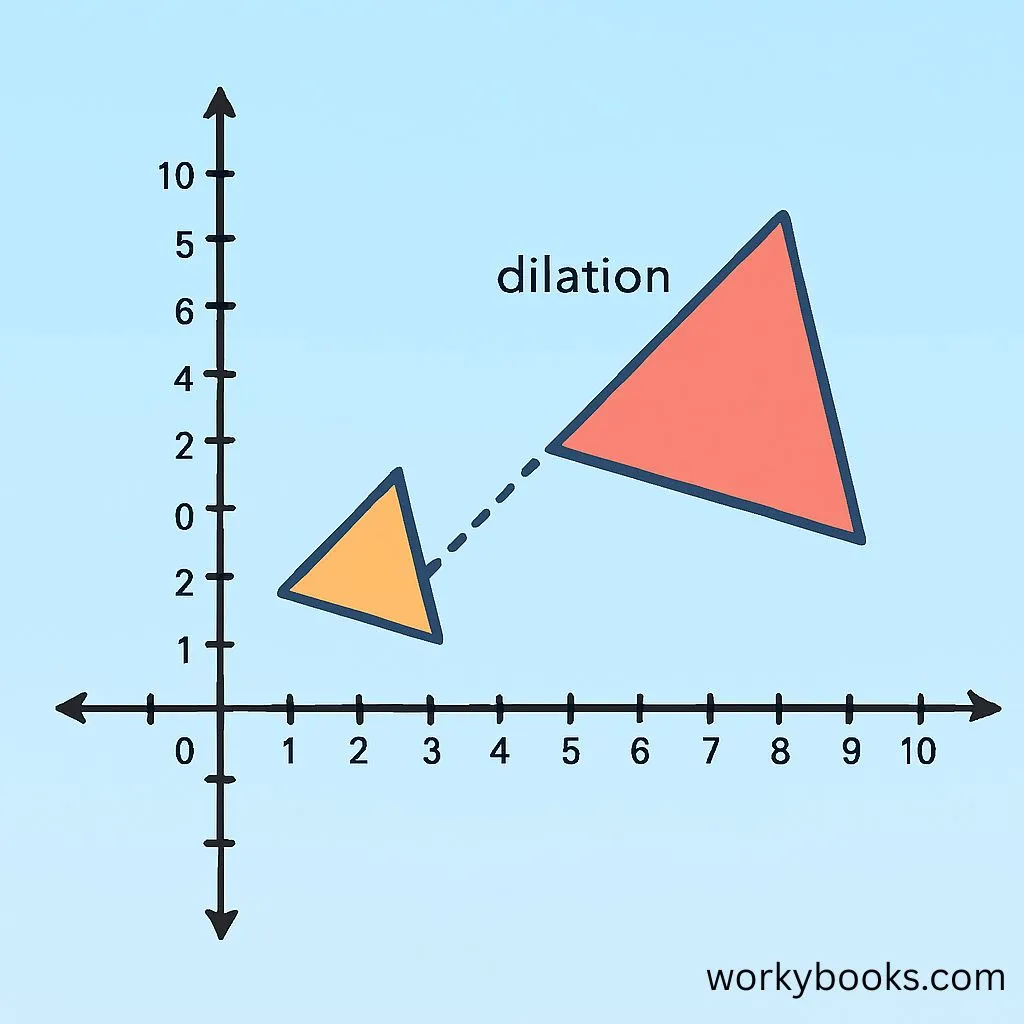
Visual Symmetry and Geometric Patterns
The aesthetic appeal of dilations stems from self-similarity and concentric harmony. When you dilate a geometric shape multiple times using a sequence of incremental scale factors (for example, $k = 0.5, 0.75, 1.25, 1.5$), you create a layered visual effect.
Consider a simple square or a regular hexagon plotted on the grid. If you apply a series of scaling factors from a fixed center, the resulting lines connect corresponding vertices to the origin. These rays serve as perspective lines, drawing the human eye inward or outward, creating a profound sense of depth and three-dimensional space on a flat two-dimensional plane.
Step-by-Step Example: Creating a Dilated Star
Let us walk through a practical exercise to see how coordinate plane geometry yields striking visual results.
- Define the Preimage: Plot a simple triangle on your coordinate grid with vertices at $A(2, 2)$, $B(4, 2)$, and $C(3, 5)$.
- Choose a Center: Use the origin $(0, 0)$ as your center of dilation.
- Apply an Enlargement Factor ($k = 2$): Multiply each coordinate by 2. The new vertices are $A'(4, 4)$, $B'(8, 4)$, and $C'(6, 10)$.
- Apply a Reduction Factor ($k = 0.5$): Return to the original triangle and multiply by $0.5$. The inner vertices are $A''(1, 1)$, $B''(2, 1)$, and $C''(1.5, 2.5)$.
When you plot all three triangles on the same coordinate plane, you immediately notice a nested, proportional arrangement. If you draw line segments connecting corresponding vertices from the inner triangle through the original and out to the outer triangle, you create a dynamic, radiant geometric composition.
Applications Beyond the Classroom
The concepts explored in coordinate plane dilations are not limited to textbook exercises. They form the mathematical backbone of several creative and technical industries:
- Computer Graphics and Animation: Vector graphics rely entirely on coordinate scaling to resize images infinitely without pixelation or loss of quality.
- Architecture and Drafting: Floor plans and structural models are dilations of real-world buildings, scaled down using precise ratios to fit on paper or computer screens.
- Optical Art (Op-Art): Artists like Bridget Riley utilize repeating geometric dilations to trick the eye into perceiving movement, curves, and pulsating depths on flat canvases.
Conclusion
Mastering transformations goes far beyond memorizing formulas. When you take the time to discover aesthetic dilations in coordinate plane geometry, you bridge the gap between analytical logic and creative expression. By manipulating scale factors and plotting coordinates with intention, you can turn a basic grid into a canvas of mathematical beauty.


