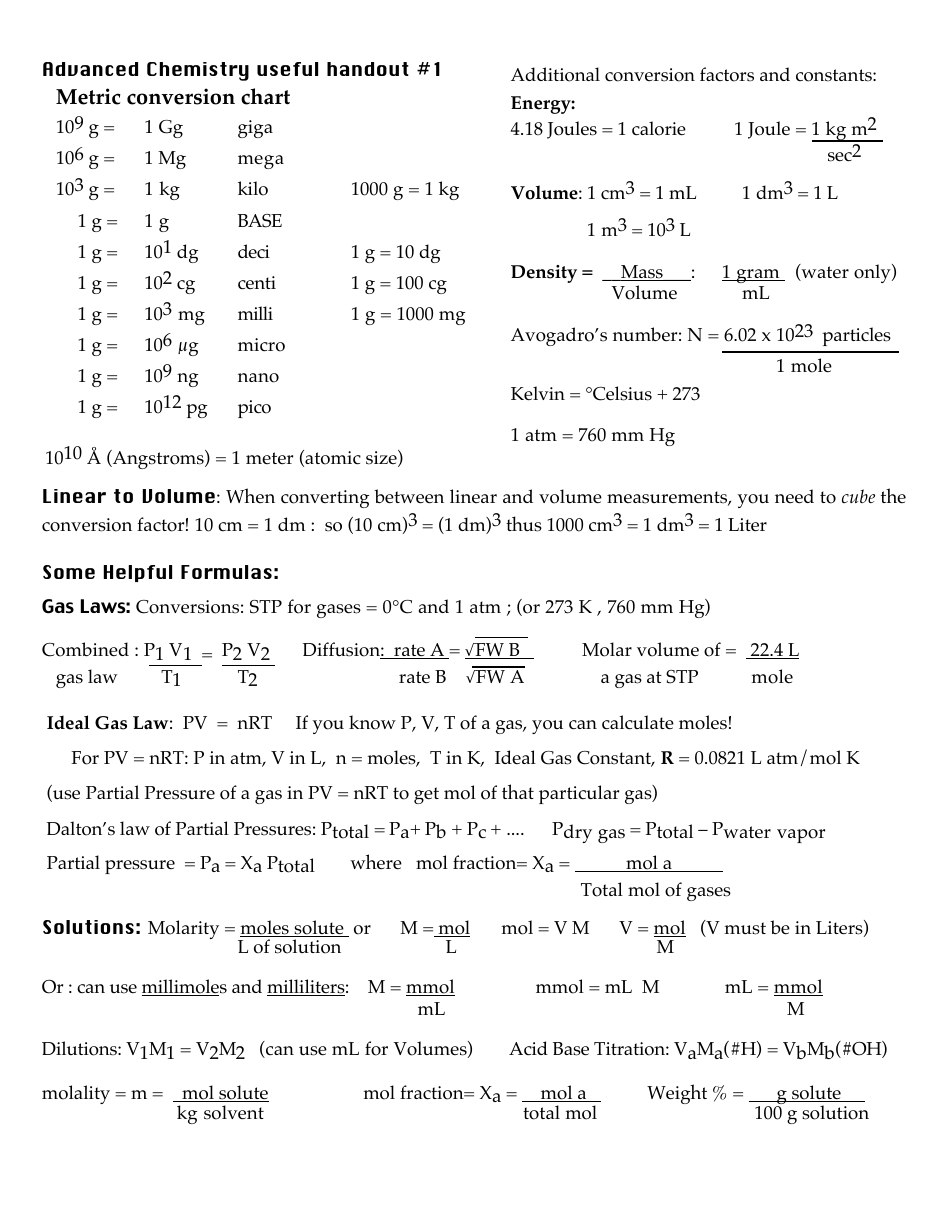
AP Chemistry Formula Sheet: Complete Guide & Tips
When preparing for the Advanced Placement Chemistry exam, few resources are as vital as the ap chemistry formula sheet. Officially titled the "AP Chemistry Equations and Constants" sheet, this document is provided to you during both the Multiple-Choice (Section I) and Free-Response (Section II) portions of the exam. While having access to equations during a timed test removes the burden of memorizing raw numbers, it presents a different challenge: knowing how, when, and where to apply each formula quickly and accurately.

Treating the formula sheet as a passive safety net is one of the most common mistakes students make. To maximize your score, you must understand the sheet’s structure, know which common formulas are intentionally omitted, and master the conversion factors embedded in the constants table.
What Is Included on the AP Chemistry Formula Sheet?
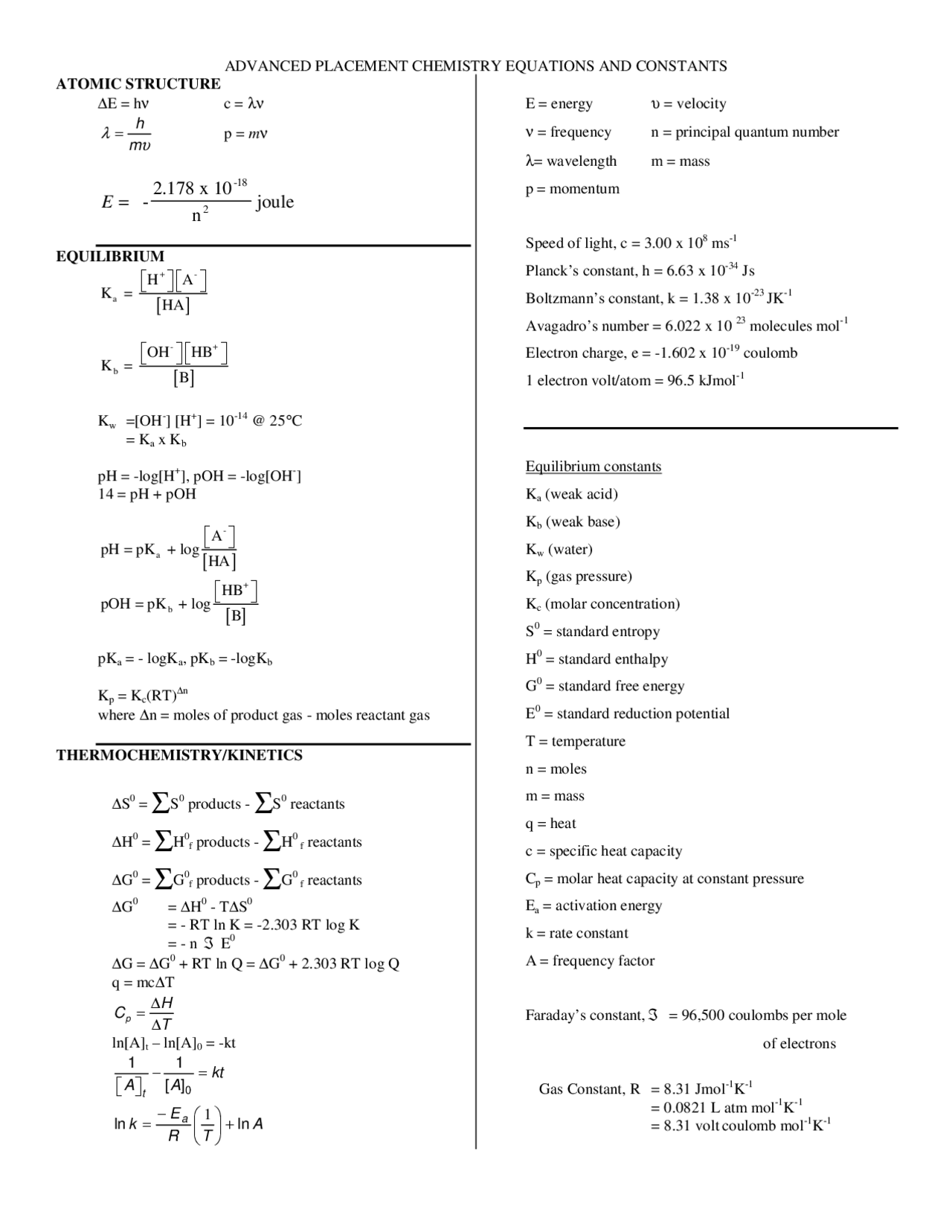
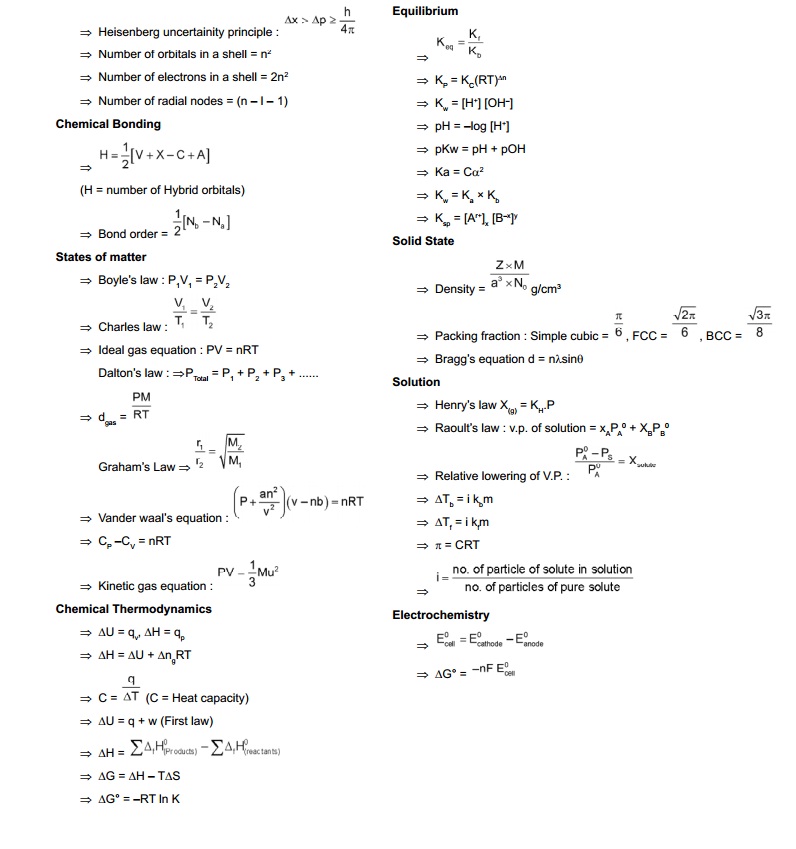
The official College Board document is split into two primary resources: a complete Periodic Table of the Elements and several distinct tables of equations, categorized by chemical domain. Understanding each category helps you locate relationships without losing valuable exam seconds.
1. Atomic Structure
This section focuses on the behavior of light, energy levels, and photons. The key relationships provided are:
E = hν(Relates photon energy to frequency)c = λν(Relates speed of light to wavelength and frequency)
These equations are frequently tested in Unit 1 (Atomic Structure and Properties) and Unit 3 (Intermolecular Forces and Properties) when analyzing photoelectron spectroscopy (PES), spectrophotometry, or transitions between quantum energy levels.
2. Equilibrium
Equilibrium calculations govern a massive portion of the AP exam, particularly Units 7 and 8. The formula sheet supplies:
- Equilibrium expressions: General definitions for
KcandKp, including the relationshipKp = Kc(RT)Δn. - Acid-base definitions: Equations for
pH,pOH, and their relationship toKw(1.0 × 10⁻¹⁴ at 25°C). - Ion-product relationships:
pKa = -log KaandpKb = -log Kb. - The Henderson-Hasselbalch equation:
pH = pKa + log([A⁻]/[HA]), used for buffer systems.
3. Kinetics
The kinetics section provides mathematical expressions for reaction rates and integrated rate laws for zero-, first-, and second-order reactions:
- First-order integrated rate law:
ln[A]t - ln[A]0 = -kt - Half-life for a first-order process:
t1/2 = 0.693 / k - Second-order integrated rate law:
1/[A]t - 1/[A]0 = kt - Zero-order integrated rate law:
[A]t - [A]0 = -kt
Notice that the half-life equation is only given for first-order reactions. If a question asks about the half-life of a zero- or second-order reaction, you must derive it using the appropriate integrated rate law.
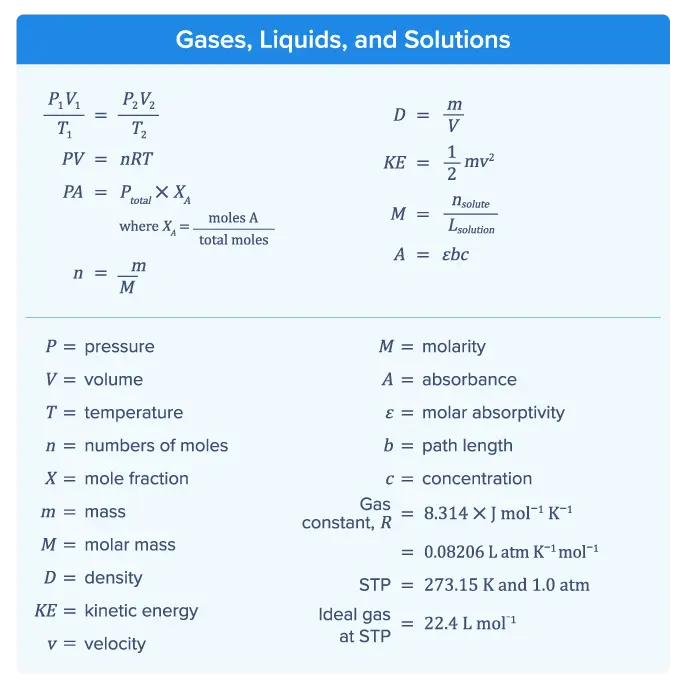
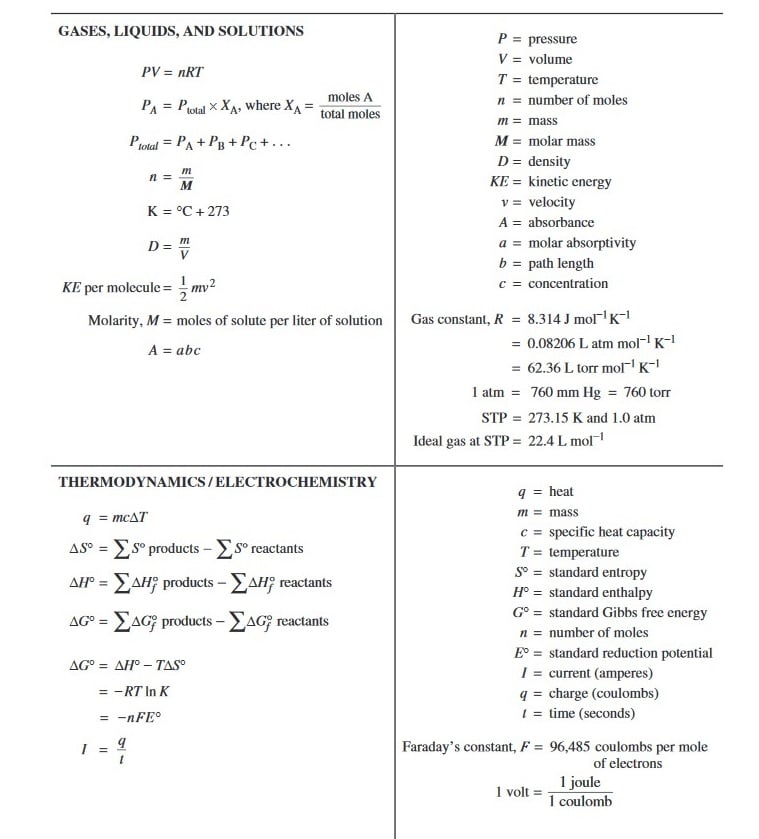
4. Gases, Liquids, and Solutions
Covering fundamental physical chemistry concepts, this block includes:
- Ideal Gas Law:
PV = nRT - Dalton's Law of Partial Pressures:
Ptotal = PA + PB + PC + ...andPA = XAPtotal - Molarity definition:
M = moles of solute / liters of solution - Beer-Lambert Law:
A = εbc(Absorbance related to molar absorptivity, path length, and concentration)
5. Thermodynamics and Electrochemistry

Often considered the most challenging mathematical section of the test, this area features:
- Standard enthalpy, entropy, and Gibbs free energy:
ΔG° = ΔH° - TΔS° - Relationship between free energy and equilibrium:
ΔG° = -RT ln K - Faraday’s laws and cell potential:
ΔG° = -nFE° - Current and charge:
I = q / t
Crucial Constants and Conversion Factors
Alongside the equations, the sheet provides physical constants you will use repeatedly throughout the exam. Pay close attention to unit combinations:
- Gas Constant (R): Listed as both
8.314 J/(mol·K)and0.08206 (L·atm)/(mol·K). Use8.314for thermodynamics and electrochemistry (where Joules are required) and0.08206for gas calculations involving atmospheres and liters. - Faraday’s Constant (F):
96,485 Coulombs per mole of electrons. - Planck’s Constant (h):
6.626 × 10⁻³⁴ J·s. - Speed of Light (c):
2.998 × 10⁸ m/s.
Formulas Not on the Sheet (What You Must Memorize)
While the College Board includes many critical expressions, several foundational formulas are intentionally omitted. You are expected to know these by heart:
- Calorimetry:
q = mcΔT(heat absorbed or released) is not explicitly listed in this form. You must also remember thatΔH = q / nunder constant pressure conditions. - Dilution Equation:
M1V1 = M2V2is absent. While derived from the molarity formula, knowing it directly saves time during solution prep questions. - Density:
d = m / V, as well as the gas density variation:d = (P × Molar Mass) / RT. - Percent Error and Percent Yield:
Percent Error = (|Experimental - Theoretical| / Theoretical) × 100%Percent Yield = (Actual Yield / Theoretical Yield) × 100%
- Formal Charge:
Formal Charge = Valence Electrons - Nonbonding Electrons - (Bonding Electrons / 2). - Root-Mean-Square Speed: The specific formula
vrms = √(3RT/M)is no longer provided; you simply need to understand the conceptual relationship that average kinetic energy depends only on absolute temperature, and heavier particles move slower at the same temperature.
Strategies for Using the Sheet Effectively on Exam Day
A reference table is only as useful as your ability to parse it under time pressure. Use these practical strategies during your practice sessions:
1. Practice Dimensional Analysis with Constants
When solving complex free-response questions, check the units of your constants. For instance, in thermodynamics calculations, ΔH° is frequently reported in kilojoules (kJ), while ΔS° is given in joules per kelvin (J/K). Because R = 8.314 J/(mol·K) operates in joules, failing to convert kilojoules to joules before calculating ΔG° = -RT ln K is a frequent source of lost points.
2. Never Study Without It
Download the official PDF directly from the College Board website at the start of your review. Do not use abbreviated classroom reference sheets or internet summaries while doing homework. By the time exam day arrives, your eyes should automatically drift to the exact quadrant of the page where your desired formula resides.
3. Verify What the Variables Represent
The sheet defines most variables in a side column (e.g., n = number of moles, T = temperature, V = volume). If you run into a high-stress moment during the test and forget whether I represents current or ionic strength, glance at the definition table to reorient yourself instantly.
Final Thoughts
The AP Chemistry formula sheet is designed to test your conceptual synthesis rather than rote memorization. Success on the AP exam comes from recognizing the underlying chemical principles in a prompt and connecting them to the right mathematical framework. Print the sheet, solve practice problems using only this reference, and walk into the testing room with confidence.