Are Jumping Spiders Smart? Inside Their Tiny Brains
Are Jumping Spiders Smart?

When most people think of spiders, they imagine passive creatures sitting in a web, waiting for an insect to stumble into a trap. However, jumping spiders (family Salticidae) break every rule in the arachnid playbook. If you have ever wondered, "are jumping spiders smart?" the answer is a resounding yes. Despite having a brain roughly the size of a poppy seed, these tiny hunters exhibit cognitive abilities that rival vertebrates, including advanced spatial awareness, strategic planning, and trial-and-error learning.
Unlike web-building spiders that rely primarily on vibrations to detect prey, jumping spiders are active hunters with sophisticated toolkits for survival. They stalk, calculate, and pounce on their targets with pinpoint precision. Their intelligence is not just a collection of hardwired instincts; it involves behavioral flexibility that continually surprises biologists.
The Biological Basis of Spider Intelligence
To understand how such a small animal can display advanced intelligence, scientists look at their unique biological adaptations. The brain of a jumping spider takes up a significant portion of its body, extending even into its legs to handle the massive influx of sensory data.
Unmatched Vision in the Arachnid World
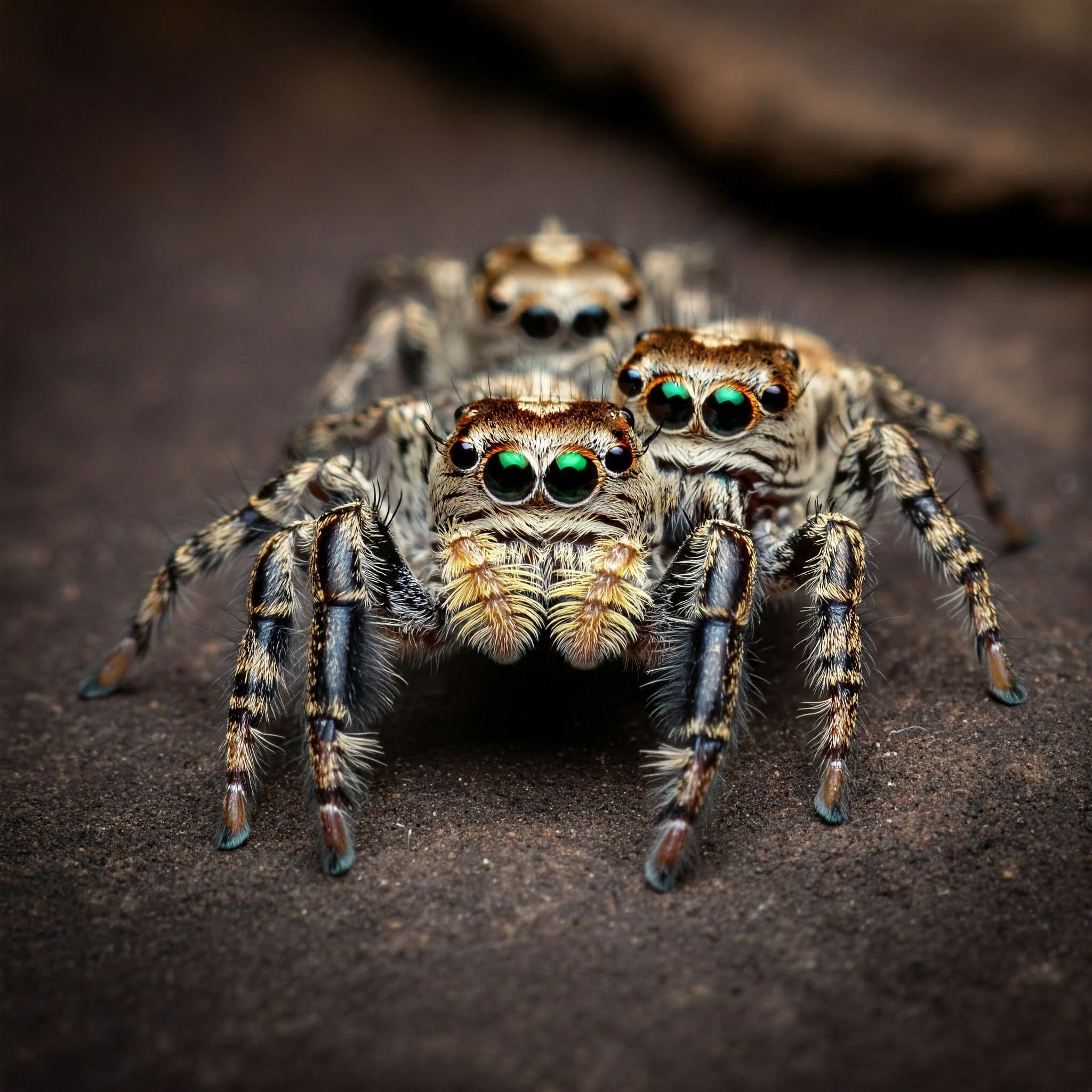
Vision is the primary driver of jumping spider intelligence. While most spiders have poor eyesight, jumping spiders possess eight eyes, with the principal anterior median eyes offering high-resolution, color vision. They can see the full visible light spectrum and even ultraviolet light.
Main Eyes: Function like high-definition camera lenses, allowing them to focus on objects up to 30 centimeters away.
Secondary Eyes: Placed around the carapace, providing a nearly 360-degree panoramic view to detect movement.
This exceptional visual processing power allows them to distinguish between different types of prey, recognize other spiders, and even perceive human faces. Their brains must process this vast visual information in real-time, laying the groundwork for complex decision-making.
Detour Planning and Spatial Reasoning
One of the most compelling pieces of evidence answering the question "are jumping spiders smart?" comes from their ability to plan detours. In laboratory experiments, scientists placed jumping spiders on a platform where they could see two different prey items, but only one path led to the food.
When the spiders lost sight of the prey while navigating the maze, they did not wander aimlessly. Instead, they consistently chose the correct path—even when it required moving away from the prey initially to reach it. This proves they can form a mental map of their environment and hold a visual goal in memory while out of sight.
Problem-Solving and Behavioral Flexibility

Intelligence is often measured by an animal's ability to solve novel problems. Jumping spiders excel in this area, demonstrating tactics that go far beyond simple reflex actions.
Strategic Hunting Tactics
Different prey require different strategies. For instance, jumping spiders of the genus *Portia* specialize in eating other spiders. They are infamous for their cunning tactics:
Deceptive Mimicry: They pluck the web of an orb-weaver spider to mimic the vibrations of a trapped insect, luring the resident spider out into the open.
Trial and Error: If one web-plucking technique fails, a *Portia* spider will alter its approach until it finds a rhythm that works.
Targeted Positioning: They often take the long way around a web to attack an enemy spider from above, avoiding the sticky traps entirely.
Learning and Memory
Jumping spiders learn from their experiences. Research has shown that they can categorize different types of prey and remember which strategies are most effective against specific insects. If a jumping spider encounters a toxic or defensive prey item, such as an ant with strong chemical defenses, it adjusts its attack angle in future encounters to minimize risk.
Interaction with Humans and Curiosity
Beyond survival mechanics, jumping spiders display personality traits that many humans find endearing. They are naturally curious creatures. When a human approaches, a jumping spider will often turn to face them, tracking their movements with their large front eyes.
Unlike many insects or arachnids that flee immediately, jumping spiders frequently pause to observe their surroundings and evaluate whether a human poses a threat. This inquisitiveness has made them viral sensations online, with macro photographers capturing their expressive, puppy-dog-like faces.
Conclusion
The evidence is clear: jumping spiders are exceptionally smart for creatures of their scale. By combining acute stereoscopic vision, mental mapping, detour planning, and adaptive hunting strategies, they punch far above their weight class in the animal kingdom. Their complex cognitive world proves that high-level intelligence is not restricted to animals with large brains, offering a fascinating glimpse into the diversity of thought on Earth.