Avoid Costly Fines with Regular Fire Extinguisher Tag Inspections
When an Occupational Safety and Health Administration (OSHA) compliance officer or a local fire marshal walks into your commercial facility, one of the first items they examine is often mounted on your walls at eye level: portable fire extinguishers. Even if an extinguisher is fully charged and mechanically sound, an outdated, missing, or improperly documented inspection tag can immediately trigger regulatory citations. Learning how to avoid costly fines with regular fire extinguisher tag inspections is essential for facility managers, safety directors, and business owners who want to maintain an audit-ready building while safeguarding their workforce.
The Regulatory Landscape: OSHA, NFPA 10, and Local Codes
Fire safety compliance is governed by a network of federal, state, and municipal regulations. At the federal level, OSHA standard 29 CFR 1910.157 dictates the placement, use, maintenance, and testing of portable fire extinguishers in the workplace. OSHA mandates that employers perform an initial and monthly visual inspection of all units, as well as an annual maintenance check conducted by a certified technician.
In addition to federal workplace safety rules, state and municipal fire codes almost universally adopt NFPA 10 (Standard for Portable Fire Extinguishers), published by the National Fire Protection Association. NFPA 10 provides detailed, prescriptive technical requirements for what must be checked, how records must be kept, and how physical inspection tags must be marked.
The True Cost of Tag Non-Compliance
Regulatory citations add up quickly. OSHA adjusts its maximum penalty amounts annually to account for inflation:
- Serious and Other-Than-Serious Violations: Over $16,000 per violation. A failure to inspect and document multiple extinguishers across a warehouse or campus can produce stacked citations.
- Failure to Abate: Over $16,000 per day past the abatement date until compliance is demonstrated.
- Willful or Repeated Violations: Exceeding $160,000 per incident for organizations that deliberately neglect safety standards or repeat documented infractions.
Beyond statutory fines, uncertified or missing tags give commercial property insurers grounds to dispute or deny coverage claims following a fire incident. If an untagged extinguisher malfunctions during an emergency, your business faces substantial liability exposure.
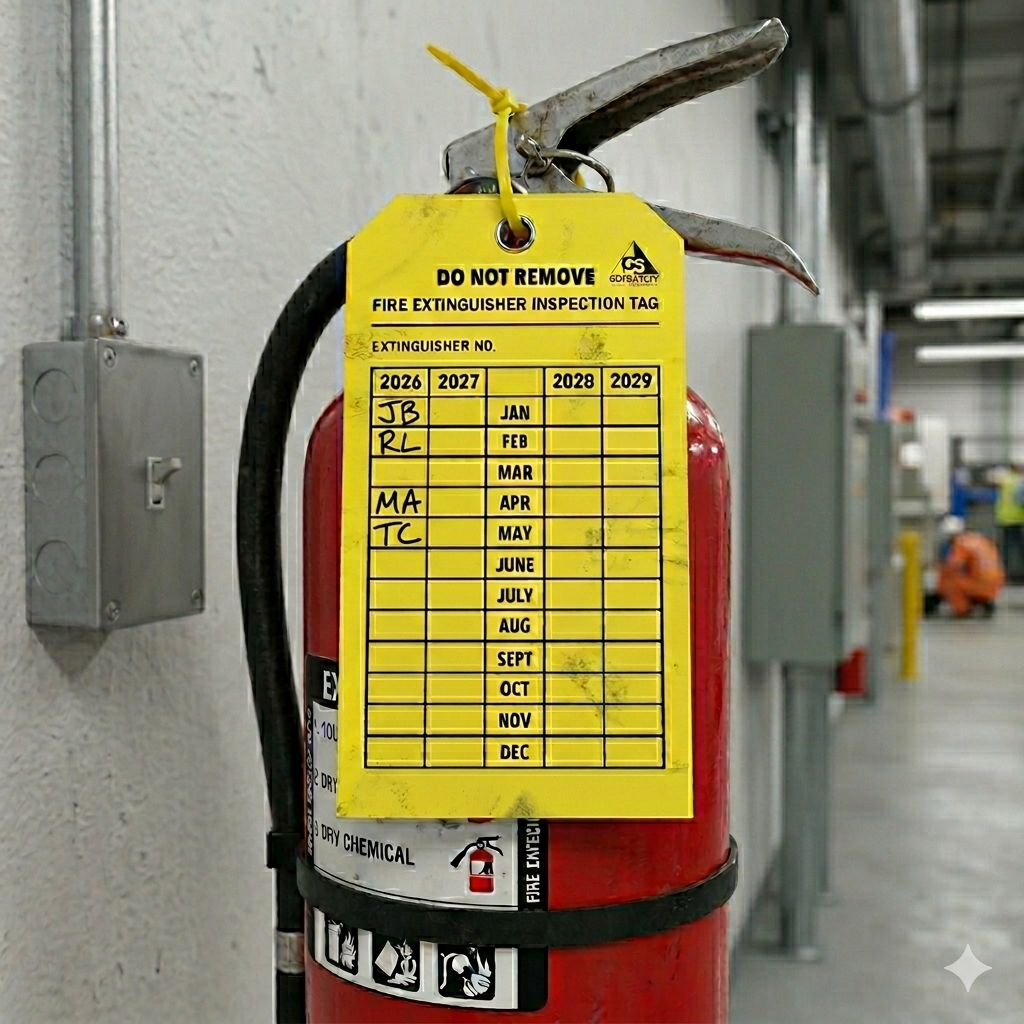
What Belongs on an Extinguisher Inspection Tag?
An extinguisher tag serves as an auditable chain of custody proving that a life-safety device will operate when called upon. Inspectors examine tags for specific historical markers:
- Monthly In-House Visual Verification: Twelve distinct slots representing each calendar month, showing the date inspected and the initials of the designated internal inspector.
- Annual Professional Maintenance Record: The date of servicing, the certified technician's signature or license number, the servicing company's name and address, and the specific service performed (e.g., re-charge, maintenance check, new unit installation).
- Extended Service Dates: Indications of required 6-year internal examinations and 12-year hydrostatic shell tests, often accompanied by an internal "verification-of-service collar" placed around the neck of the cylinder.
Avoid Costly Fines with Regular Fire Extinguisher Tag Inspections
Compliance is not an annual scramble; it is an ongoing operational habit. Establishing a tiered schedule prevents compliance gaps, preserves equipment lifespan, and eliminates surprise inspection penalties.
1. The 30-Day Monthly Visual Check
NFPA 10 and OSHA require a visual inspection at minimum 30-day intervals. This routine review can be performed by a designated in-house employee. During this check, verify the following points before signing the tag:

- Location and Accessibility: The unit is in its designated bracket or cabinet, fully visible, unobstructed by pallets, furniture, or equipment, with at least 36 inches of clear perimeter space.
- Pressure Gauge Reading: The needle rests firmly inside the green operable zone, indicating that propellant pressure is neither low nor dangerously overcharged.
- Physical Condition: The cylinder, handle, and nozzle show no signs of corrosion, physical impact, leakage, clogging, or tampering.
- Safety Seals: The pull pin is held securely by an intact plastic tamper seal.
- Tag Endorsement: The inspector records the exact date and legible initials in the current month's block on the tag.
2. Annual Certified Maintenance
Every 12 months, in-house checks must be supplemented by a comprehensive examination performed by a licensed fire protection professional. The technician thoroughly examines mechanical parts, verifies internal chemical conditions, weighs the cylinder to ensure no slow loss of agent has occurred, installs a new external tamper seal, and attaches a new annual inspection tag.
3. Hydrostatic Testing and Internal Maintenance
Depending on the extinguisher type (such as standard ABC dry chemical vs. carbon dioxide or pressurized water), cylinders require periodic internal teardowns (typically every 6 years) and hydrostatic pressure testing (every 5 or 12 years). Ensure your service vendor stamps or labels these milestones directly on the cylinder shell and cross-references them on your active maintenance logs.
Common Tagging Mistakes That Trigger Fines
Inspectors routinely spot the same procedural shortcuts during facility walk-throughs. Avoiding these common pitfalls keeps your documentation defensible:
- "Pencil-Whipping" Tags: Pre-signing multiple months in advance or sitting in an office signing off on twelve extinguishers without physically verifying them. Regulators can easily spot identical ink patterns or cross-check inspection timestamps against security footage.
- Missing Monthly Initials: Missing just one or two months creates a broken chain of compliance. An inspector will treat a blank month as a missed inspection.
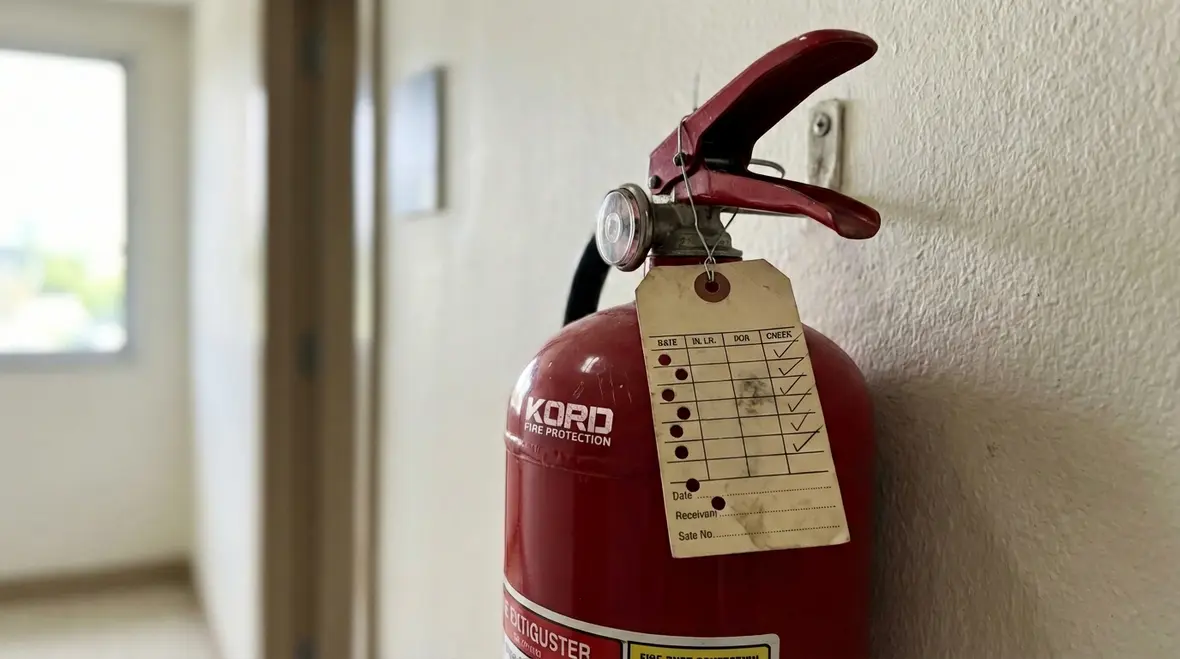
- Illegible or Weather-Damaged Tags: Outdoor units, industrial wash-down bays, and construction environments require durable, weatherproof synthetic tags. Cardboard or standard paper tags that tear, fade in UV light, or run from moisture fail compliance standards.
- Missing Verification Collars: When an annual service requires breaking the seal or opening the valve, technicians must install a continuous, unbroken collar around the neck of the unit. Its absence indicates to an inspector that internal maintenance was skipped despite a fresh tag.
Modernizing Records: Hybrid and Digital Tagging
NFPA 10 permits electronic inspection tracking systems, provided that records are kept on a computer program that produces an unalterable audit trail. Many modern facilities now attach durable barcode or RFID tags to each extinguisher.
Using a mobile device, internal inspectors scan the unit's unique code, step through a required digital checklist, and submit data in real time. The software automatically flags missing units, out-of-spec pressure readings, or overdue timelines. Even with digital tracking, maintaining a legible physical backup tag on the unit remains recommended practice, as local fire marshals often demand an immediate visual record during spot inspections.
Building an Audit-Proof Facility Routine
Protecting your organization from fines requires a repeatable system rather than individual memory. Appoint primary and secondary inspection coordinators so that vacations and sick leave do not disrupt monthly rounds. Schedule visual inspections for the first week of every month, leaving ample time to correct identified issues before the 30-day window closes.
By treating the humble fire extinguisher tag as a vital legal record rather than an afterthought, you ensure your emergency equipment functions reliably, protect your capital from unnecessary enforcement penalties, and maintain a safe environment for your team.