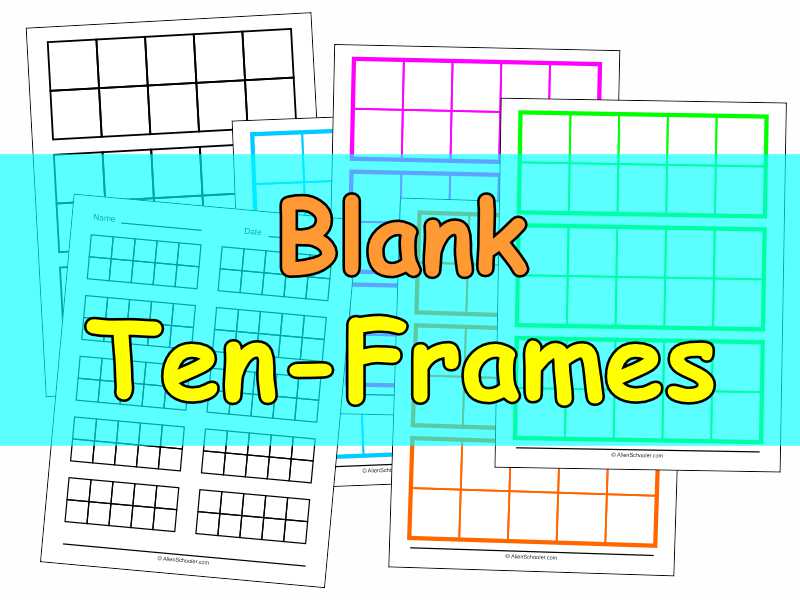
Back to School Essential Blank Ten Frame Tools
As classrooms gear up for a fresh academic year, teachers and parents alike search for supplies that deliver genuine educational value. Among the standard array of pencils, notebooks, and folders, one mathematical visual aid stands out as a must-have: Back to School Essential Blank Ten Frame Tools. Whether you are setting up a kindergarten classroom or organizing a homeschool space, these simple two-by-five rectangular grids provide the foundation for essential number sense.

Number sense is not just about counting; it is about understanding how numbers relate to each other, especially to the numbers five and ten. Ten frames help children transition from simple counting by ones to conceptualizing quantities as composite units. Below, we explore why these tools are indispensable, how to choose the right versions, and creative ways to integrate them into daily routines.
Why Ten Frames Are Crucial for Early Math
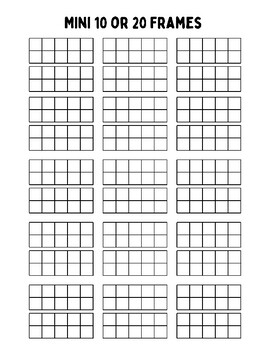
Before children can tackle addition, subtraction, and place value, they must develop visual benchmarks for numbers. A ten frame consists of two rows of five squares each. Because our number system is based on tens, this layout is uniquely powerful for young learners.
Standardized testing and math curricula consistently emphasize the importance of subitizing—the ability to instantly recognize the number of objects in a small group without counting them one by one. Blank ten frames encourage subitizing by organizing counters in recognizable patterns. When a child sees three counters on the top row and two on the bottom, they quickly learn to recognize five without pointing and counting.
Developing Anchor Numbers
The concept of "anchoring to 5 and 10" is one of the greatest benefits of using a ten frame. When children place seven counters on a frame, they instantly see that it is made of a full row of five plus two more. They also naturally notice that there are three empty spaces left. This visual layout plants the seeds for advanced mental math strategies, such as making ten to add or subtract.
Choosing the Best Blank Ten Frame Tools
When shopping or prepping for the new school year, you will encounter various types of ten frame tools. Selecting the right format depends on your learning environment, student age group, and budget.
- Magnetic Dry-Erase Boards: Perfect for whole-group instruction or individual student desks. Children can draw counters, write numbers underneath, and wipe them clean instantly.
- Large Foam Floor Mats: Great for kinesthetic learners. Kids can jump onto the squares or place oversized bean bags into the frames to represent numbers physically.
- Laminated Cardstock Printables: A cost-effective, portable option for math centers and homework packets.
- Interconnecting Plastic Trays: These allow students to physically snap two frames together to explore numbers from 11 to 20.
Hands-On Activities to Try This Year
Blank ten frames are exceptionally versatile. Because they do not have pre-printed dots, you can use them for an endless variety of mathematical investigations. Here are four engaging activities to kick off the school year.
Video: Back to School Math Warm-Up | Subitizing with Ten Frames, Tally Marks & Pictures

1. Roll and Fill
Give each student a blank ten frame and a handful of small counters (such as math beads, mini erasers, or buttons). Have students roll a six-sided die, count that many items, and place them onto their frame starting from the top left. This reinforces one-to-one correspondence and left-to-right tracking.
2. Flash and Cover
Build visual memory and subitizing skills by flashing a completed ten frame card to students for just three seconds. Hide the card and ask them to recreate the exact configuration on their own blank frames. Discuss the different ways they saw the counters arranged.
3. Making Ten Combinations
Place exactly ten counters of one color on the frame. Have a student close their eyes while you hide a certain number of counters under your hand. When they open their eyes, they look at the frame and determine how many counters are missing. This introduces basic algebraic thinking and number bonds to ten.
4. Addition and Subtraction Stories
Use two different colors of counters to model word problems. For example: "There are 6 frogs on a log (red counters). 3 more frogs hop over (yellow counters). How many frogs are on the log now?" Students place the counters onto the blank grid to physically act out the narrative.
Tips for Classroom and Home Organization
To keep your math centers running smoothly, proper storage is key. Store printed or laminated frames in heavy-duty plastic sleeves or color-coded folders. Keep counters in small, snap-shut containers or drawstring bags so they do not spill across the room.
Encourage children to treat their ten frames and counters with care, emphasizing that math tools help their brains grow. By introducing these visual aids early in the school year, you build a sturdy mathematical foundation that will support students through addition, subtraction, and beyond.