Beat Fear Fast: Say Goodbye to Speech Anxiety with This Hack
Your palms are sweating, your heart is hammering against your ribs, and your mind is desperately racing to remember your opening line. Whether you are standing in front of a corporate boardroom, a university lecture hall, or a crowded wedding reception, public speaking triggers a primal survival response in the human brain. If you have ever wished you could wave a magic wand and say goodbye to speech anxiety with this hack, you are far from alone. Studies consistently show that glossophobia—the fear of public speaking—affects up to 75% of the population.

Fortunately, overcoming this hurdle does not require years of therapy or a complete overhaul of your personality. By understanding the root cause of your nervous system's alarm bells and utilizing a simple, scientifically validated psychological shift, you can completely transform how you feel before taking the stage.
Understanding the Root of Public Speaking Fear
To defeat your nervous system, you first need to understand what is happening inside your body. When you look out at an audience, your brain's amygdala interprets the crowd as a potential predator. It floods your bloodstream with cortisol and adrenaline, triggering the classic fight-or-flight response.
This biological reaction makes absolute sense if you are running away from a saber-toothed tiger. However, it is entirely counterproductive when you are simply trying to explain quarterly financial projections or deliver a toast. Your heart rate spikes, your mouth dries out, and your hands tremble. The harder you try to suppress these symptoms, the more panicked you become, creating a vicious cycle of performance anxiety.
The Power of Physiological Reappraisal
Traditional advice tells us to "calm down" or "relax" before a big presentation. This is arguably the worst advice you can possibly follow. Telling an amped-up nervous system to simply relax is like telling a speeding train to instantly stop. Your body is running on high-octane adrenaline; trying to force it into a state of zen creates a frustrating internal tug-of-war.
Instead of trying to shift your emotional state from high anxiety to complete calmness, Harvard Business School researcher Alison Wood Brooks discovered a far more effective strategy: physiological reappraisal. This is the ultimate hack to say goodbye to speech anxiety.
Physiological reappraisal acknowledges that excitement and anxiety are physiologically identical. Both states feature high arousal, rapid heart rates, elevated cortisol, and focused alertness. The only difference is the narrative you attach to those physical sensations. When you are anxious, you tell yourself, "I am terrified and I am going to fail." When you are excited, your brain tells yourself, "I am energized and ready to perform."
How to Execute the Anxiety-to-Excitement Hack
Video: Public Speaking Anxiety Tips: 6 Mindset Tips

Implementing this psychological reframe takes mere seconds, but it requires deliberate intention. Follow this step-by-step process the next time you feel the pre-speech jitters creeping in:
- Notice the physical symptoms: Acknowledge that your heart is beating fast and your palms are warm without judging yourself for it.
- Reframe the narrative: Say out loud or quietly to yourself, "I am not nervous; I am excited." Research shows that verbalizing this simple phrase tricks your brain into adopting the positive narrative.
- Focus outward: Direct your attention away from your internal physical sensations and focus entirely on the value you are about to deliver to your audience.
Additional Strategies to Lock in Your Confidence
While the anxiety-to-excitement hack works wonders on your mindset, combining it with practical preparation ensures your presentation goes off without a hitch.
Nail the First Two Minutes
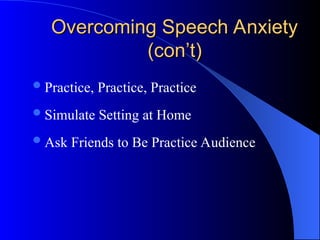
Speech anxiety is almost always at its absolute worst during the opening moments of a presentation. Once you get past the first two minutes, your adrenaline levels begin to naturally normalize. Write out your opening lines word-for-word and practice them until you can deliver them on autopilot. Knowing you have a strong, smooth start gives your brain a safety net.
Focus on Service, Not Performance
When we feel nervous, we tend to become hyper-focused on ourselves: How do I look? Is my voice shaking? Are they judging me? Shift your paradigm entirely. View your presentation not as a performance where you are being judged, but as an act of service. You possess information, insights, or stories that can help the people sitting in front of you. When your primary goal is to help your audience, there is no room left for ego-driven fear.
Master Your Nerves Once and for All
Public speaking does not have to be a source of dread. The physical symptoms you experience before stepping up to a microphone are not a sign of weakness or a predictor of failure—they are simply raw energy waiting to be channeled. By utilizing physiological reappraisal, you stop fighting your biology and start using it to your advantage. Try this simple reframe before your next big moment, watch your mindset shift, and finally leave your stage fright behind.