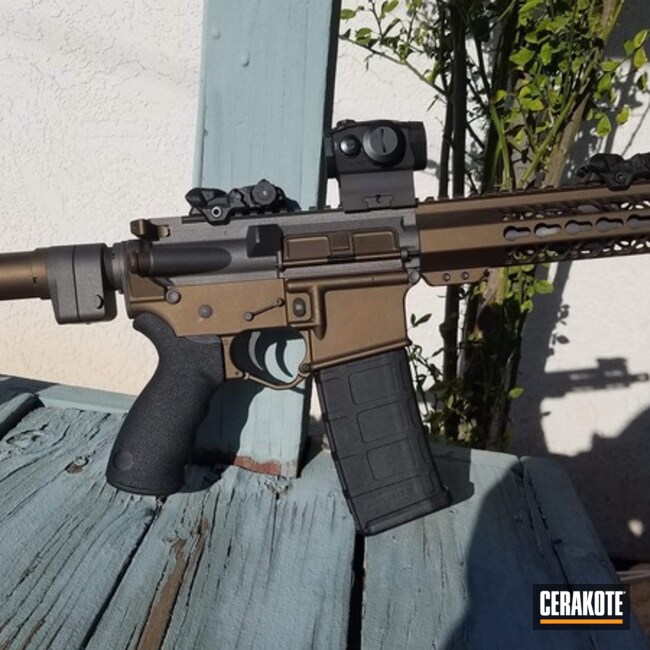
Building a 2 Tone AR 15: Color Ideas & Finishes
For decades, the standard civilian rifle came in one color: matte black. Often dubbed the "black rifle," the platform prioritized utility over aesthetics. Today, custom builds and factory offerings have evolved, making the 2 tone ar 15 one of the most sought-after visual configurations on the range. Breaking up the silhouette of a monolithic black rifle not only gives it a custom appearance but can also serve practical roles in ambient camouflage and heat dissipation.

Whether you are piecing together your first stripped receiver set or looking to refresh a tired duty gun, balancing two distinct shades requires careful planning. Here is everything you need to know about two-tone layouts, popular color combinations, and application methods.
Why Choose a 2 Tone AR 15 Layout?
A two-tone setup delivers the perfect middle ground between a plain factory rifle and a fully painted, intricate camouflage pattern. There are three core advantages to this approach:
- Visual Balance: Monolithic colors—especially bright tans or deep greens—can look overwhelming when applied to every single pin, lever, and surface. A contrasting secondary color grounds the build visually.
- Cost and Convenience: Creating a two-tone appearance does not require coating every microscopic part. You can leave standard small parts (like trigger pins, takedown pins, and forward assists) in their original black finish while finishing major components.
- Modularity: If you use furniture (stocks, grips, and rail covers) as your secondary color, you can change your rifle's color palette in ten minutes with simple hand tools.
Popular Color Schemes for Two-Tone AR Builds
While personal taste ultimately dictates your choice, several time-tested pairings have become modern classics in the firearm community.
1. Flat Dark Earth (FDE) and Matte Black
FDE and black is the undisputed standard in two-tone configurations. Popularized by modern military conflicts in arid environments, this pairing provides excellent contrast. The dark receivers anchor the design, while desert tan furniture or rail systems break up the outline. It looks purposeful, tactical, and clean.
2. Olive Drab (OD) Green and Black
For woodland environments, an OD Green and black combination provides organic camouflage without relying on disruptive paint patterns. OD Green is subtle, pairing especially well with black receivers and barrel assemblies. It gives the platform a rugged, outdoors-ready aesthetic that never goes out of style.
3. Sniper Grey or Tungsten and Black
If you prefer an urban, industrial appearance, tungsten or battleship grey creates a stark, mechanical contrast against hardcoat black. Grey offers a technical look that stands out sharply at civilian range days while remaining neutral enough for defensive and competition setups.
4. Burnt Bronze and Black
For shooters who appreciate a premium metallic sheen, Burnt Bronze provides a rich, dark earth tone with copper undertones. It strikes a balance between understated utility and the flash of a custom competition gun. Burnt Bronze receivers paired with deep black furniture and controls consistently turn heads.
Three Ways to Lay Out Your Two-Tone Scheme

How you distribute your two chosen colors across the rifle fundamentally changes its profile. Most builders follow one of three primary design layouts:
The Upper/Lower Split
In this format, one receiver half is coated in your secondary color, while the other remains standard. The most common variation features an FDE or grey upper receiver paired with a black lower, or vice versa. This creates a clean horizontal divide along the rifle's mechanical center.
The Core Metal vs. Furniture Layout
This is the simplest and most cost-effective method. Your upper receiver, lower receiver, and handguard remain hardcoat black, while all polymer components—the buttstock, pistol grip, magazine, forward grip, and rail scales—are swapped for your secondary color. Alternatively, coating the handguard and receivers while running black furniture creates a sharp negative-space effect.
The Accent Accentuation
In this configuration, major components (receivers and handguard) are coated in an alternate primary color like OD Green or Tungsten, while high-wear operational components remain black. The charging handle, safety selector, dust cover, magazine release, and barrel provide black punctuation marks across the colored canvas.
Finishing Methods: Cerakote vs. Anodizing vs. Spray Paint
Achieving a two-tone look requires choosing the right finishing medium based on your budget, tools, and expectations for durability.
- Cerakote (Thin-Film Ceramic Coating): The gold standard for custom rifle finishes. Applied via spray gun and baked in an oven (H-Series), Cerakote offers outstanding chemical resistance, wear resistance, and the widest color library available. It can be applied over aluminum, steel, and polymer.
- Type III Hardcoat Anodizing: An electrochemical process integrated into the aluminum itself. "Tanodized" or colored anodized receivers offer unmatched surface hardness, but colors can vary significantly between production batches due to alloy chemistry and dye tanks.
- Rattle-Can (DIY Spray Paint): Using quality camouflage paints like Krylon or Rust-Oleum Specialty is inexpensive and easily reversible. While it wears rapidly around handling areas, many shooters actively prefer the distressed, "field-used" aesthetic of a worn two-tone rattle-can job.
Tackling the "50 Shades" Matching Challenge
One major hurdle when assembling a two-tone AR-15 is color inconsistency, especially with earth tones. Flat Dark Earth from one manufacturer rarely matches FDE from another. A Magpul stock, an Aero Precision handguard, and a BCM grip may all technically be sold as "FDE," yet each features distinct yellow, brown, or greenish undertones.
You have two ways to handle this reality:
- Embrace the Gradient: Lean into the variation. Modern military clone rifles (such as the MK18 or modern military URGI builds) deliberately feature multi-tonal tan, bronze, and FDE components. It adds depth and realistic field utility.
- Single-Batch Coating: If you want absolute uniformity on your non-black parts, purchase raw or standard black components and have them Cerakoted together by the same applicator using a single paint mix.
Final Thoughts
The beauty of building a two-tone AR lies in its versatility. By stepping away from the standard all-black configuration, you introduce contrast, personality, and environment-specific utility without sacrificing the reliable performance of the platform. Start with a clear color pairing, decide where you want your lines of contrast, and select the finish that matches your durability requirements.