Calculate Puppy Arrival with Gestation Period Dogs
Welcoming a new litter of puppies is an exciting time for any dog owner or breeder. However, waiting for the big day can also feel nerve-wracking if you do not know when to expect the newborns. To properly prepare your home and monitor the mother's health, you need an accurate estimate of her due date. Fortunately, you can easily calculate puppy arrival with gestation period dogs by understanding the basics of canine reproduction and tracking a few crucial timelines.

Understanding the Canine Gestation Period
Unlike humans, who have a pregnancy lasting roughly nine months, dogs have a much shorter gestation period. On average, a dog's pregnancy lasts between 58 and 68 days from the exact moment of fertilization, with the typical average resting right around 63 days (or nine weeks).
However, relying solely on the date of mating can be misleading. Sperm can survive inside the female reproductive tract for up to seven days, meaning fertilization may not happen on the exact day you bred your dogs. This biological quirk is why puppies can sometimes arrive a few days earlier or later than expected and still be completely healthy.
How to Calculate Puppy Arrival with Gestation Period Dogs
If you want to pin down an expected whelping date, you need a reliable starting point. Because tracking the exact day of ovulation or fertilization is tricky, veterinarians use specific methods to calculate when the puppies will be born.
1. The Standard 63-Day Rule
The simplest way to estimate a due date is to count 63 days forward from the date of the first successful mating. While this is a helpful baseline, it is far from foolproof due to the variable lifespan of canine sperm. If you bred the dog multiple times over a span of several days, your margin of error increases.
2. Veterinary Ovulation Timing
For professional breeders, precision is vital. Veterinarians can track ovulation using progesterone blood tests and vaginal cytology. Once the veterinarian identifies the exact day of the luteinizing hormone (LH) surge and subsequent ovulation, you can count precisely 65 days forward (or 63 days from the day of actual fertilization) for a highly accurate due date.
Video: How to Do Ultrasound on Pregnant Dogs: Quick Guide to Scanning & Measure Puppy Gestational Age!

3. Ultrasound and X-Ray Confirmation
If you do not know the breeding date at all, your veterinarian can still help you estimate puppy arrival. An ultrasound performed around day 25 to 30 of pregnancy can estimate fetal age based on size. Later in pregnancy, around day 55, an X-ray provides a definitive count of the puppies and helps gauge skeletal maturity, giving you a clearer picture of when labor will begin.
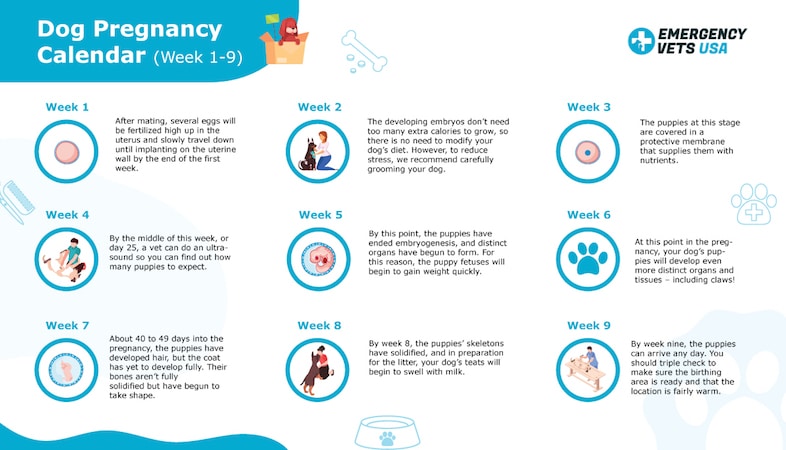
Stages of Canine Pregnancy by Week
Tracking the weekly milestones of a pregnant dog helps you provide the right nutrition and veterinary care at every stage. Here is a brief look at what happens inside the womb:
- Weeks 1 and 2: Fertilization occurs as embryos travel to the uterus. The mother's behavior and physical appearance will remain largely unchanged.
- Weeks 3 and 4: Implantation takes place. You might notice mild morning sickness, a slight decrease in appetite, or a pinker coloration to her nipples.
- Weeks 5 and 6: The embryos officially become recognizable fetuses. Organ development is underway, skeletal systems begin to calcify, and the mother's belly will visibly expand. Her appetite will increase significantly.
- Weeks 7 and 8: Hairless puppies are fully formed. The mother will start producing colostrum and may begin nesting behaviors, such as digging in blankets or seeking out quiet spaces.
- Week 9: The final stretch. Puppies are ready for birth. The mother's temperature will drop below 99°F, signaling that labor will begin within 24 hours.
Preparing for Whelping Day
Once you calculate your dog's expected arrival window, preparation is key to ensuring a smooth delivery. Set up a whelping box in a quiet, low-traffic area of your home at least a week before the due date. Line it with clean, washable towels or pads so the mother can nest comfortably.
Gather essential supplies, including clean towels, a digital kitchen scale to weigh the newborns, unflavored dental floss for tying cords (if necessary), and the phone number for your local emergency veterinarian. Monitor the mother closely during the final week, checking her rectal temperature twice daily to catch the dramatic drop that precedes labor.
Conclusion
Predicting a litter's birthday requires a mix of good record-keeping, biological awareness, and veterinary guidance. By taking the time to calculate puppy arrival with gestation period dogs, you can ensure the mother receives optimal nutrition, your whelping area is ready, and you are fully prepared to welcome a healthy new litter of puppies into the world.