Cardone’s $500M Net Worth Explained: Key Investments
Grant Cardone has become one of the most recognizable figures in modern business, sales training, and real estate syndication. While public estimates regularly place his personal fortune between $500 million and $600 million, separating his gross assets under management from his actual personal equity often confuses casual observers. In this financial breakdown, Cardone’s $500M Net Worth Explained: The Key Investments That Built the Wealth! serves as our guiding framework to explore how an automotive sales consultant transformed high-margin operating cash flow into a multi-billion-dollar commercial real estate empire.

Cardone’s $500M Net Worth Explained: The Key Investments That Built the Wealth!
To understand Cardone’s net worth, one must understand the distinction between personal balance-sheet wealth and the total value of assets managed. Cardone Capital oversees roughly $4.5 billion to $5 billion in commercial real estate assets. However, Cardone does not own those assets outright; they are held inside syndication funds funded by thousands of retail and institutional investors.
Cardone’s personal net worth—conservatively estimated at $500 million—stems from three primary pillars:
- Direct General Partner (GP) and Limited Partner (LP) Equity: Personal co-investments in his own real estate funds, plus carried interest and equity splits.
- 100% Owned Operating Companies: High-cash-flow entities including Cardone Enterprises, Cardone Training Technologies, and the 10X media machine.
- Private Equity and Advisory Stakes: Equity positions acquired through Cardone Ventures alongside operating partner Brandon Dawson.
1. The Real Estate Engine: Cardone Capital
Real estate is the primary vehicle that preserves and compounds Cardone’s wealth. Unlike traditional home flippers or single-family rental owners, Cardone exclusively targets large-scale, institutional-grade assets.
Multi-Family Class-A Communities
Cardone Capital’s portfolio includes more than 14,000 apartment units spread across secondary and primary growth markets in Florida, Texas, Arizona, and Georgia. Cardone’s criteria focus on institutional-quality properties—typically built within the last ten years, featuring 250 to 500+ units, located in markets with favorable tax climates and strong net job migration.
These properties provide steady monthly distributions, protecting his capital against inflation while utilizing long-term fixed-rate debt to maximize equity returns.
Crowdfunding and Syndication Fees
Cardone pioneered the use of Regulation A+ and Regulation D crowdfunding rules under the JOBS Act to raise capital directly from both non-accredited and accredited investors via social media. This model produces substantial wealth for Cardone through:
- Acquisition fees: Upfront percentages charged upon securing multi-million-dollar transactions.
- Asset management fees: Ongoing operational charges for overseeing the property management operations.
- Carried interest / promote: A performance fee granting Cardone’s management arm a percentage of profits once investors achieve a preferred return hurdle.
2. High-Margin Operating Companies: Cardone Enterprises
Real estate protects capital, but operating businesses generate the raw cash needed to buy commercial assets. Cardone spent decades building high-margin, low-overhead digital and consulting businesses that produce millions of dollars in monthly free cash flow.
Cardone University and Sales Training
Cardone Training Technologies houses Cardone University, an enterprise and retail cloud-based sales training platform. Digital education platforms typically operate with gross margins exceeding 80% to 90%. Tens of thousands of individual sales professionals and corporate sales teams—particularly auto dealerships and financial service firms—pay recurring licensing fees to access his training curriculum.
Video: Grant Cardone on 5 Steps to Becoming Millionaire, $2B in Property, NOT Buying Home (Full Interview)
Publishing, Speaking, and 10X Media
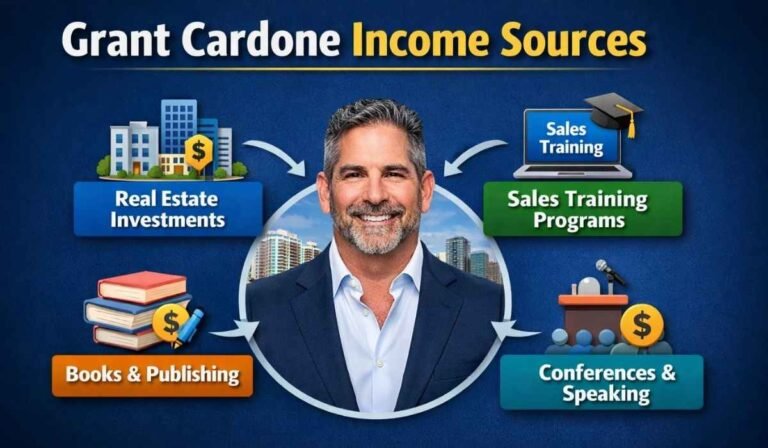
Cardone is the author of several bestselling business books, including The 10X Rule, Sell or Be Sold, and If You're Not First, You're Last. Beyond book royalties, the 10X ecosystem organizes major stadium conferences, mastermind groups, and private mentorship programs. The 10X Growth Conference alone generates tens of millions in gross ticket sales, sponsorship packages, and back-end program enrollments per event.
3. Private Equity: Cardone Ventures
In recent years, Cardone expanded beyond sales consulting and real estate into private equity through Cardone Ventures, a partnership with business scaling specialist Brandon Dawson.
Rather than providing traditional debt or venture capital, Cardone Ventures partners with established small-to-medium businesses (typically generating $2 million to $50 million in annual revenue). In exchange for marketing leverage, sales infrastructure, and operational restructuring, Cardone Ventures acquires significant minority or controlling equity stakes. This allows Cardone to participate directly in the enterprise valuation growth and liquidation events of dozens of private companies.
The Financial Mechanics: How Cardone Protects His Wealth
A major reason Cardone’s wealth scaled so rapidly to the $500 million threshold is his strict adherence to tax efficiency and liquidity redeployment.
The "Cash Is Trash" Philosophy
Cardone famously advocates holding minimal idle cash in bank accounts. Operating profits from his software, consulting, and media businesses are systematically transferred into commercial real estate down payments. This prevents cash drag caused by inflation and eliminates the temptation to misallocate capital.
Cost Segregation and Bonus Depreciation
Commercial real estate offers some of the most aggressive tax incentives in the United States tax code. Through cost segregation studies, multi-family investors can accelerate depreciation schedules on components of an apartment complex (such as appliances, flooring, paving, and HVAC systems).
This accounting maneuver produces heavy paper losses that offset the taxable operational income produced by Cardone's active training companies, allowing him to retain and reinvest nearly every dollar generated.
Prudent Use of Non-Recourse Debt
Cardone leverages institutional mortgage debt from government-sponsored enterprises (Fannie Mae and Freddie Mac) as well as commercial life insurance companies. This debt is generally non-recourse, meaning Cardone's personal assets outside the specific real estate asset are sheltered from liability in the event of an economic downturn.
Key Takeaways for Everyday Investors
While few investors will build a multi-billion-dollar portfolio, Cardone’s wealth-building trajectory offers valuable structural lessons for personal finance:
- Build active income first: Cardone did not start with commercial real estate; he spent his 20s and 30s mastering sales and consulting to accumulate investable surplus cash.
- Trade cash for income-producing equity: Divert operational business revenue into physical, appreciating assets that generate passive cash flow.
- Prioritize tax optimization: Align investments with tax codes that favor capital expenditure, real estate depreciation, and long-term capital gains over ordinary income.
- Harness audience and scale: By building a direct-to-consumer brand, Cardone bypassed Wall Street intermediaries, raising hundreds of millions of dollars directly from real-world consumers.
Through this integrated flywheel of high-margin operating cash, disciplined real estate allocation, and strategic private equity holdings, Grant Cardone transformed personal sales expertise into an enduring, half-billion-dollar empire.