CHCl3 Lewis Diagram: Step-by-Step Drawing Guide
Introduction to Chloroform and the CHCl3 Lewis Diagram

Understanding molecular structures is a fundamental skill in chemistry, and one of the classic molecules students and professionals encounter is chloroform. To truly understand its bonding and reactivity, drawing a accurate CHCl3 Lewis diagram is the best starting point. Chloroform, formally known as trichloromethane, consists of one carbon atom, one hydrogen atom, and three chlorine atoms.
In this comprehensive guide, we will break down the exact process of constructing the Lewis structure for $\text{CHCl}_3$. We will also explore its electron geometry, molecular shape, polarity, and hybridization to give you a complete picture of how this molecule behaves in three-dimensional space.
Step-by-Step Guide to Drawing the CHCl3 Lewis Diagram
Drawing any Lewis structure follows a reliable, systematic method based on valence electron counting. By tallying the available electrons and distributing them to satisfy the octet rule, you can easily arrive at the correct structure for trichloromethane.
Step 1: Count the Valence Electrons
The first step in creating a CHCl3 Lewis diagram is to determine the total number of valence electrons contributed by each atom in the formula:
- Carbon (C): Located in Group 14, carbon contributes 4 valence electrons.
- Hydrogen (H): Located in Group 1, hydrogen contributes 1 valence electron.
- Chlorine (Cl): Located in Group 17, each chlorine contributes 7 valence electrons. Since there are three chlorine atoms, we multiply this by 3 ($3 \times 7 = 21$).
Now, sum these values together to find the total valence electron pool:
$\text{Total Valence Electrons} = 4 \text{ (from C)} + 1 \text{ (from H)} + 21 \text{ (from 3 Cl)} = 26 \text{ valence electrons}$.
Step 2: Identify the Central Atom
Next, we must decide which atom sits at the center of the molecule. Electronegativity and bonding capacity dictate this choice:
- Hydrogen can only form a single bond and can never be a central atom.
- Chlorine atoms typically prefer to form a single bond and complete their octets with three lone pairs.
- Carbon has a lower electronegativity than chlorine (2.5 vs. 3.16) and can form four bonds, making it the ideal central atom.
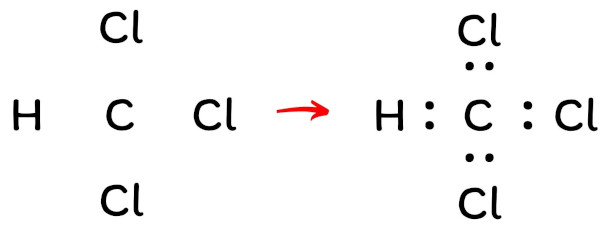
Place the carbon atom in the center and arrange the single hydrogen atom and the three chlorine atoms around it.
Step 3: Draw Single Bonds
Connect the surrounding atoms to the central carbon atom using single covalent bonds (represented by a single line). Each single bond represents a shared pair of two electrons:
- Carbon to Hydrogen (C-H)
- Carbon to Chlorine 1 (C-Cl)
- Carbon to Chlorine 2 (C-Cl)
- Carbon to Chlorine 3 (C-Cl)
Four single bonds consume $4 \times 2 = 8$ electrons from our total pool of 26. This leaves us with $26 - 8 = 18$ valence electrons to place.
Step 4: Distribute Remaining Electrons as Lone Pairs
We now assign the remaining 18 electrons to the outer atoms to satisfy their octets. Hydrogen already shares two electrons in its single bond, which fills its maximum capacity of a duet. Therefore, hydrogen needs no further electrons.
Each of the three chlorine atoms needs an octet (8 electrons). Since each chlorine is already sharing 2 electrons via its single bond with carbon, each chlorine requires 6 additional electrons, or 3 lone pairs:

- Chlorine 1 gets 3 lone pairs (6 electrons).
- Chlorine 2 gets 3 lone pairs (6 electrons).
- Chlorine 3 gets 3 lone pairs (6 electrons).
Multiplying 3 lone pairs by 2 electrons each across three chlorine atoms accounts for all remaining 18 electrons ($3 \times 6 = 18$).
Step 5: Check Octets and Formal Charges
To verify our completed CHCl3 Lewis diagram, we check the octet rule for every atom:
- Hydrogen: Has 2 valence electrons in its single bond (Stable duet).
- Chlorine atoms: Each has 6 electrons in lone pairs and 2 electrons in a shared bond, totaling 8 electrons (Stable octet).
- Carbon atom: Participates in 4 single bonds, meaning it shares 8 electrons, perfectly satisfying the octet rule.
Calculating formal charges further confirms stability. For carbon: $4 \text{ (valence)} - 0 \text{ (non-bonding)} - 4 \text{ (bonds)} = 0$. For chlorine: $7 - 6 - 1 = 0$. For hydrogen: $1 - 0 - 1 = 0$. Every atom has a formal charge of zero, indicating an optimal, stable Lewis structure.
Molecular Geometry and VSEPR Theory of Chloroform
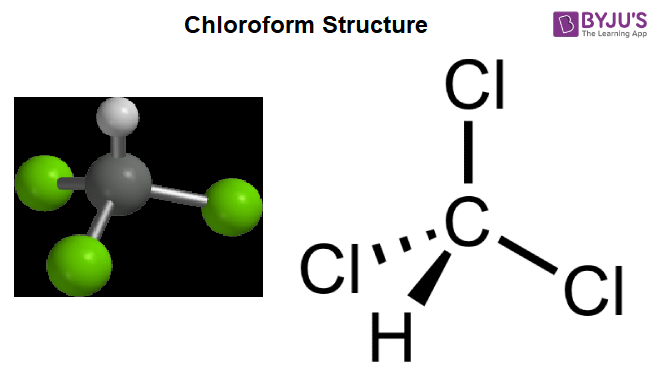
While a Lewis structure is drawn on a flat, two-dimensional piece of paper, real molecules exist in three-dimensional space. To understand chloroform's physical shape, we apply Valence Shell Electron Pair Repulsion (VSEPR) theory.
Looking at the central carbon atom in our structure, we see:
- Four regions of electron density (four single bonds: one C-H bond and three C-Cl bonds).
- Zero lone pairs on the central carbon atom.
An electron geometry with four bonding pairs and zero lone pairs translates to a tetrahedral molecular geometry. The symmetrical arrangement minimizes repulsion between the electron clouds surrounding the carbon atom.
Bond Angles and Hybridization
Because of its tetrahedral geometry, the ideal bond angles in a perfectly symmetric tetrahedral molecule are $109.5^\circ$. However, because chlorine atoms are significantly larger and more electronegative than hydrogen, the actual bond angles in chloroform vary slightly:
- The $\text{Cl-C-Cl}$ bond angles are slightly compressed.
- The $\text{Cl-C-H}$ bond angles deviate to accommodate the bulkier electron clouds of the chlorine atoms.
In terms of atomic orbital overlap, the carbon atom undergoes $sp^3$ hybridization. Carbon mixes one $2s$ orbital and three $2p$ orbitals to form four equivalent hybrid orbitals, which then overlap with the $1s$ orbital of hydrogen and the $3p$ orbitals of the chlorine atoms.
Polarity of Chloroform ($ ext{CHCl}_3$)
A frequent question following the creation of a CHCl3 Lewis diagram is whether the molecule is polar or nonpolar. The answer heavily depends on its three-dimensional asymmetry.
Chlorine is a highly electronegative element compared to carbon and hydrogen. This creates individual polar covalent bonds where electron density is pulled away from carbon and toward the three chlorine atoms. Although the molecule features a tetrahedral shape, it is not symmetrical:
- Three vertices are occupied by chlorine atoms.
- One vertex is occupied by a hydrogen atom.
Because the dipoles created by the carbon-chlorine bonds do not cancel out, chloroform has a net dipole moment (approximately 1.04 D). This makes $\text{CHCl}_3$ a polar molecule, which explains why it is an excellent solvent for various organic compounds.
Summary
Mastering the CHCl3 Lewis diagram is an essential milestone in understanding organic chemistry fundamentals. By carefully counting valence electrons, assigning a central atom, distributing lone pairs, and applying VSEPR theory, you gain insight into chloroform's tetrahedral geometry, $sp^3$ hybridization, and polar nature. Keep these steps in mind, and drawing structures for similar haloforms like $\text{CHFI}_2$ or $\text{CHBr}_3$ will become second nature.