Colorado Paycheck Estimator: Avoid Freelancer Penalties
Understanding the Freelancer Tax Burden in Colorado

Transitioning from traditional employment to freelancing offers incredible freedom, but it also shifts the heavy burden of tax withholding squarely onto your shoulders. When you work a W-2 job, your employer automatically deducts federal, state, and FICA taxes from every paycheck. As a 1099 independent contractor, zero taxes are withheld automatically.
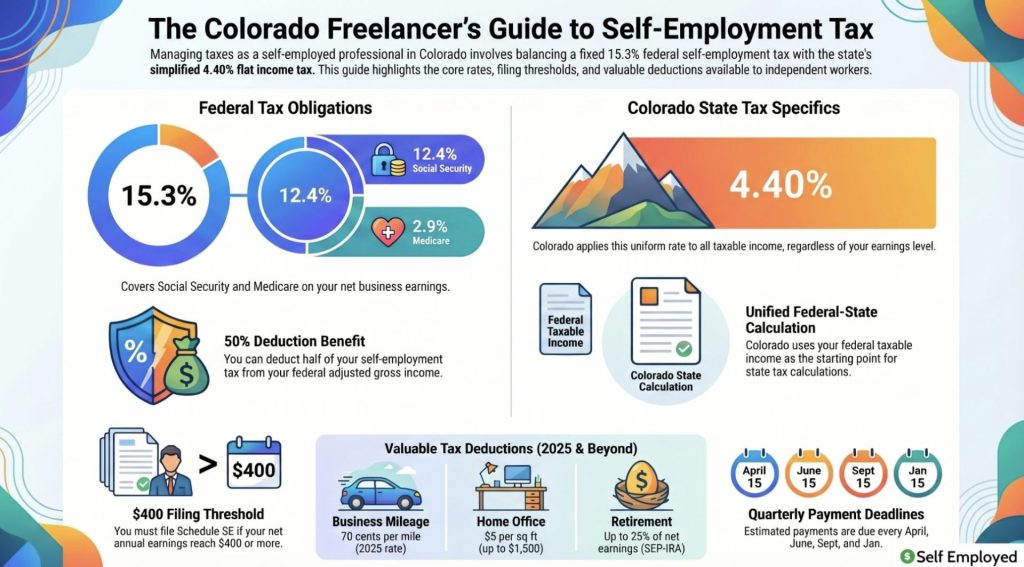
In Colorado, freelancers must contend with both federal income taxes and a flat state income tax rate of 4.4%. Without an employer acting as a tax collector, the responsibility to set aside money and pay the government on time falls entirely on you. Failing to do so triggers costly underpayment penalties from both the IRS and the Colorado Department of Revenue.
Many self-employed individuals make the mistake of waiting until April to calculate what they owe. This reactive approach often leads to severe cash flow crunches and unexpected fines. Fortunately, utilizing a Colorado paycheck estimator can change your financial strategy, helping you project earnings and remit the correct amounts throughout the year.
Why Traditional Paycheck Tools Fall Short for 1099 Workers
Standard payroll calculators found online are typically designed for traditional employees. They assume a steady salary, standard W-4 withholdings, and split FICA contributions where an employer pays half. For a freelancer, these standard calculators are practically useless and can lead to dangerous underestimations.
The Self-Employment Tax Factor
Freelancers must pay the full 15.3% Self-Employment Tax to cover Social Security and Medicare. Traditional paycheck calculators rarely account for this separate calculation correctly when applied to fluctuating contract income. Furthermore, independent contractors can deduct half of their self-employment tax when calculating adjusted gross income, a nuance standard payroll tools frequently ignore.
Variable Income Streams
Freelance income rarely arrives in neat, equal bi-weekly increments. Some months bring lucrative client projects, while others are remarkably lean. A proper income estimation tool tailored for self-employed professionals allows you to input variable monthly revenue, factoring in business expenses to arrive at a realistic net profit figure before calculating taxes.
How a Colorado Paycheck Estimator Helps Freelancers Avoid Penalties
The IRS and the State of Colorado operate on a "pay-as-you-earn" system. If you expect to owe more than $1,000 in federal taxes or $500 in state taxes when you file your annual return, you are legally required to make quarterly estimated tax payments. Missing these deadlines or paying too little results in statutory interest and penalties.
Here is how utilizing an accurate tax and income estimation tool protects your hard-earned money:

- Precise Quarterly Calculations: By inputting your year-to-date earnings and projecting future quarters, you can determine the exact dollar amount due by April 15, June 15, September 15, and January 15.
- Accounting for Colorado-Specific Deductions: A localized calculation tool factors in Colorado's specific tax code, including state-level deductions and the flat 4.4% income tax, preventing state-specific underpayment penalties.
- Eliminating End-of-Year Surprises: Knowing your exact tax liability month-to-month prevents the shock of a massive, unaffordable tax bill in the spring.
- Optimizing Deductible Expenses: Estimators allow you to subtract legitimate business expenses—like home office costs, software subscriptions, and equipment—so you never overpay or underpay based on gross revenue alone.
Step-by-Step Strategy to Bulletproof Your Freelance Finances
Calculating your taxes is only half the battle; building a disciplined routine ensures you actually have the cash available to pay them. Follow these steps alongside your estimation tool to stay completely penalty-free.
1. Separate Your Personal and Business Finances
Never mix your freelance revenue with your personal checking account. Open a dedicated business bank account. Every time a client pays an invoice, immediately transfer a designated percentage—typically 25% to 30% for federal, state, and self-employment taxes—into a separate tax savings sub-account.
2. Run Monthly Estimates
Your income will fluctuate, which means your tax liability changes too. Make it a habit to plug your numbers into your estimation software at the end of every month. If you land a massive new client, your estimated quarterly payment for the upcoming deadline needs to be adjusted upward immediately.
3. Mark the Quarterly Deadlines
IRS and Colorado quarterly estimated tax deadlines do not fall on neat three-month intervals. Program these dates into your digital calendar with two-week advance reminders:
- Q1 (January 1 – March 31): Due April 15
- Q2 (April 1 – May 31): Due June 15
- Q3 (June 1 – August 31): Due September 15
- Q4 (September 1 – December 31): Due January 15 of the following year
Common Freelancer Tax Mistakes to Avoid
Even with great tools, independent contractors sometimes fall into traps that trigger government notices. Keep these common pitfalls in mind:
- Ignoring Local Occupational Taxes: Some Colorado cities, such as Denver, levy a miniature Occupational Privilege Tax (OPT) for individuals working within city limits. Ensure your overall financial planning accounts for local levies, not just state and federal ones.
- Missing the Safe Harbor Rule: To completely avoid underpayment penalties, aim to pay at least 100% of your prior year's total tax liability (or 110% if your adjusted gross income exceeds $150,000) through quarterly installments, regardless of what you earn this year.
- Waiting Until the Last Minute to File: Electronic filing systems for the Colorado Department of Revenue can experience heavy traffic. Estimate and submit your payments well before the midnight deadlines.
Take Control of Your Independent Income Today
Freelancing in Colorado provides immense career satisfaction, but managing your own tax withholding is the price of admission. By ditching generic payroll calculators and adopting a workflow centered around accurate income and tax estimation, you protect your business from unnecessary penalties, interest charges, and financial stress. Treat your tax obligations like any other critical business expense, and enjoy the peace of mind that comes with being fully compliant.