Connecticut 10-Day Weather: Forecast & Planning Guide
Anyone who has spent time in Southern New England knows the old adage: if you don’t like the weather, wait five minutes. When checking a connecticut 10-day weather forecast, that volatility can make planning an outdoor wedding, a weekend on Long Island Sound, or a hike in the Litchfield Hills feel like a gamble. However, extended forecasts are not purely guesswork. By understanding how meteorologists construct multi-day models and recognizing the distinct geographic zones across the state, you can make confident decisions days before an event.
Understanding Connecticut's Three Distinct Microclimates
Despite being the third-smallest state by land area, Connecticut features surprisingly diverse terrain that creates stark microclimates. A single statewide forecast rarely tells the full story. When you look at an extended weather outlook, you must anchor your expectations to the specific region you plan to visit.
1. The Coastal Strip (Long Island Sound)
Towns along the I-95 corridor—including Stamford, Bridgeport, New Haven, and New London—are heavily influenced by Long Island Sound. In spring and early summer, the cold water acts as a natural air conditioner, often keeping coastal communities 5 to 10 degrees cooler than inland cities. During winter, the reverse occurs: maritime air often keeps temperatures just above freezing, turning what would be a heavy interior snowfall into cold, driving rain or sleet.
2. The Central River Valley
Stretching from Middletown through Hartford and up to the Massachusetts border, the Connecticut River Valley sits at lower elevations and tends to trap air. In July and August, this region frequently logs the highest temperatures and most oppressive humidity levels in the state. In winter, cold air can settle into the valley bottom overnight, creating sharp morning temperature inversions and patchy freezing fog.
3. The Western and Eastern Highlands
The Northwest Hills (including Litchfield and Norfolk) rise above 1,000 feet, catching storms moving in from the Great Lakes and Canada. This area regularly records the lowest overnight temperatures in the state and consistently leads Connecticut in annual snowfall. The Eastern Highlands (the "Quiet Corner") feature similar rolling topography, resulting in earlier autumn frosts and slower spring warm-ups than the nearby shoreline.
How Reliable Is a Connecticut 10-Day Weather Forecast?
Modern weather forecasting relies on global numerical models like the American GFS (Global Forecast System) and the European ECMWF (European Centre for Medium-Range Weather Forecasts). While satellite technology and supercomputing have advanced dramatically, atmosphere predictability degrades as time extends. Here is how you should evaluate each phase of a 10-day forecast:
- Days 1 to 3 (Near-term): High confidence. High-resolution models can predict precipitation timing down to two-hour windows, track frontal boundaries precisely, and estimate high and low temperatures within 2 to 3 degrees Fahrenheit.
- Days 4 to 7 (Medium-range): Moderate confidence. Models reliably identify broad weather patterns—such as the arrival of a significant cold front or a persistent heat ridge. However, exact rain start times and the precise rain/snow boundary line can still shift by 50 to 100 miles.
- Days 8 to 10 (Long-range): Trend indicators only. At this range, daily hourly breakdowns are statistical estimates rather than firm forecasts. Use Days 8 through 10 to understand overarching trends: will the pattern be unseasonably warm, unusually cold, active and stormy, or dry and calm?
Seasonal Patterns to Watch in Extended Outlooks

Connecticut experiences four distinct seasons, each shaped by competing air masses from the Gulf of Mexico, the Canadian Arctic, and the Atlantic Ocean. Reading a long-range forecast effectively means knowing what risks to look for depending on the month.
Winter: Nor'easters and the Rain/Snow Line
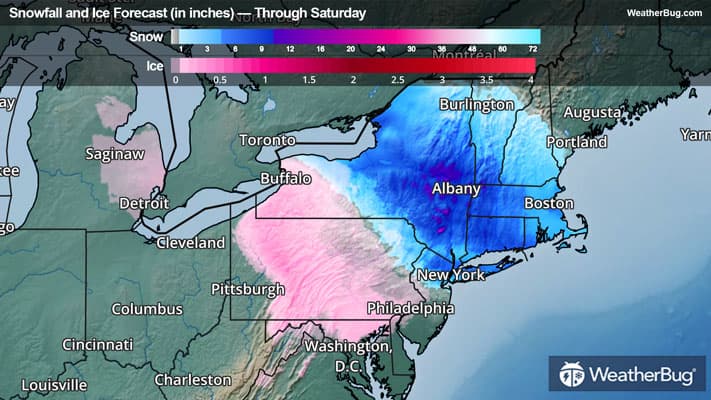
Between December and March, coastal storms known as Nor'easters pose the greatest forecast challenge. These systems draw moisture from the Atlantic while pulling sub-freezing air from Canada. In a 10-day window, a projected storm track shift of just 30 miles east or west can mean the difference between a foot of dry snow in Hartford and a dreary 38-degree rain shower in Norwalk.
Spring: Temperature Swings and Coastal Inversions
Spring in Connecticut is notoriously unpredictable. March and April forecasts often oscillate wildly between 65-degree sunny afternoons and sudden late-season snow flurries. Pay close attention to projected wind directions in the 10-day outlook: a prevailing south or southeasterly wind off the cold ocean water will keep the coastline blanketed in maritime fog, while northern Hartford County enjoys clear skies.
Summer: Convective Storms vs. Stable Heat
Summertime extended forecasts frequently show a standard icon of a sun behind a cloud with a lightning bolt day after day. In New England, summer rain rarely lasts all day; instead, heat and humidity build until afternoon pop-up thunderstorms form along the hills and track eastward. When assessing summer models, look at dew points: dew points above 65°F indicate high humidity and an elevated chance of localized severe downpours.
Fall: Crisp Air and Tropical Remnants
Autumn brings the most stable weather of the year to Connecticut, featuring crisp, sunny days and cool nights that fuel the world-renowned fall foliage season. However, late August through October also represents the peak of Atlantic hurricane season. Extended forecasts during this period must be watched for tropical systems tracking up the Eastern Seaboard, which can bring widespread flooding rains and high wind gusts.
Practical Tips for Planning Around a 10-Day Outlook
- Look at National Weather Service (NWS) Area Forecast Discussions: Skip the automated generic smartphone app icons and read the technical discussion written by local meteorologists. Connecticut is split between two offices: NWS New York (Upton) covers Fairfield, New Haven, Middlesex, and New London counties, while NWS Boston (Norton) covers Hartford, Tolland, Windham, and Litchfield counties.
- Track the Ensemble Means, Not Single Runs: Weather models run multiple times a day. If a Day 8 forecast shows a major blizzard on one run, wait to see if subsequent runs confirm it. When dozens of slight model variations (an "ensemble") agree on an outcome, forecast confidence rises significantly.
- Pack for Layers Regardless of Projections: Because maritime breezes can drop shoreline temperatures by 15 degrees in less than an hour, always keep a windbreaker or light sweater accessible during spring and summer outings.
By treating the back half of any extended forecast as a strategic guide rather than an absolute promise, you can plan outdoor recreation, travel, and seasonal events across Connecticut with realistic expectations and minimal disruption.