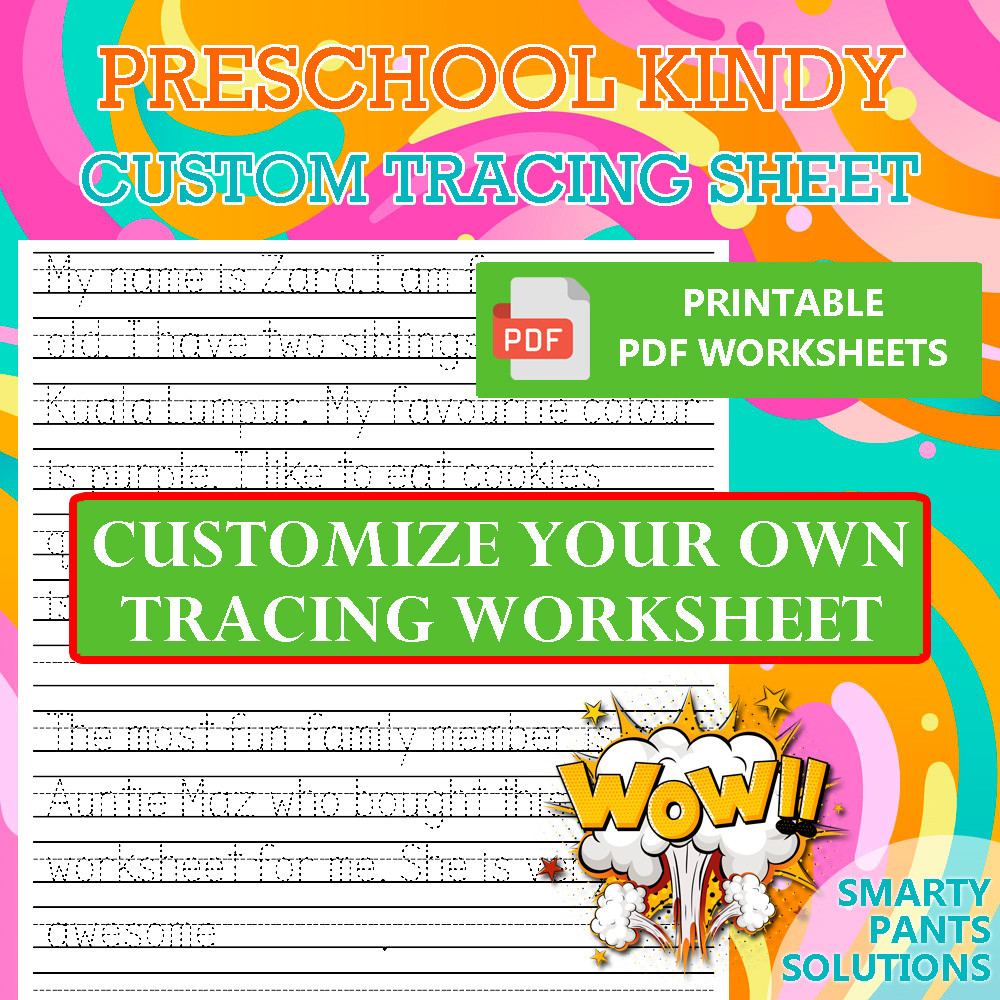
Create Free Custom Tracing Worksheets Fast
Teaching young children how to write can feel like an uphill battle when you rely entirely on generic workbooks. Standard activity books often move too fast, use unfamiliar vocabulary, or fail to target the specific letters and numbers a child struggles with most. This is where custom tracing worksheets change the game. By tailoring practice pages to a child's exact developmental stage, interests, and name, you can turn a frustrating drill into an engaging, confidence-boosting activity.

Whether you are a kindergarten teacher building a differentiated curriculum, a homeschooler looking for targeted spelling practice, or a parent wanting to help your preschooler master their grip, making your own printables gives you total control. In this guide, we will explore why personalized practice works, what tools you can use to generate these pages, and how to design effective layouts that keep kids engaged.
Why Personalization Matters in Early Handwriting
Children learn best when the subject matter is relevant and attainable. Generic workbooks are mass-produced for a broad audience, meaning they rarely address a specific child's bottlenecks. Personalized printables offer distinct cognitive and motor-skill advantages.
Targeting Specific Letter Struggles
Every child develops unique quirks in their handwriting. Some children consistently mirror-image the letter 'b' and 'd', while others struggle with the loops in 'g' and 'j'. Standard worksheets force kids to trace every letter equally. With customized pages, you can isolate the exact characters your child needs to repeat, creating a high-repetition drill sheet focused solely on problem areas.
Building Name Recognition and Ownership
A child's own name is usually the first word they want to read and write. Seeing their name at the top of a page fosters a sense of ownership and excitement. Creating name-tracing printables helps children master the sequence of letters unique to their identity, paving the way for broader literacy skills.
How to Create Custom Tracing Worksheets
You do not need to be a professional graphic designer to create clean, polished handwriting sheets. Several digital methods and tools allow you to generate custom tracing worksheets in minutes.
- Dedicated Worksheet Generators: Online tools built specifically for teachers and parents let you type in custom text, select a font style (like D'Nealian, Zaner-Bloser, or standard block print), and instantly export a PDF.
- Word Processing Software: Programs like Microsoft Word or Google Docs can work if you download specialized dotted-line fonts. You can adjust the font size to 72pt or larger, change the font color to a light gray for tracing, and add directional arrows.
- Design Platforms: Tools like Canva offer drag-and-drop elements, grid lines, and educational templates that make layout design simple and visually appealing.
Best Practices for Designing Effective Worksheets
Creating a worksheet that looks good is only half the battle. To ensure the child actually benefits from the exercise, keep these instructional design principles in mind.
Video: How to Make Name Tracing Sheets in Canva to Teach Your Child How to Write Their Name

Choose the Right Font Style
The font you choose dictates how the child learns muscle memory. Avoid overly stylized or decorative fonts. Stick to clean, elementary school-approved typography that features:
- Simple, straight vertical lines for letters like 'l', 't', and 'h'.
- Traditional single-floor or double-floor 'a' and 'g' variants that match what they see in their reading books.
- Clear starting dots or directional arrows to show the child where the pencil stroke begins.
Balance Tracing with Freehand Practice
A great worksheet does not rely solely on dotted lines from start to finish. Scaffold the learning process by structuring your rows logically:
- Row 1 (Guided Tracing): Full dotted lines with directional arrows and starting points.
- Row 2 (Fading Support): Dashed lines where every other letter is missing, requiring the child to bridge the gap.
- Row 3 (Independent Practice): A single starting dot or baseline guide, challenging the child to write the letter freehand.
Incorporate Visual Themes
Kids get bored easily. If you are practicing the letter 'M', include a small, black-and-white line drawing of a monkey or a mushroom at the top of the page. This serves a dual purpose: it reinforces phonetic associations and gives the child a coloring reward once the handwriting practice is complete.
Materials to Maximize Your Printables
Once you generate and print your custom tracing worksheets, you can maximize their utility with a few simple classroom hacks:
If you plan to reuse the worksheets multiple times, slide them into heavy-duty plastic dry-erase pockets or laminate them. Give the child a fine-tip dry-erase marker. This transforms a single-use printable into a reusable center activity, reduces paper waste, and lowers the pressure of making permanent mistakes.
For pencil grip development, ensure you are using standard primary pencils with soft, thick graphite (such as #2 soft lead) so the child does not have to press down too hard, which can lead to hand fatigue.
Conclusion
Customizing educational materials bridges the gap between a child's current ability and their learning potential. By designing custom tracing worksheets, you remove unnecessary friction, target exact motor skill roadblocks, and make handwriting practice personal and fun. Take ten minutes today to generate a targeted name or letter sheet, and watch how much more engaged your young learner becomes.