Create Your Emergency Fund Blueprint Today
Life is inherently unpredictable. A sudden transmission failure, an unexpected medical bill, or a sudden layoff can instantly disrupt your financial equilibrium. If you rely on credit cards or high-interest personal loans to handle these surprises, a single setback can turn into years of compounding debt. The most effective way to protect your financial future is to take proactive control: create your emergency fund blueprint today and construct a financial fortress that safeguards your household against life's inevitable storms.
An emergency fund is not an investment designed to make you wealthy. Instead, it is an insurance policy funded by cash, designed to keep you solvent. Below is a comprehensive, actionable guide to mapping out, funding, and managing your personal safety net from scratch.
What Qualifies as a Genuine Financial Emergency?
Before allocating a single dollar, you must clearly define what an emergency actually is. Without firm boundaries, an emergency fund easily morphs into a slush fund for spontaneous weekend trips, holiday shopping, or semi-annual insurance bills that should have been budgeted for in advance.
A true emergency meets three strict criteria:
- It is unexpected: You could not have planned for it on an ordinary calendar (e.g., an unexpected appliance breakdown, sudden illness).
- It is necessary: It directly affects your health, your ability to earn an income, or your basic shelter (e.g., urgent dental work or a car repair required to commute to your job).
- It is urgent: It cannot be delayed until next month's paycheck without causing severe financial or physical harm.
Routine car maintenance, annual property taxes, and predictable holiday gifts are expenses, not emergencies. Treating them as separate line items in your monthly budget keeps your emergency reserves intact for genuine crises.
Why You Must Create Your Emergency Fund Blueprint Today
Procrastination is the greatest threat to financial security. Many people delay saving because they believe they cannot save "enough" to make a difference. However, starting with an intentional framework immediately shifts your financial psychology from reactive panic to strategic confidence.
When an unexpected expense hits, individuals without cash reserves face severe friction: charging purchases to credit cards with APRs exceeding 20%, borrowing against retirement accounts, or leaning on family. Having an established blueprint breaks this debt cycle. It preserves your long-term investments by ensuring you never have to liquidate stocks during a market downturn just to cover a short-term bill.
Step 1: Calculate Your Baseline Survival Number
A common rule of thumb suggests saving three to six months of expenses. However, blindly guessing this number often leads to setting an unrealistic goal that causes frustration. To determine your real target, calculate your essential monthly survival number rather than your current monthly spending.
Differentiating Needs from Discretionary Wants
Review your bank and credit card statements from the past 90 days. Strip away all discretionary lifestyle spending and tally only what you must pay to survive if all income ceased:
- Housing (rent or mortgage payment, property taxes, HOA fees)
- Basic utilities (water, electricity, heating, essential internet)
- Core groceries (excluding dining out, delivery, and premium convenience items)
- Critical transportation (fuel, public transit passes, auto insurance, minimum car payment)
- Healthcare premiums and vital prescriptions
- Minimum debt obligations (student loans, credit card minimums)
If your total monthly take-home spending is $5,000, your essential baseline expenses might only be $3,200. This smaller, focused figure represents your actual monthly benchmark.
Determining Your Time Horizon: 3, 6, or 9 Months?
Not everyone needs the exact same duration of coverage. Tailor your multiplier to your personal situation:
- 3 Months: Best for dual-income households with stable salaried positions, low debt, and easily marketable skills.
- 6 Months: Recommended for single-earner households, families with dependents, or workers in moderately volatile industries.
- 9 to 12 Months: Ideal for freelancers, business owners, commission-only sales professionals, or individuals working in niche industries where hiring cycles are extended.
Step 2: Build Milestone Goals to Maintain Momentum
Staring at a target like $18,000 can feel demoralizing if you currently have $200 in savings. To prevent burnout, break your blueprint down into staged milestones.
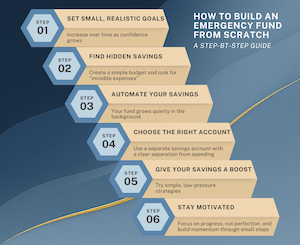
Milestone 1: The Starter Fund ($1,000 to $1,500)
Your first objective is speed. Amass $1,000 to $1,500 as quickly as possible. This micro-buffer catches minor shocks—such as a blown tire or a minor plumbing leak—without forcing you to take on new high-interest debt while you pay down existing balances.
Milestone 2: One Full Month of Basic Expenses
Reaching this stage gives you breathing room. If an illness knocks you out of work or a client invoice is delayed, your household can operate normally for 30 days without external help.
Milestone 3: The Full Safety Reserve (3 to 6 Months)
Once you eliminate high-interest debt, shift your aggressive cash-accumulation strategy toward completing your multi-month reserve. At this level, you can weather a major economic downturn or extended job transition with minimal lifestyle panic.
Step 3: Choose the Right Home for Your Reserves
Where you store your emergency cash is just as important as how much you save. Your priority must always be capital preservation and liquidity, not aggressive growth.
- High-Yield Savings Accounts (HYSAs): An HYSA at an FDIC-insured online bank is the gold standard for emergency funds. These accounts pay competitive annual percentage yields (APYs) that help offset inflation, while keeping your cash completely liquid and free from market risk.
- Money Market Accounts (MMAs): Similar to HYSAs, MMAs offer competitive yields and often include a debit card or check-writing access for rapid deployment during an immediate crisis.
- What to Avoid: Never store your core emergency fund in the stock market, speculative cryptocurrencies, physical cash hidden in your home, or long-term Certificates of Deposit (CDs) that charge early withdrawal penalties. A stock drop often coincides with broader economic contractions and layoffs—the exact moment you might need that money most.
Step 4: Automate and Accelerate Your Savings Pipeline
Willpower is a finite resource. If you wait to save whatever money is left at the end of the month, you will rarely find any remaining. Systematic automation removes emotion and discipline from the equation.
Set up a split direct deposit through your employer's payroll system, sending a fixed percentage or specific dollar amount directly into your designated high-yield emergency account. Because the funds bypass your everyday checking account, you eliminate the temptation to spend them.
To accelerate your timeline, funnel asymmetrical cash windfalls straight to your reserve:
- Annual tax refunds
- Work performance bonuses
- Cash gifts
- Proceeds from selling unused household items
Establishing Rules for Replenishment
An emergency fund is built to be used. When a legitimate crisis happens and you draw down your account, do not view it as a failure—celebrate that your system worked exactly as intended. You handled an emergency without taking on debt.
However, your financial posture must adjust immediately following a withdrawal. Pause extra investing contributions and cut discretionary spending temporarily. Direct all surplus cash flow toward restoring the fund back to its baseline target before returning to long-term wealth-building goals.
Take the First Step
Financial peace of mind is not reserved exclusively for high earners; it belongs to those who plan intentionally for life's uncertainties. Calculate your baseline monthly number, open a dedicated high-yield savings account, and automate your very first transfer today. Each dollar you set aside moves you one step closer to complete financial independence.