DeepL French to English: How Accurate Is It?
When navigating cross-border business, academic research, or everyday conversations, finding a reliable translator is essential. For years, Google Translate dominated the market by default, but DeepL has earned a reputation for producing remarkably natural prose. If you regularly work with deepl french to english translations, you know that capturing the subtle rhythm, idioms, and grammatical nuances of the French language is no easy feat. This guide breaks down how DeepL handles French-to-English translation, where it outperforms competitors, and how you can get the cleanest results possible.

Why DeepL French to English Excels at Nuance
Machine translation has evolved past rigid, word-for-word substitutions. DeepL’s underlying architecture relies on advanced deep neural networks trained on vast repositories of human-translated material, originally leveraged from Linguee's extensive bilingual database. This foundational data gives it an intuitive grasp of how humans actually speak and write.
French is known for its syntactic complexity: flexible word orders, subtle subjunctive moods, and frequent use of figurative speech. DeepL reads entire sentences and surrounding paragraphs to determine context, rather than isolating individual words. Consequently, it routinely avoids the stilted, robotic phrasing that has historically plagued automated language tools.
Handling "Faux Amis" and False Cognates
One of the biggest hurdles in French-to-English translation is the prevalence of faux amis (false friends)—words that look identical or similar in both languages but carry completely different meanings. A mediocre translation tool often trips over these:
- Actuellement: Often misconstrued by basic translators as "actually," DeepL correctly renders this as "currently" or "at present."
- Assister à: Rather than assuming it means "to assist," DeepL recognizes the prepositional context and translates it as "to attend."
- Éventuellement: Instead of defaulting to "eventually," DeepL translates it accurately based on context as "possibly" or "potentially."
DeepL vs. Google Translate: A Quick Comparison
While both platforms have made massive strides using neural machine translation (NMT), they serve slightly different strengths. Below is an overview of how they compare when translating French into English:
- Natural Flow: DeepL consistently generates English phrasing that sounds idiomatic and native. Google Translate is accurate on facts, but its output can sometimes feel syntactically stiff.
- Register & Tone: DeepL Pro offers a built-in formality toggle, letting you switch smoothly between formal and informal voice—a vital feature when navigating French polite conventions (vouvoiement vs. tutoiement).
- Language Support: Google Translate supports well over 100 languages, whereas DeepL focuses on roughly 30. However, for French and English—two of DeepL's core languages—the depth of training is exceptional.
- User Interface Adjustments: DeepL allows you to click any word in the translated output to see instant synonyms and alternative sentence structures. Choosing an alternative automatically adapts the surrounding syntax.
Key Features to Maximize Your Translation Quality
To get the most out of translating French to English using DeepL, you should leverage several built-in features that elevate it beyond a simple text box.
1. Interactive Synonym Selection
If a translated sentence feels slightly off for your specific audience, you do not have to rewrite it manually. Clicking on any word in DeepL’s English output produces a drop-down list of contextual synonyms. Selecting one triggers the neural network to rewrite the rest of the sentence around that choice, ensuring subject-verb agreement and natural preposition usage remain intact.
2. The Glossary Tool
Technical manuals, legal contracts, and corporate communications often require strict adherence to specific terminology. DeepL’s Glossary feature allows you to define explicit translation rules. For example, if you need le conseil d’administration translated strictly as "the Supervisory Board" instead of "the Board of Directors," you can lock that rule in so the tool never deviates.
3. Full Document Translation
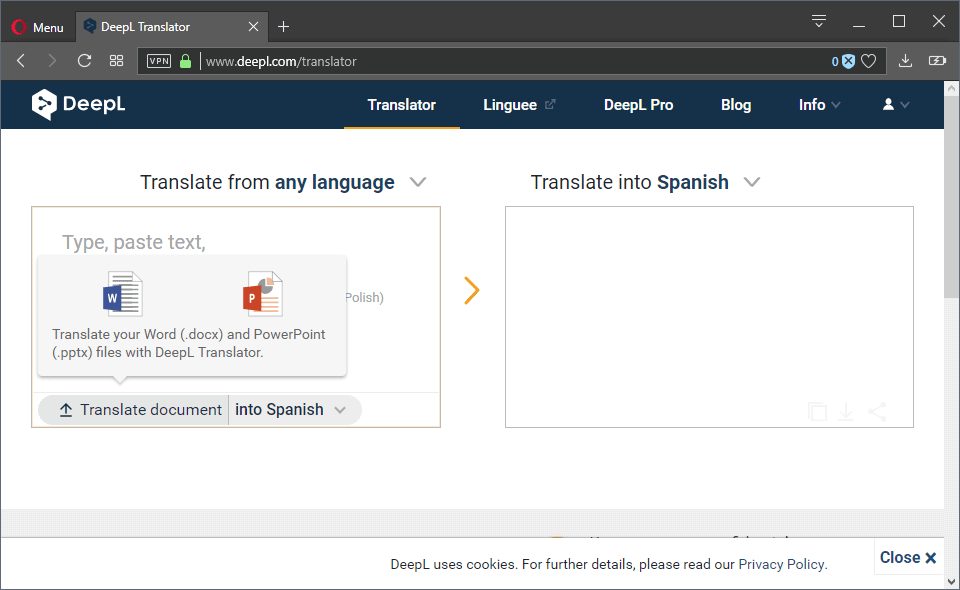
Rather than copying and pasting fragments, you can upload entire files (.docx, .pdf, .pptx, or text files). DeepL preserves your formatting, tables, font hierarchies, and image placements while converting the underlying French content into clean English, saving hours of manual desktop publishing.
Where DeepL Still Struggles
Despite its technical prowess, no AI translator is infallible. Being aware of DeepL's limitations prevents embarrassing mistakes before you hit send or publish.
Hyper-Local Slang and Verlan
French colloquial speech relies heavily on argot (slang) and verlan (inverting syllables, such as chelou for louche, or meuf for femme). DeepL handles mainstream slang reasonably well, but contemporary internet culture, regional dialects (such as Quebecois French idioms like attache ta tuque), or rapid-fire youth culture can produce literal or confusing English translations.
Ambiguous Pronoun References
In French, all nouns possess grammatical gender (masculine or feminine), which dictates the pronoun used (il or elle). When translating into English—which primarily uses "it" for objects and "he/she" for people—DeepL must infer whether a noun is an inanimate object or an individual. In passages with vague context, it may occasionally assign human gender pronouns to inanimate objects, requiring a quick human review.
Practical Tips for Best Results
- Clean up source formatting: Poorly formatted source text with broken line returns or unusual punctuation can disrupt DeepL's context detection. Ensure the French text is formatted in complete sentences.
- Provide surrounding context: Avoid translating isolated fragments or bullet points devoid of context. Pasting an entire paragraph allows the engine to parse narrative tone and gender references accurately.
- Proofread names and acronyms: French corporate structures (e.g., SARL, SAS) or institutional acronyms (e.g., SNCF, CPAM) may occasionally be over-translated or left unexplained. Decide ahead of time whether to preserve them or supply an explanatory English equivalent.
The Final Verdict
For individuals, content creators, and international professionals, DeepL represents the gold standard in French to English automated translation. By combining deep contextual comprehension with flexible customization tools like glossaries and interactive rewrites, it produces translations that read naturally and retain the intent of the original French text. While final human proofreading remains essential for high-stakes legal or creative publishing, DeepL cuts the heavy lifting down to a fraction of the time.