Define Net Capital Outflow: Meaning, Formula & Role
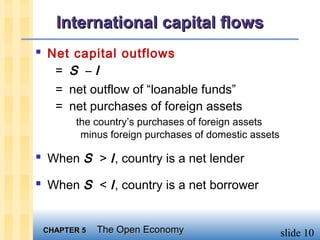
In an interconnected global economy, capital flows across national borders just as freely as manufactured goods, digital services, and raw commodities. When international analysts assess a country's financial footing, they frequently look at how much capital is leaving the nation compared to how much is entering it. To understand this dynamic, economists define net capital outflow (NCO)—sometimes referred to as net foreign investment—as the total value of foreign assets purchased by domestic residents minus the total value of domestic assets acquired by foreign investors.
Understanding net capital outflow provides critical insights into a country's currency stability, its domestic savings rates, and its broad economic relationship with the rest of the world. Far from being a mere accounting entry, NCO reflects deep-seated patterns in how a nation saves, invests, and trades across borders.
The Mathematical Formula for Net Capital Outflow
At its core, net capital outflow tracks cross-border investment flows during a specific period, usually a quarter or a fiscal year. The fundamental formula is straightforward:
Net Capital Outflow (NCO) = Domestic Purchases of Foreign Assets - Foreign Purchases of Domestic Assets
Depending on the relative sizes of these two flows, a country will register either positive or negative net capital outflow:
- Positive Net Capital Outflow (NCO > 0): Domestic residents are buying more foreign assets than foreigners are buying domestic assets. Capital is actively leaving the country on a net basis to seek returns elsewhere.
- Negative Net Capital Outflow / Net Capital Inflow (NCO < 0): Foreign investors are accumulating more domestic assets than domestic residents are acquiring abroad. The nation is drawing in net capital from international sources.
Forms of Cross-Border Capital: FDI vs. Portfolio Investment
When calculating net capital outflow, economists group cross-border transactions into two broad categories: Foreign Direct Investment and Foreign Portfolio Investment. Both directly influence the total figure, but they operate on vastly different time horizons and reflect distinct economic motives.
1. Foreign Direct Investment (FDI)
Foreign direct investment involves establishing lasting enterprise or controlling physical operations abroad. Examples include an American automaker building a manufacturing facility in Mexico or a German engineering firm acquiring a controlling interest in a robotics firm in Japan. FDI represents an active, long-term commitment that typically brings technical expertise, corporate governance, and physical capital along with financing. Because exiting an FDI holding takes significant time and liquidity, these flows tend to be more stable.
2. Foreign Portfolio Investment (FPI)
Foreign portfolio investment covers purely financial assets where the buyer acquires no direct operational control over the underlying entity. Common examples include a domestic mutual fund buying shares of a foreign corporation, or a retail investor purchasing foreign government debt securities. Unlike FDI, portfolio capital is highly liquid; it can flow into an economy rapidly during boom periods and flee overnight at the first sign of macroeconomic instability.
How Economists Define Net Capital Outflow and Its Key Drivers
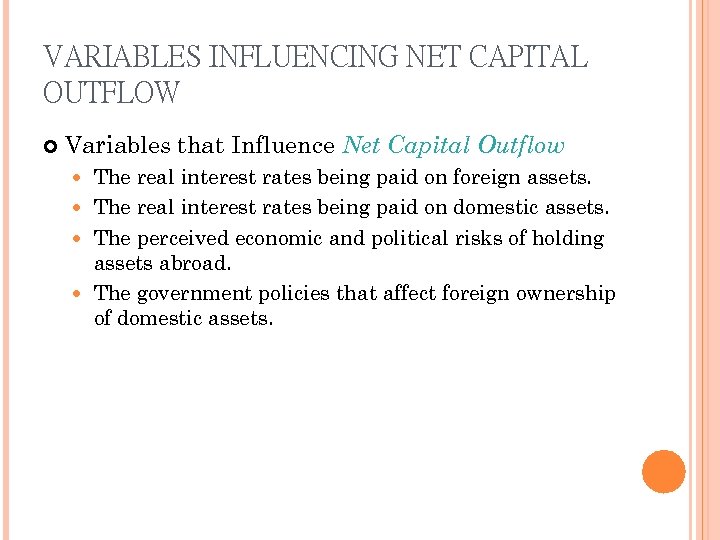
Capital is fundamentally restless—it perpetually migrates toward markets that offer the most attractive balance of risk and reward. Several interrelated economic variables determine the magnitude and direction of a country's net capital outflow.
Real Interest Rates
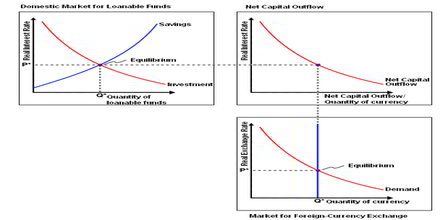
One of the strongest short-term drivers of NCO is the real interest rate differential between countries. If sovereign bonds in the United States offer a 5% real return while comparable debt in Europe yields 2%, global capital naturally converges on dollar-denominated assets. This dynamic increases foreign purchases of domestic assets in the higher-yielding country, driving its net capital outflow down (or pulling it deeper into negative territory).
Economic and Political Risk
Investors do not evaluate return in a vacuum; they weigh it against potential losses. Countries characterized by political volatility, expropriation risks, high inflation, or unstable legal frameworks often suffer from elevated capital flight. Domestic investors prefer to park their savings in stable overseas havens, while foreign investors avoid entering the market. This scenario sharply elevates net capital outflow, occasionally causing rapid depreciation of the local currency.
Exchange Rate Expectations

Anticipated currency movements play a decisive role in cross-border capital allocations. If an asset pays an attractive nominal yield abroad, but the host country's currency is projected to depreciate heavily against the investor's home currency, the actual return could turn negative once converted. Investors constantly evaluate whether expected currency appreciation or depreciation will enhance or erode their yield.
National Savings and Investment Balances
Over the medium to long term, net capital outflow is governed by national macroeconomic accounting. In open-economy macroeconomics, national saving ($S$) is divided between domestic investment ($I$) and net capital outflow ($NCO$):
S = I + NCO
When a country's domestic savings exceed its internal investment opportunities, surplus funds flow abroad, generating a positive NCO. Conversely, when domestic investment demand outpaces domestic savings, the country must attract foreign capital, leading to a negative NCO.
The Accounting Identity: Net Capital Outflow Equals Net Exports
One of the most essential concepts in international finance is the macroeconomic identity connecting net capital outflow directly to the trade balance (net exports, or $NX$):
NCO = NX
Every transaction recorded in international commerce has an equal and opposite entry across the balance of payments. If a nation exports more goods and services than it imports ($NX > 0$), it accumulates foreign currency or claims on foreign entities in exchange for those goods. That surplus foreign currency must be invested in foreign assets—such as foreign bank accounts, bonds, or stocks—producing a corresponding positive net capital outflow ($NCO > 0$).
Conversely, a country running a persistent trade deficit ($NX < 0$) is importing more goods than it sells. To finance this shortfall, it must sell domestic assets (stocks, real estate, treasury bills) to foreigners. Consequently, its foreign liabilities increase relative to its foreign assets, producing a net capital inflow ($NCO < 0$).
Real-World Context: Why Net Capital Outflow Matters
Neither a positive nor a negative NCO is inherently good or bad; its desirability depends on the structural context of the economy in question.
The United States: Structural Capital Inflows
For decades, the United States has operated with a negative net capital outflow (a net capital inflow). Because the U.S. dollar serves as the primary global reserve currency, foreign central banks, sovereign wealth funds, and private investors consistently demand dollar-denominated assets like U.S. Treasuries. This foreign demand keeps domestic borrowing costs relatively low, allowing the U.S. economy to invest at levels far higher than its modest domestic private savings rate would otherwise permit. The flip side of this dynamic is an enduring, persistent trade deficit.
Japan and Germany: Structural Capital Outflows
In contrast, economies like Japan and Germany frequently maintain positive net capital outflows. Both nations have high domestic savings rates, mature domestic infrastructures, and aging demographics, which constrain internal investment opportunities. As a result, German and Japanese institutional investors channel massive amounts of excess capital into high-growth emerging markets and U.S. debt markets, generating continuous trade surpluses that counterbalance these financial outflows.
Conclusion: The Bigger Picture
To define net capital outflow is to examine how a nation's wealth navigates the world financial system. It bridges the gap between everyday physical trade and complex financial market movements. Whether a nation is expanding its global asset footprint through positive NCO or borrowing international savings via negative NCO, monitoring capital flows remains essential for evaluating currency trajectories, interest rate trends, and long-term economic resilience.