Dept of Sanitation Salary: What Workers Make in 2024
Understanding the Dept of Sanitation Salary Structure

Working for the Department of Sanitation is often considered one of the most stable and sought-after civil service careers. Beyond the job security and pension benefits, applicants are naturally drawn to the profession because of the competitive dept of sanitation salary potential. While starting pay can seem modest compared to private-sector jobs requiring similar physical labor, structured pay increases, hefty overtime opportunities, and unmatched benefits make it a lucrative long-term career.
In major metropolitan areas—with New York City's Department of Sanitation (DSNY) being the most prominent example—compensation packages are governed by strict union contracts. This means that raises, step increases, and holiday pay are entirely transparent and predictable. If you are considering applying for a sanitation worker position, understanding how this compensation structure evolves from day one to retirement is essential.
Starting Pay vs. Top-Scale Earnings
The journey of a sanitation worker's income is defined by a gradual step-progression system. In municipal sanitation departments, new hires rarely start at the maximum pay rate. Instead, employees move through a series of pay steps over several years until they reach top scale.
The NYC DSNY Pay Progression Model
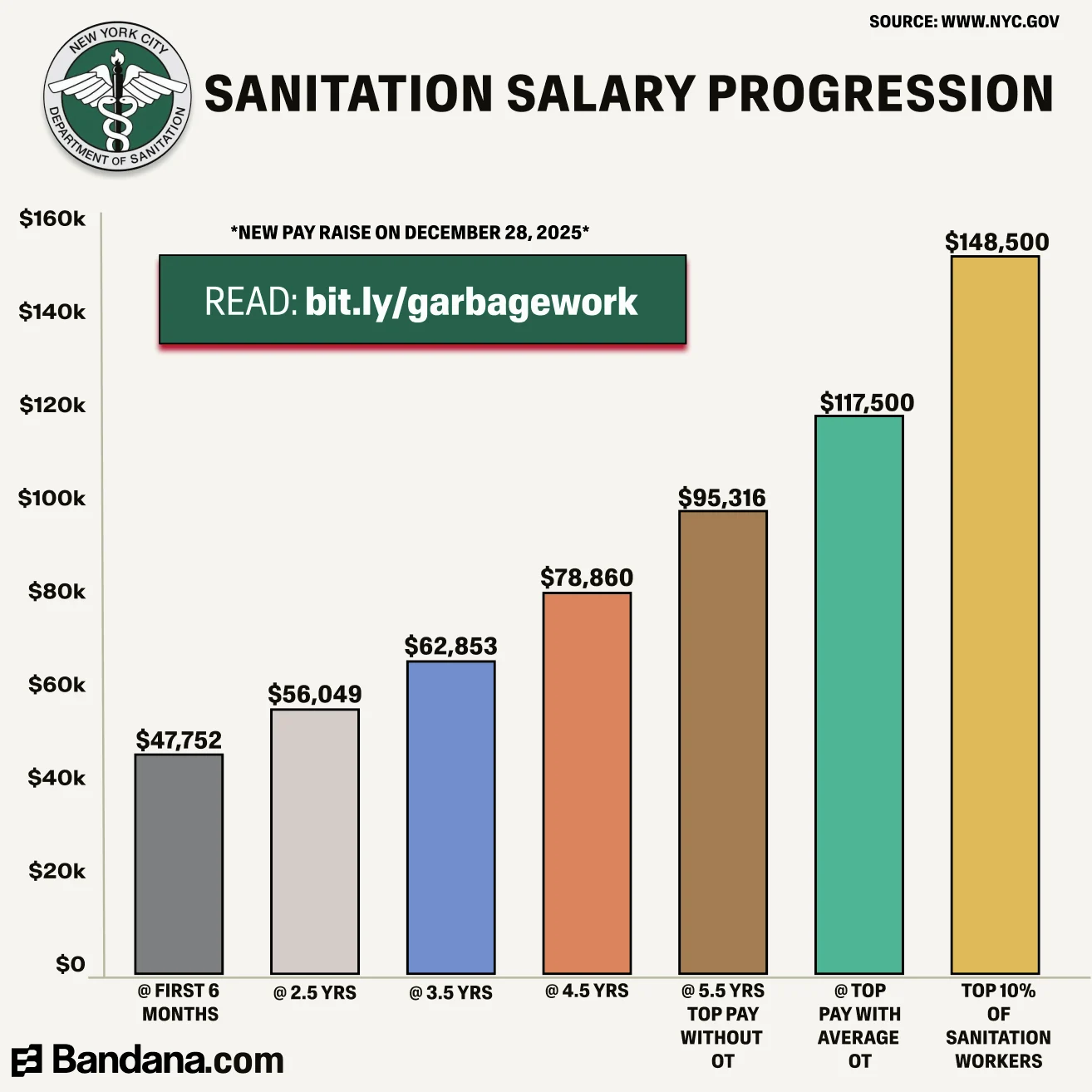
Taking New York City as the benchmark for municipal sanitation compensation, the pay scale illustrates significant growth from the first day on the job to five and a half years of service:
- Starting Salary (Hired after recent contract updates): New sanitation workers typically start at a base entry-level salary of around $40,000 to $45,000 per year. While this is lower than the historical starting pay, municipal contracts often include retroactive or escalating raises.
- Step Increases: Employees advance through multiple steps roughly every six months to a year. With each step, the base salary increases significantly.
- Top-Scale Salary: After completing five and a half years of continuous service, a sanitation worker reaches top-scale base pay. This base rate frequently exceeds $85,000 to $90,000 per year, not including longevity bonuses, uniform allowances, or holiday pay.
How Overtime Boosts Annual Income
When evaluating a dept of sanitation salary, looking only at the base pay paints an incomplete picture. Sanitation departments operate 24 hours a day, 365 days a year, regardless of weather conditions. This operational reality creates massive opportunities for overtime earnings, particularly during winter snowstorms and seasonal demand spikes.
During major snow removal operations, sanitation workers often log double shifts, working around the clock to clear city streets. Overtime is typically paid at an elite time-and-a-half rate, and emergency double-time provisions can apply depending on the specific union contract. It is common for experienced sanitation workers to add $10,000 to $30,000 or more to their annual earnings through overtime alone, pushing total take-home pay well into the six-figure range.
Additional Compensation and Perks

Beyond base wages and overtime, a sanitation career comes with a suite of financial incentives that enhance the total compensation package:
- Night Differential: Workers assigned to evening or overnight shifts receive a percentage bump in their hourly pay.
- Uniform Allowance: Annual stipends are provided to help cover the cost of maintaining and replacing heavy-duty uniforms and specialized gear.
- Holiday Pay: Working on designated public holidays yields premium holiday pay rates or compensatory time off.
- Longevity Pay: After a specific number of years on the job (typically 5, 10, 15, and 20 years), workers receive cumulative longevity bonuses added directly to their base salary.
Comprehensive Benefits and Retirement Plans
The true value of working for a municipal sanitation department extends far beyond the paycheck. The comprehensive benefits package often justifies taking a lower starting salary compared to the private sector.
Health Insurance and Paid Time Off
Sanitation workers generally receive robust health, dental, and vision insurance packages, often with little to no employee-contributed monthly premiums. Additionally, workers enjoy generous paid time off, including sick leave, personal days, and escalating vacation days based on years of service.
The Civil Service Pension
Perhaps the most attractive component of a sanitation career is the defined-benefit pension plan. After 20 or 25 years of service (depending on the specific tier and municipal guidelines), workers can retire with a guaranteed lifetime pension—often calculated as a percentage of their final average salary. This provides financial security that few private-sector waste management jobs can match.
How to Qualify and Maximize Your Earnings
Securing a position with a major department of sanitation requires patience and preparation. Most municipal departments fill roles through competitive civil service exams, which are only offered periodically. Candidates must pass a written test, a physical agility test, and a rigorous background check, which includes drug screening and a clean driving record (usually requiring a Commercial Driver's License, or CDL).
Once hired, maximizing your dept of sanitation salary comes down to maintaining a strong attendance record, volunteering for overtime shifts during peak seasons, and pursuing promotional opportunities. Workers can eventually test for supervisory roles such as supervisor, general superintendent, or district superintendent, which command significantly higher base salaries and open the door to advanced administrative responsibilities.