Diver Welder Salary: How Much Do Underwater Welders Make?
Underwater welding is often romanticized as a glamorous, high-paying adventure. While the compensation can indeed be extraordinary, the reality involves grueling physical labor, freezing water, hazardous conditions, and extensive specialized training. If you are considering entering this niche field, understanding the true diver welder salary potential is essential before investing time and money into commercial diving school.

In this guide, we will break down average earnings, the specific factors that influence pay, and what you can expect financially as you progress through your career.
Average Diver Welder Salary Expectations
Pinpointing an exact diver welder salary can be challenging because pay is rarely structured like a standard 9-to-5 office job. Instead of a flat annual salary, commercial divers are frequently paid hourly, by the project, or receive day rates with heavy overtime incentives.
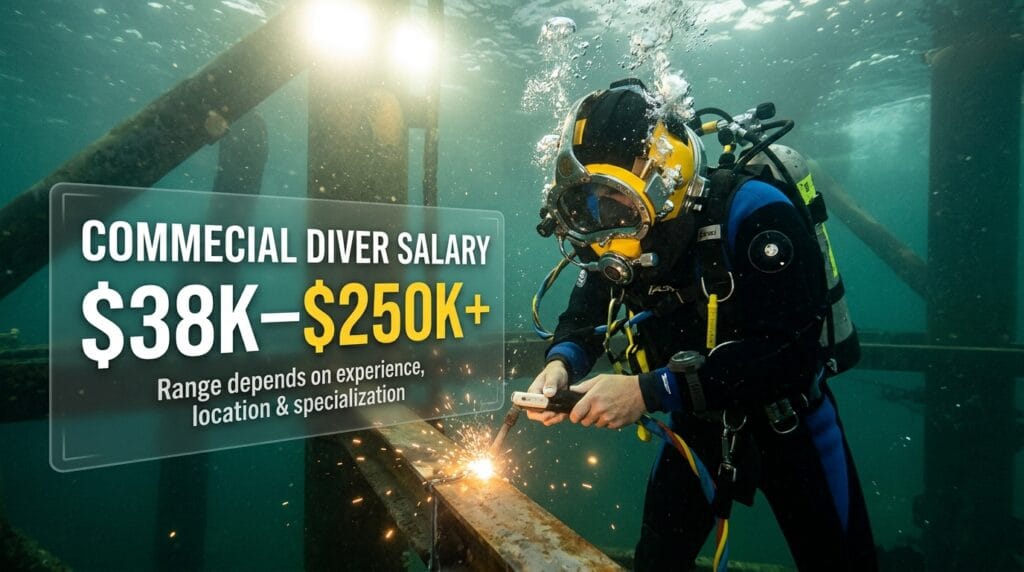
On average, entry-level commercial divers in the United States make between $50,000 and $60,000 per year. However, as divers gain experience, acquire advanced certifications, and transition into specialized underwater welding, earnings increase significantly. Experienced diver welders typically earn between $80,000 and $120,000 annually.
At the elite end of the spectrum—such as saturation divers working on deep offshore oil rigs—salaries can easily exceed $150,000 to $200,000 per year. However, these positions require years of experience and carry the highest levels of physical and psychological stress.
Key Factors That Influence Underwater Welding Pay
No two diver welder paychecks are alike. Several critical variables determine how much money you take home at the end of a project.
1. Depth and Diving Method
The depth at which you work is one of the biggest drivers of your paycheck. Diving is generally split into two categories:
- Inshore Diving: Working in harbors, rivers, bridges, and dams at shallower depths. Inshore jobs tend to be steadier and closer to home, but the pay is lower, typically ranging from $50,000 to $75,000 annually.
- Offshore Diving: Working in the open ocean on oil platforms, pipelines, and wind farms. Offshore jobs pay substantially more due to the danger and isolation, with experienced hands making well into the six figures.
Furthermore, saturation diving—where divers live in pressurized chambers for weeks at a time to work at extreme depths—commands the highest rates in the industry, often paying thousands of dollars per day worked.
2. Certifications and Skill Set
Video: Underwater Welding Salary: Real Pay, Offshore vs Onshore, And How People Hit $300K #welding #welder

An underwater welder is, first and foremost, a certified commercial diver, and secondarily a skilled welder. To command top dollar, you must hold multiple credentials:
- Commercial diving certification (from an accredited school like DCI, Diver's Institute of Technology, or similar).
- Surface-supplied air and mixed-gas diving certifications.
- AWS (American Welding Society) underwater wet and dry welding certifications.
- Medical clearances, First Aid, CPR, and chamber operator tickets.
The more versatile your skill set, the more valuable you are to marine construction companies, translating directly to a higher diver welder salary.
3. Location and Industry Demand
Geographic location dictates where the jobs are and how much they pay. Regions with heavy maritime commerce, offshore oil extraction, or bridge infrastructure projects offer the most employment opportunities. In the U.S., the Gulf of Mexico (Texas and Louisiana) and the Pacific Northwest are major hubs for commercial diving. Globally, regions with active North Sea oil and gas operations or Gulf Coast energy sectors pay top-tier rates.
Inshore vs. Offshore Earnings Breakdown
When evaluating career paths, the choice between inshore and offshore work heavily impacts your lifestyle and income.
- Inshore Diver Welders: These professionals usually work standard 40-hour weeks, sleep in their own beds, and handle tasks like ship husbandry, infrastructure inspection, and harbor maintenance. The pay is more modest, but the work-life balance is far superior.
- Offshore Diver Welders: These workers operate on rotation schedules—often working 28 days on and 28 days off, or similar shifts. While on the rig, they work grueling 12-hour shifts daily. The compensation reflects this sacrifice, including hazard pay, depth bonuses, and overtime rates.
Additional Benefits and Hidden Costs
When calculating a diver welder salary, it is important to look beyond the base figures. Many offshore contracts include per diems, travel allowances, and hazard bonuses.
At the same time, professionals must factor in hidden costs. Specialized gear, ongoing certification renewals, and potential gaps between contracts mean that managing your finances prudently is a necessity in this industry. Furthermore, the physical toll can lead to early retirement due to occupational hazards like decompression sickness or musculoskeletal strain, making long-term financial planning crucial.
Is Underwater Welding Worth the Pay?
The allure of a high diver welder salary draws many applicants, but the attrition rate in commercial diving school is notoriously high. The job requires immense mental toughness, technical precision in zero-visibility water, and comfort with claustrophobic and dangerous environments.
If you genuinely love diving, possess strong mechanical and welding aptitude, and are willing to pay your dues working up from tender to inshore diver and finally to deep-sea specialist, underwater welding can be a lucrative and intensely rewarding career.