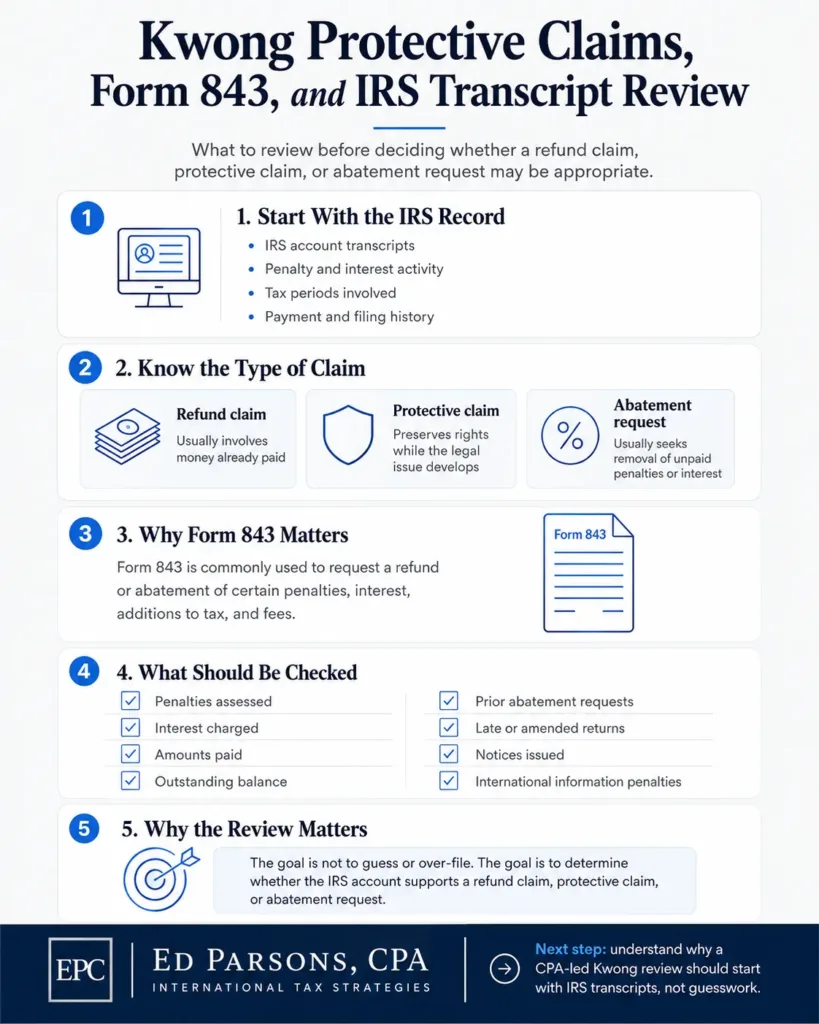
Don't Let IRS 843 Deadlines Catch You Off Guard
When dealing with the Internal Revenue Service, few administrative remedies are as valuable—or as frequently misunderstood—as IRS Form 843 (Claim for Refund and Request for Abatement). Whether you were hit with a substantial failure-to-pay penalty due to a family emergency or accrued erroneous interest caused by an administrative delay inside the IRS, Form 843 is your primary vehicle to reclaim those funds. However, don't let IRS 843 deadlines catch you off guard: the statutory clocks governing refund claims are rigid, strictly enforced by federal law, and unforgiving if missed.

Unlike standard tax deductions or discretionary hardship extensions, refund and abatement deadlines under the Internal Revenue Code (IRC) represent legal jurisdictional limits. If you file even one day late, the IRS lacks the statutory authority to issue your refund, no matter how compelling your underlying defense might be. Understanding how Form 843 works, when it applies, and the specific timelines that govern it is essential for protecting your financial rights.
Understanding the Scope of IRS Form 843
Before tracking calendar dates, it is critical to confirm whether Form 843 is actually the form you need. Taxpayers often mistakenly file Form 843 to claim refunds on personal income taxes (Form 1040) or corporate income taxes (Form 1120). That is an automatic rejection.
For standard income tax adjustments, you must file an amended return (such as Form 1040-X or 1120-X). Form 843 is reserved for very specific scenarios, including:
- Penalty Abatements: Requesting a refund or abatement of penalties assessed for failure to file, failure to pay, or failure to deposit (often under "Reasonable Cause" or the "First-Time Penalty Abatement" policy).
- Interest Abatement: Seeking relief from accrued interest caused by unreasonable IRS delays or administrative errors in performing ministerial or managerial acts (IRC § 6404(e)).
- Erroneous Written Advice: Erroneous written guidance provided directly by an IRS employee (IRC § 6404(f)).
- Non-Income Tax Refunds: Certain employment, gift, estate, or excise taxes when an amended return form is not specifically designated.
Don't Let IRS 843 Deadlines Catch You Off Guard: Key Timelines
The core time limits for filing Form 843 are established by IRC § 6511. This statute governs the window within which any formal claim for credit or refund must be filed. If you are seeking a refund of penalties or interest you have already paid, your claim must satisfy one of two primary statutory periods:
- The Three-Year Rule: Within three years from the date the related tax return was filed.
- The Two-Year Rule: Within two years from the date the tax, penalty, or interest was paid.
Under IRC § 6511(a), the operational deadline is whichever period expires later. If no return was filed (for instance, in situations involving certain excise taxes or non-filing penalties assessed by substitute returns), the claim must be filed within two years of the payment date.
The Lookback Rule: A Hidden Trap
Meeting the filing deadline is only half the battle; you must also comply with IRC § 6511(b), known as the "lookback period." Even if your claim is technically filed on time, the amount of money the IRS is legally permitted to refund is capped based on when the payments were made.
- If filed within three years of filing the return: The refund cannot exceed the total amount paid within the three-year period immediately preceding the filing of Form 843 (plus any statutory extensions).
- If filed under the two-year rule: The refund is strictly limited to the amounts paid within the two years immediately preceding the filing date of Form 843.
Consider an example: Suppose you were assessed a failure-to-pay penalty in 2021. You entered into an installment agreement and made small payments over four years, finishing in early 2025. If you file Form 843 in late 2025 under the two-year rule, you can only recover the penalty portions paid in 2024 and 2025. Payments made in 2021 through 2023 are permanently barred from recovery because they fall outside the two-year lookback window.
Deadlines for Interest Abatement (IRC § 6404(e))
Interest abatement claims carry unique considerations. Generally, interest legally cannot be waived simply for "reasonable cause"; interest follows the underlying debt. However, under IRC § 6404(e), the IRS has the discretion to abate interest that accrued solely due to an unreasonable error or delay by an IRS employee in performing a ministerial act (such as losing a file) or a managerial act (such as reassigning personnel without notification).
The statute of limitations for an interest claim under Form 843 follows the standard IRC § 6511 rules. However, if the IRS formally issues a Notice of Final Determination disallowing your claim for interest abatement, a secondary, critical deadline begins: you have exactly 180 days from the date the IRS mails that notice to petition the United States Tax Court for review under IRC § 6404(h). Missing this 180-day window revokes your right to judicial review.

Establishing Valid Legal Grounds Before Time Runs Out
Preparing a timely Form 843 requires assembling clear, credible evidence. The IRS routinely denies vague claims. To make your filing successful within the deadline, categorize your claim properly:
1. Reasonable Cause
Under Internal Revenue Manual (IRM) guidelines, reasonable cause exists when a taxpayer exercises ordinary business care and prudence but is still unable to comply with obligations. Common grounds include death or serious illness of the taxpayer or immediate family member, destruction of records due to a casualty (fire, flood, natural disaster), or unavoidable absence. Third-party documentation—such as hospital records, insurance claim reports, or death certificates—must be attached to Form 843.
2. First-Time Abatement (FTA)
If you have an otherwise clean compliance record (three years of filing and paying on time prior to the year in question), you may qualify for administrative First-Time Penalty Abatement. While FTA can often be requested over the phone for uncollected balances, Form 843 is essential if you have already paid the penalty and are seeking a refund.
3. Erroneous Written Advice
Under IRC § 6404(f), penalties must be abated if they resulted directly from written advice provided by the IRS in response to a specific written request by the taxpayer. You must submit copies of your original written inquiry, the IRS's erroneous written reply, and proof showing that the penalty directly resulted from following that advice.
Are There Any Exceptions to the Filing Deadlines?
Equitable tolling—the legal doctrine that pauses statutory clocks due to unfairness—generally does not apply to federal tax refund statutes. However, Congress enacted one specific statutory exception under IRC § 6511(h): Financial Disability.
The limitation period is suspended during any period in which an individual taxpayer is "financially disabled." According to the statute, this means the individual is unable to manage their financial affairs due to a medically determinable physical or mental impairment that has lasted (or can be expected to last) for a continuous period of at least 12 months, or is expected to result in death. To claim this exception, you must attach a detailed physician statement to Form 843 that meets the stringent requirements outlined in IRS Revenue Procedure 99-21.
A Practical Checklist to Beat the Form 843 Clock
- Order Account Transcripts: Pull your IRS Account Transcripts to verify the exact dates penalties were assessed and payments were posted. Never guess payment dates.
- Identify the Applicable Statute: Calculate both the three-year and two-year dates. Mark the later date as your absolute hard deadline.
- Calculate the Lookback Cap: Confirm that the payments you want refunded occurred within the lookback window. If not, evaluate whether financial disability applies.
- Draft a Clear Explanation: Complete lines 5 through 7 on Form 843 thoroughly. Explain clearly what happened, why you meet the legal criteria, and cite the relevant section of the Internal Revenue Code or Internal Revenue Manual.
- Use Certified Mail: Send Form 843 via USPS Certified Mail with Return Receipt Requested, or an IRS-approved private delivery service (FedEx, UPS). Under IRC § 7502 (the "timely-mailed, timely-filed" rule), your postmark serves as the filing date, but only if you have certified proof of mailing.
Penalty and interest relief can return thousands of dollars back to your business or household, but the IRS will not track down your eligibility for you. By moving promptly, securing clean documentation, and respecting the statutory timeframes, you ensure that administrative technicalities never stand between you and the money you are legally entitled to recover.