Drik Panchang Nalla Neram: Auspicious Timing Guide
In traditional Vedic and Tamil astrology, timing an important endeavor properly can mean the difference between effortless success and unnecessary obstacles. Many practitioners and householders consult the drik panchang nalla neram to determine the most favorable windows of the day. By merging accurate astronomical calculations (Drik Ganitha) with ancient principles of Muhurtha, modern almanacs provide an exact, location-based view of when planetary energies support new beginnings.

Understanding the Concept of Nalla Neram
"Nalla Neram" translates directly from Tamil as "good time" or "auspicious hour." Traditionally, daily life in South India follows a structured calendar where each 24-hour cycle is segmented into periods ruled by distinct cosmic influences. Some segments carry high vibrational, constructive energy suitable for sacred rites, business launches, and family celebrations, while others are marked by disruptive or sluggish forces.
Unlike broad planetary transits that last weeks or months, Nalla Neram is a daily, micro-level timing tool. It pinpoints periods during daylight (Pagal) and nighttime (Iravu) when positive cosmic influences dominate. Undertaking endeavors during these hours helps mitigate minor astrological afflictions and aligns your actions with favorable solar and planetary rhythms.
The Value of the Drik (Drigganita) Calculation System
Historically, Indian calendars relied on algorithmic models outlined in classical texts such as the Surya Siddhanta. Over centuries, small mathematical variations accumulated between theoretical calculations and the actual visual positions of celestial bodies. To resolve this discrepancy, modern astrologers and astronomers adopted the Drik Ganitha (observational calculation) methodology.
Drik Panchang uses modern ephemeris tables and observational astronomy to calculate the exact moments of sunrise, sunset, planetary positions, and lunar phases for any specific geographic coordinate. When you check Nalla Neram via a Drik-based calendar, you are looking at timings customized to your city or town's actual local sunrise rather than a standardized, generic regional chart.
How to Read Drik Panchang Nalla Neram for Day and Night
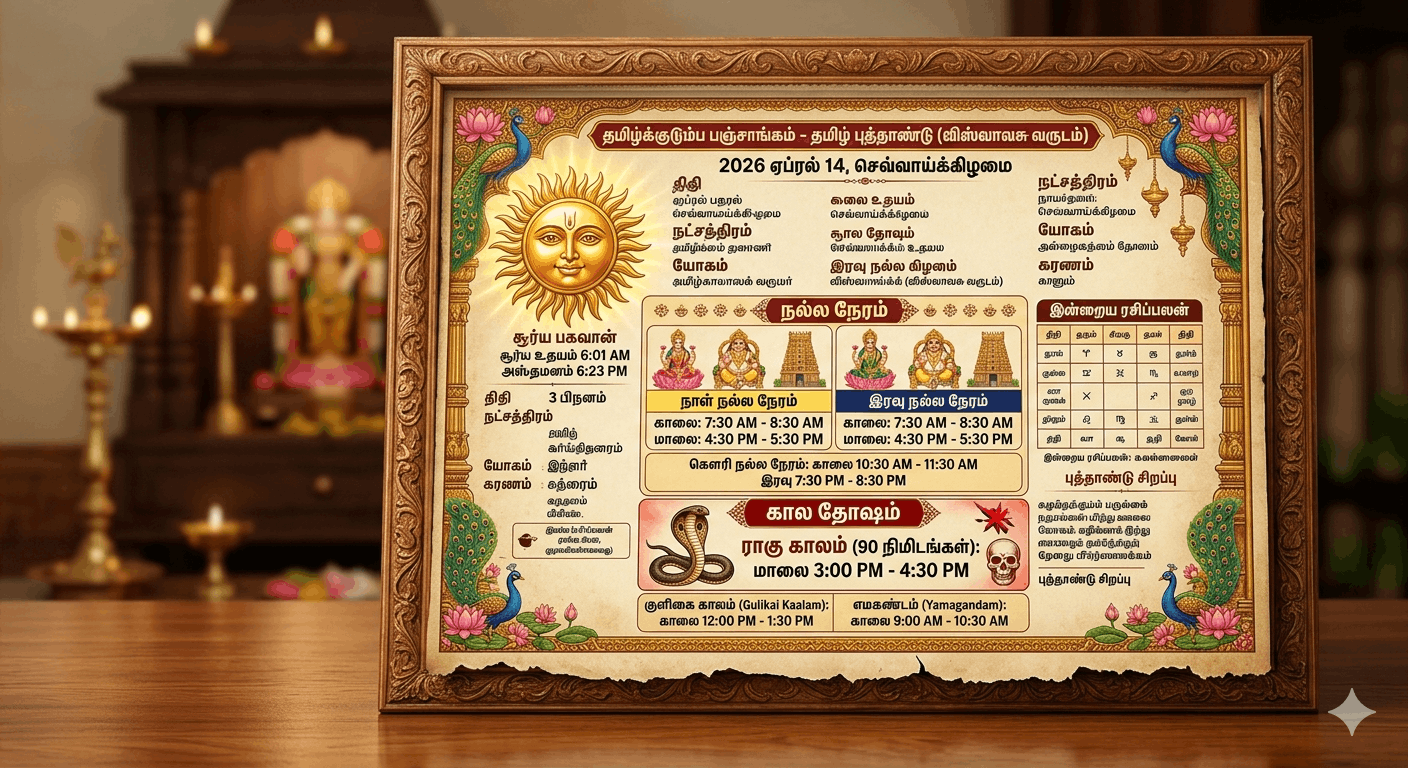
A standard 24-hour cycle contains two distinct Nalla Neram windows: one during the day and one during the night. Each window typically spans roughly 60 to 90 minutes, determined by dividing the daylight and nighttime hours into specific segments.
Daytime Nalla Neram (Pagal Nalla Neram)
Daytime Nalla Neram falls between local sunrise and local sunset. It is primarily used for commercial, social, and domestic activities, including:
- Starting a new business venture or making initial financial investments.
- Signing contracts, deeds, or agreements.
- Conducting housewarming ceremonies (Grihapravesam) or entering a new home.
- Buying high-value assets such as gold, property, or vehicles.
- Administering first doses of medicine or undergoing elective health procedures.
Nighttime Nalla Neram (Iravu Nalla Neram)
Nighttime Nalla Neram falls between local sunset and the following morning's sunrise. While less frequently utilized for business or daytime rituals, it holds immense importance for:
- Tantric or specific temple pujas conducted after dusk.
- Traditional wedding ceremonies that extend through the evening.
- Initiating overnight travel or pilgrimage journeys.
- Spiritual contemplation, meditation (Dhyana), and mantra initiation (Deeksha).
Gowri Panchangam vs. Standard Nalla Neram

When studying auspicious timings, you will often encounter both standard Nalla Neram tables and the Gowri Panchangam. While both seek the ideal moment for action, their underlying mechanics differ slightly.
Standard Nalla Neram is a broad, dependable indicator designed for swift, daily reference. It offers fixed-ratio segments based on the day of the week, adjusted to local daylight duration.
Gowri Panchangam breaks the day and night into eight equal divisions, each ruled by one of five positive or three negative energies:
- Amirtham (Nectar): The most auspicious segment; ideal for all noble and vital beginnings.
- Sugam (Comfort): Favorable for wellness, leisure, family events, and trade.
- Uthi (Gain/Enterprise): Excellent for starting businesses, learning, and financial growth.
- Labham (Profit): Highly recommended for trading, investments, and acquiring assets.
- Subham (Goodness): Ideal for religious rituals, engagements, and auspicious meetings.
- Rogam (Disease), Visham (Poison), and Soram (Theft): Inauspicious segments to be strictly avoided.
For high-stakes events like weddings or property purchases, astrologers cross-reference standard Nalla Neram with Gowri Panchangam to ensure the chosen window falls under Amirtham, Sugam, or Uthi.
Inauspicious Windows: What to Avoid
Determining a truly auspicious period requires checking for negative windows as well. In Vedic astrology, a designated Nalla Neram will never directly overlap with major malefic segments, but nearby transitions demand careful planning. Watch out for these three daily periods:
- Rahu Kalam: Ruled by Rahu, the northern lunar node. Undertaking new beginnings, purchasing assets, or signing agreements during Rahu Kalam often results in delays, misunderstandings, or unexpected complications.
- Yamagandam: Ruled by Yama, the deity of death and justice. It is considered unsuitable for financial initiatives, celebrations, and travel, as it can attract loss or discord.
- Kuligai (Gulika Kalam): Ruled by the son of Saturn (Manda/Gulika). Actions taken during Kuligai tend to repeat themselves. Therefore, it is considered excellent for purchasing real estate or starting an investment, but harmful for borrowing money, paying debts, or conducting funerals.
Step-by-Step: Choosing the Ideal Timing for Important Events
To extract the greatest benefit from Drik Panchang timings, follow this sequential process:
- Set your exact location: Ensure your panchang tool is calibrated to the town or city where the event will physically take place. Timings vary substantially between longitudes.
- Identify the daily Nalla Neram: Pinpoint the daytime or nighttime window that fits your schedule.
- Cross-verify with Gowri Panchangam: Confirm that the selected segment aligns with an auspicious attribute like Amirtham or Labham.
- Screen for Inauspicious Clashes: Confirm the chosen timeframe is completely clear of Rahu Kalam and Yamagandam.
- Assess Tithi and Nakshatra: For life-defining events (such as marriages or groundbreakings), examine whether the prevailing lunar day (Tithi) and constellation (Nakshatra) support the specific activity.
Common Mistakes to Avoid
A frequent error is relying on pre-printed calendar tables printed for a central metro area (like Chennai or Bengaluru) while residing hundreds of miles away. Because Nalla Neram depends on the local moment of sunrise, using non-localized charts can introduce discrepancies of 15 to 45 minutes—placing your planned event right inside a malefic period like Rahu Kalam.
Another common mistake is treating Nalla Neram as a universal cure for fundamentally incompatible days. While Nalla Neram provides a safe micro-window for routine tasks, major life milestones still require assessing personal horoscopic factors, such as Janma Rashi and ongoing Dasha-Bhukti periods.
Conclusion
Using the Drik Panchang Nalla Neram empowers you to bring conscious order to daily affairs, bridging traditional cultural wisdom with exact astronomical data. By understanding how these windows are formed, avoiding conflicting malefic periods, and calibrating calculations to your local coordinates, you can optimize your efforts and initiate projects with clarity and confidence.