Edison's Genius: From Lab to $1 Billion
Thomas Edison is widely celebrated as one of history's greatest inventors, holding 1,093 US patents in his name. However, viewing Edison merely as a tinkering scientist misses half the picture. The true magic of his legacy lies in how he took concepts From Lab to $1 Billion—How Edison’s Genius Created Unlimited Wealth! He didn't just invent objects; he invented the modern industrial research and development (R&D) model and built scalable commercial empires around his discoveries.

The Menlo Park Invention Factory
Before Edison established his legendary complex in Menlo Park, New Jersey, in 1876, invention was largely a solitary pursuit. Inventors worked in cramped workshops, hoping for a lucky breakthrough. Edison changed the paradigm entirely by creating the world's first industrial research laboratory.
Menlo Park was designed for team-based, systematic innovation. Edison gathered a diverse group of skilled mechanics, chemists, mathematicians, and engineers. By centralizing talent and equipment, he turned invention from a sporadic art form into a predictable manufacturing process. This institutional efficiency allowed him to produce a minor invention every ten days and a major breakthrough every six months.
Commercializing the Incandescent Light Bulb
Many people incorrectly believe Edison invented the first light bulb. Dozens of inventors had experimented with electric illumination before him. What Edison did differently was recognize that a standalone bulb was useless without an entire economic and technological ecosystem.
To turn his incandescent lamp into a commercial titan, Edison had to solve several interconnected problems:
- Durability: Finding a filament material that could burn for hundreds of hours without burning out.
- Distribution: Designing copper wiring, fuses, meters, and switches to safely deliver electricity to homes and businesses.
- Generation: Building central power stations capable of supplying steady electrical current across entire neighborhoods.
By packaging the light bulb with a complete utility infrastructure, Edison created a recurring revenue model. Customers didn't just buy a bulb once; they paid for electricity month after month.
Strategic Patenting and Defending Intellectual Property
Edison understood that brilliant ideas possess zero commercial value if competitors can easily steal them. He treated patent law as a core business strategy rather than an administrative afterthought.
Video: How Thomas Edison Built an Empire on Stolen Genius (The Dark Truth of Edison vs. Tesla)
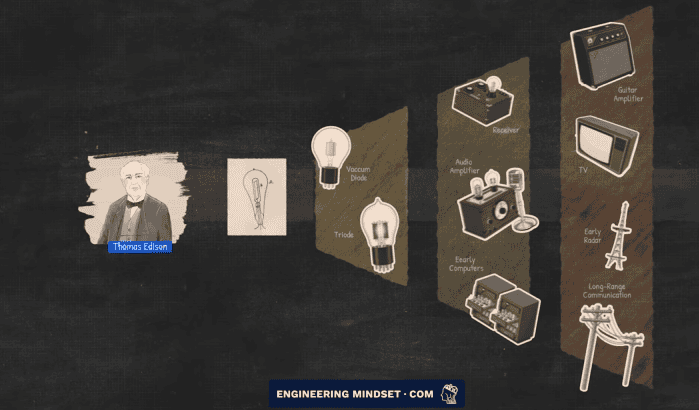
He filed patents broadly and aggressively to protect every incremental improvement on his inventions. When rivals attempted to infringe on his designs, Edison utilized his deep financial backing—supported by industrialist J.P. Morgan—to wage relentless legal battles. This aggressive defense of intellectual property solidified monopolies for his ventures, driving massive valuation growth.
From Startups to Industrial Giants
Edison’s ability to scale startups into multinational corporations set the standard for modern capitalism. His enterprise philosophy centered on vertical integration and market creation.
The Birth of General Electric
In 1892, Edison’s various lighting and manufacturing entities merged with rival Thomson-Houston to form the General Electric Company (GE). This merger combined complementary patents and manufacturing facilities, creating an absolute powerhouse in the electrical industry. GE became a cornerstone of the American economy and one of the most valuable corporations of the 20th century.
The Motion Picture Industry
Edison also applied his industrial methodology to entertainment. Through the invention of the kinetograph and kinetoscope, he laid the groundwork for cinema. He formed the Motion Picture Patents Company (the Edison Trust) to control camera technology, film stock, and projection equipment, monetizing every single frame of film produced during the early silent era.
Lessons in Wealth Creation from Edison
Edison’s journey offers timeless lessons for modern entrepreneurs, investors, and inventors looking to bridge the gap between technical innovation and financial success.
- Solve the Whole Problem: Do not just build a product; build the ecosystem, distribution channels, and support systems required for customers to use it effortlessly.
- Build Systems, Not Just Products: Shift from individual effort to team-based R&D to scale your creative output.
- Protect Your Assets: Treat intellectual property as a primary moat against market competitors.
- Embrace Failure: Edison viewed failed experiments not as dead ends, but as data points that brought him closer to the working solution.
Ultimately, Thomas Edison proved that true genius is not merely conceptual. By combining relentless experimentation with shrewd business acumen, he unlocked a blueprint for generating sustained, massive wealth that continues to inspire innovators today.


