Editable Dilations Templates for Personalized Learning
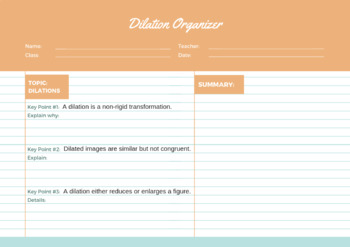
Geometry instruction often hits a stumbling block when it comes to transformations. While some students grasp coordinate rules instantly, others struggle to visualize how a figure expands or shrinks away from a center point. Relying on a single worksheet for the entire class leaves advanced learners bored and struggling students behind. By utilizing editable dilations templates for personalized learning, educators can bridge this gap, tailoring practice problems to meet individual student needs.

Why Standard Dilation Worksheets Fall Short
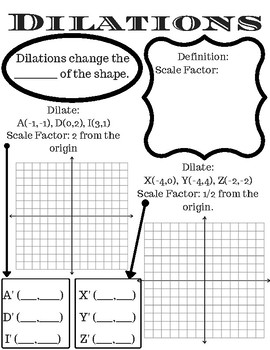
Traditional textbooks typically offer a one-size-fits-all approach to teaching dilations. Students are given a dozen problems with the origin as the center of dilation ($0,0$) and integer scale factors. However, true mathematical proficiency requires a deeper understanding.
Students need exposure to centers of dilation outside the origin, fractional scale factors, and real-world application problems. When teachers rely solely on static printouts, they cannot easily adjust the difficulty level, add scaffolding, or provide immediate, targeted feedback. Differentiation becomes an exhausting manual chore rather than a seamless part of daily instruction.
Core Components of Effective Dilations Templates
To build a truly personalized learning environment, your templates must offer flexibility and depth. Whether you use digital tools like Google Slides, GeoGebra, or printable PDFs with customizable fields, effective templates share several common traits.
1. Variable Center Points
Many students master dilations from the origin quickly, but panick when the center of dilation moves to a point like $(2, -1)$. Editable templates allow you to swap out center coordinates instantly. You can create Tier 1 problems centered at $(0,0)$, Tier 2 problems centered on a vertex of the shape, and Tier 3 problems centered at an arbitrary coordinate.
2. Varied Scale Factors
Scale factors dictate whether a figure enlarges or reduces. A robust template collection should feature:
- Whole numbers greater than 1 for standard enlargements.
- Proper and improper fractions (e.g., $1/2$, $3/4$, $5/3$) for reductions and scaling.
- Negative scale factors to introduce directional reversals and spatial reasoning challenges.
3. Scaffolded Coordinate Grids
Not all students process visual information the same way. Some benefit from heavily labeled coordinate grids with bold axes, while others are ready for blank coordinate planes. Editable templates let you adjust the grid scale, add hints, or include worked-out examples directly on the student's workspace.
Video: What Is Personalized Learning?
Implementing Editable Dilations Templates in Class
Personalized learning is not about handing out random worksheets; it is about intentional pathways. Here is how you can integrate these templates into a modern math classroom.
Diagnostic-Driven Grouping
Start a unit on geometric transformations with a quick diagnostic exit ticket. Group students based on their performance:
- Group A (Re-teaching): Focus on dilations from the origin with whole-number scale factors using heavily scaffolded templates.
- Group B (On-Level): Practice mixed center points and fractional scale factors.
- Group C (Extension): Challenge students with negative scale factors and real-world architectural scaling problems.
Digital vs. Printable Formats
Offering both digital and physical templates ensures accessibility. Digital formats allow students to manipulate vectors, measure side lengths with digital tools, and self-check their coordinate calculations. Meanwhile, printable versions are ideal for tactile learners who benefit from drawing lines of dilation with rulers and colored pencils.
Best Practices for Creating Your Own Templates
If you want to design your own repository of editable resources, keep these pedagogical tips in mind:
First, keep the design clean. Cluttered coordinate planes cause cognitive overload, making it difficult for students to distinguish between the pre-image and the dilated image. Use contrasting colors or distinct line styles (solid vs. dashed) for the original and transformed shapes.
Second, include answer keys with step-by-step algebraic breakdowns. Personalized learning relies heavily on student self-assessment. When learners can check not just the final coordinates, but the multiplication process used to get there, they can correct their own misconceptions independently.
Conclusion
Mastering geometric transformations requires targeted practice and visual intuition. By moving away from rigid textbooks and embracing editable dilations templates for personalized learning, you empower every student to progress at their own speed. Whether reinforcing foundational coordinate rules or challenging advanced thinkers with complex scale factors, flexible templates are the key to a more dynamic, inclusive mathematics classroom.