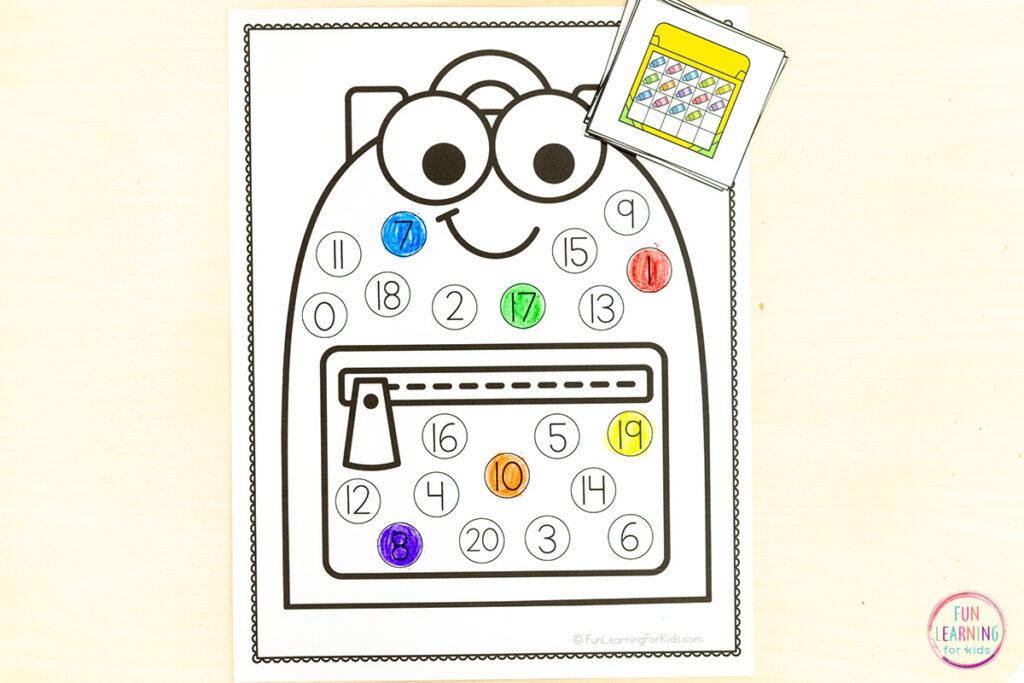
Effortless Number Learning for Back to School
The transition into a new academic year often brings a mix of excitement and anxiety, particularly when it comes to early mathematics. Many parents assume that preparing a child for classroom math requires structured drills, workbooks, and flashcards. In reality, fostering genuine numeracy is far more intuitive. Embracing effortless number learning for back to school means integrating quantitative concepts into your family's everyday rhythm, turning routine moments into intuitive, low-pressure lessons.

Understanding Number Sense vs. Rote Counting
Before introducing activities, it helps to understand how children actually learn math. Many young children can recite numbers from 1 to 20 without understanding what those numbers represent. This is rote memorization—similar to singing the alphabet—not mathematical comprehension.
True foundational math relies on three core concepts:
- One-to-One Correspondence: Understanding that each number named corresponds to one specific object (e.g., touching one apple while saying "one," then touching a second apple while saying "two").
- Subitizing: The ability to recognize a small quantity without counting each item individually, such as identifying four dots on a die instantly.
- Cardinality: Grasping that the final number counted represents the total quantity of the group.
When you focus on these fundamental skills rather than memorization speed, children develop an authentic, resilient framework for school-level math.
Daily Routines for Effortless Number Learning for Back to School
You do not need extra hours in your day to build math fluency. The most effective teaching opportunities happen naturally inside your existing morning and evening routines.
1. Breakfast Table Estimation and Counting
Turn breakfast preparation into an informal lab. Ask your child to grab just enough spoons for the family, matching utensils to seats at the table. If you are slicing bananas, ask them to predict how many slices you will get from half a banana. When serving berries, arrange them in a ten-frame layout (two rows of five) so your child begins to see groups of five and ten automatically.
2. The Commute Counting Challenge
Whether walking, riding the bus, or driving to school, the environment is full of numerals and patterns. Look for specific numbers on speed limit signs, license plates, and house addresses. For younger learners, shift from numeral identification to environmental counting: "Can we spot five red cars before the next traffic light?"
3. Laundry and Toy Sorting
Classification is a foundational math skill. When putting away clean clothes, invite your child to pair socks, sort items by color, or arrange shirts from smallest to largest. When packing up building blocks, count by twos or arrange bins by shape. These actions teach grouping and categorization without feeling like formal study.
Low-Stress Games That Build Core Skills
Video: Back to School Creative Math | Learn to Count for Kids | Number Cartoon | Numberblocks

Play is the most efficient medium for deep learning. Instead of worksheets, pull out everyday household items to play simple, high-impact math games.
Dot Dice Roll and Match
Standard six-sided dice are unmatched tools for teaching subitizing. Roll a die, have your child state the number immediately without counting the dots individually, and then ask them to jump, clap, or tap the table that many times. To elevate the game, use two dice and practice "counting on"—identifying the larger number instantly and counting up from there.
Domino Parking Lot
Draw a series of "parking spaces" on a piece of cardboard, numbering each space from 0 to 12. Have your child pick a domino, count the total pips across both sides, and park the domino in its matching numbered space. This visual, tactile exercise demonstrates how different combinations can equal the same total (for example, a 3-and-3 domino and a 4-and-2 domino both park in space 6).
The "More, Less, or Equal" Snack Game
Place two small piles of pretzels or crackers side-by-side—one with four crackers and one with six. Ask: "Which pile has more? How do you know?" Then ask: "What do we need to do to make them equal?" This introduces early algebraic thinking and subtraction in a tangible, motivating way.
Grade-by-Grade Readiness Checklist
Depending on your child's age, the target skills for the start of the school year will vary. Use this quick guide to calibrate your daily interactions:
- Preschool / Pre-K: Identifying numbers 1 to 5, counting up to 10 objects accurately, recognizing basic shapes (circle, square, triangle), and understanding relative sizes (bigger, smaller).
- Kindergarten: Counting reliably to 20, recognizing numerals up to 10, subitizing quantities up to 5, comparing groups using "greater than" and "less than," and simple sorting by two attributes (e.g., color and size).
- First Grade: Counting to 100, understanding basic place value (tens and ones), solving simple addition and subtraction within 10, and reading a basic calendar or clock to the hour.
- Second Grade: Fluent addition and subtraction facts within 20, skip-counting by 2s, 5s, and 10s, understanding odd and even numbers, and measuring lengths using informal and standard units.
Reframing Math Talk to Eliminate Anxiety
Children absorb adult attitudes toward school subjects very early. If a parent remarks, "I was never good at math," children often internalize that math ability is a fixed trait rather than a learned skill. Eliminate self-deprecating remarks about mathematics from your household vocabulary.
Instead, celebrate mistakes as natural steps in problem-solving. If your child miscounts a row of coins, avoid jumping in immediately with the correction. Ask open-ended questions like: "Let's recount that slowly together. Where did we start?" or "Why do you think that total makes sense?" This encourages metacognition—the ability to think about one's own thinking—and builds resilience.
Consistency Over Intensity
You do not need sixty-minute tutoring sessions to ensure academic readiness. Ten minutes of relaxed, intentional engagement spread throughout the day is significantly more effective than weekend cram sessions. When math is treated as a natural lens through which we view and organize the world, children enter the classroom confident, curious, and fully equipped to thrive.