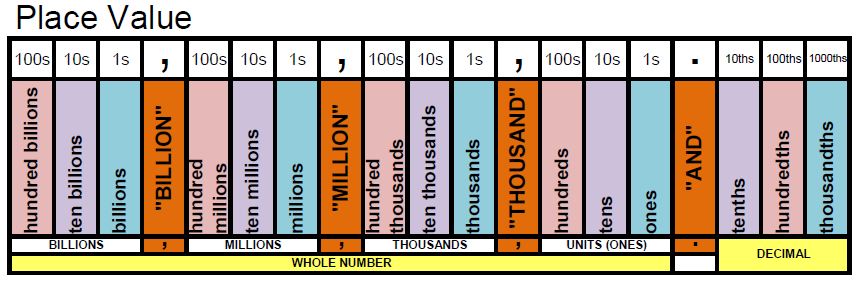
Elegant Billions Place Value for Adults
When we encounter numbers in the billions and trillions, our brains often struggle to grasp their true magnitude. While children learn place value through hundreds and thousands, adult life—spanning corporate finance, national economies, and global demographics—requires a more sophisticated mental model. Mastering elegant billions place value for adults bridges the gap between abstract digits on a spreadsheet and the real-world scale of wealth, population, and technology.

Why Adult Place Value Matters
Most adults can read standard financial figures, but reading a number aloud and truly comprehending its physical or financial reality are two entirely different skills. In daily life, we rarely touch anything worth a billion dollars, making the concept inherently abstract. Yet, headlines about national debt, unicorn startup valuations, and tech acquisitions routinely toss around nine- and ten-figure sums.
Developing an intuitive grasp of these numbers prevents cognitive overload. It helps professionals evaluate corporate balance sheets, allows voters to analyze economic policy proposals, and gives everyday investors perspective on global markets. Understanding scale transforms a wall of zeros into a meaningful narrative.
The Anatomy of a Billion
To understand billions place value, we must first look at how place value columns scale. In the short scale naming system used in the United States and most of the English-speaking world, numbers grow by powers of a thousand:
- Ones: 1 to 999
- Thousands: 1,000 to 999,999
- Millions: 1,000,000 to 999,999,999
- Billions: 1,000,000,000 to 999,999,999,999
Visually, a billion is written as a 1 followed by nine zeros: 1,000,000,000. Each grouping of three digits, separated by commas, represents a distinct period: ones, thousands, millions, and billions. Reading a number like 4,250,600,300 becomes manageable when you break it down period by period: "Four billion, two hundred fifty million, six hundred thousand, three hundred."
Mental Models for Enormous Numbers
Numbers on paper are cold. To build an elegant mental framework, you need physical analogies that bridge the gap between human experience and astronomical quantities. Here are three powerful ways to conceptualize a billion.
1. The Time Scale Analogy
Time is one of the easiest dimensions for humans to feel. Consider the difference between a million and a billion using seconds:
- One million seconds is about 11.5 days.
- One billion seconds is about 31.7 years.
This stark difference illustrates the "billionaire gap." It highlights why the jump from a million to a billion is not just a minor mathematical step, but an exponential leap.
2. The Physical Stack Analogy
Video: WCLN - Place Value to Billions

Imagine stacking physical dollar bills. A single U.S. bill is roughly 0.0043 inches thick.
- A stack of $1,000 in one-dollar bills is about 4.3 inches high—easily fitting on a desk.
- A stack of $1 million in one-dollar bills would reach roughly 358 feet into the air—taller than a 30-story building.
- A stack of $1 billion in one-dollar bills would reach over 67 miles high, piercing the stratosphere and pushing past the boundary of outer space.
3. The Corporate and Economic Scale
In business, billions dictate the valuation of modern enterprises. When a company is valued at $5 billion, it means the market believes the enterprise can generate or hold that level of future value. Understanding this helps professionals contextualize quarterly reports, venture capital funding rounds, and government expenditures without feeling overwhelmed by the sheer volume of digits.
Common Pitfalls in Reading Large Numbers
Even seasoned professionals make errors when transitioning between millions and billions, particularly when dealing with different reporting standards or global currencies.
The Short Scale vs. Long Scale Confusion
If you read international financial documents, be aware of naming conventions. While the US and UK use the "short scale" (where a billion is 1,000 million), many European and Latin American countries use the "long scale," where a billion represents a million millions (what the short scale calls a trillion). When managing international portfolios, always verify whether the reporting entity utilizes short or long scale metrics.
Misplacing the Decimal Point
In financial modeling, a misplaced decimal point can turn a multi-million dollar budget into a multi-billion dollar error. Always use comma separators in written communication, and train your eye to instantly recognize the nine-digit threshold that marks the entrance into the billions.
Practical Tips for Everyday Numeracy
You do not need a degree in mathematics to keep your large-number literacy sharp. Incorporate these habits into your routine:
- Round for Comprehension: When reading news reports, round numbers to the nearest tenth of a billion (e.g., $4.2B instead of $4,218,903,112) to make the data digestible.
- Use Scientific Notation as a Backup: For quick math checks, remember that one billion is expressed as $1 \times 10^9$. This prevents zero-counting errors on calculators and spreadsheets.
- Break Down Complex Figures: When analyzing a large budget, divide the total by population or operating days to find a per-capita or daily metric that makes human sense.
Conclusion
Mastering large numbers is an empowering exercise in financial and civic literacy. By utilizing structural breakdowns, physical analogies, and careful reading habits, you can navigate nine-figure and ten-figure sums with absolute confidence. Elegant billions place value for adults is not about memorizing textbook rules—it is about cultivating a clear, grounded perspective on the scale of our modern world.