Elton John: Royalty to Real Estate Billionaire Portfolio
Few entertainers in modern history have matched the longevity, cultural footprint, and financial triumph of Sir Elton John. Over six decades, the British singer-songwriter evolved from a classically trained piano prodigy into one of the most commercially successful figures in global entertainment. Today, analysts view his financial trajectory through a lens that extends far beyond record sales. From royalty to real estate: Elton John’s diversified billionaire portfolio represents a masterclass in modern asset allocation, transitioning generational music royalties into prime real estate, museum-caliber art, and lucrative enterprise equity.

While celebrity wealth is frequently vulnerable to volatile markets or unchecked spending, John’s contemporary financial footprint tells a story of strategic discipline. Guided by elite business managers and his husband and business partner, David Furnish, John transformed lifetime gross career earnings exceeding $1 billion into a resilient, multi-asset fortune designed for generational preservation.
From Royalty to Real Estate: Elton John’s Diversified Billionaire Portfolio
To understand the breadth of John’s holdings, one must look at how his portfolio balances recurring royalty cash flows with inflation-resistant physical assets. Rather than concentrating his net worth in traditional securities or speculative startups, his strategy leans heavily into tangible assets with proven historical appreciation.
1. The Royalty Engine: Music Rights, Streaming, and Historic Touring
The foundation of John’s balance sheet remains his unmatched intellectual property. Alongside his long-time lyricist Bernie Taupin, John created one of the deepest commercial songbooks in 20th-century music, spanning over 300 million records sold worldwide. Classic tracks such as "Rocket Man," "Tiny Dancer," "Bennie and the Jets," and "Your Song" generate continuous mechanical, performance, and synchronization royalties across global streaming platforms and commercial media.
Live entertainment serves as a massive liquidity driver. His multi-year "Farewell Yellow Brick Road" tour completed its 330-show run by grossing over $939 million, ranking among the top-grossing concert tours in global history. This monumental cash injection gave John the liquidity necessary to fund capital-intensive acquisitions and retire leverage without diluting his underlying intellectual property.
2. The Global Property Empire: Windsor, Nice, and Beyond
Real estate serves as the premier anchor of John’s wealth. Unlike investors who pursue speculative residential developments, John targets ultra-prime locations with intrinsic historical and geographic scarcity.
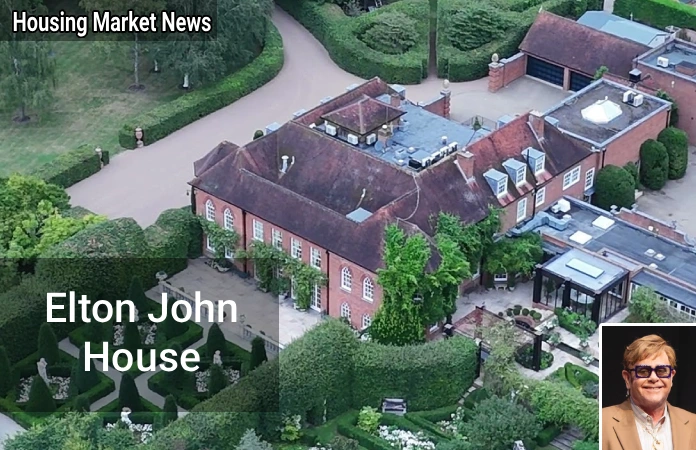
- Woodside Estate (Old Windsor, Berkshire): Acquired in 1974 for roughly £400,000 following his early commercial breakthrough, this 37-acre English country estate is now estimated to be worth well over £40 million. Woodside functions as John’s primary residence, featuring immaculate 18th-century gardens, an expansive library, and extensive equestrian grounds.
- Mont Boron Villa (Nice, France): Known locally as "the summer house," this fortress-like 1920s villa sits high above the French Riviera. Offering panoramic views of the Mediterranean and the Baie des Anges, the property boasts immense land value in one of the most tightly restricted real estate corridors on earth.
- Beverly Hills Compounds (California): John has owned multiple adjacent parcels in the exclusive Trousdale Estates neighborhood of Beverly Hills. Combining mid-century architectural pedigree with high-security perimeters, these estates capture significant appreciation driven by high-net-worth demand in Southern California.
- Venice Apartment (Giudecca): Situated on the tranquil island of Giudecca, this 17th-century palazzo apartment overlooks the Venetian lagoon, providing an asset class that is virtually impossible to duplicate.
- The Strategic Atlanta Exit: For over three decades, John maintained a multi-story penthouse suite in Buckhead, Atlanta, which served as his North American touring base. In late 2023, he divested the property for more than $7.2 million, demonstrating a disciplined approach to liquidating non-essential real estate when lifestyle needs shift.
3. Blue-Chip Art and Photography: Tangible Alternative Investments
Where many ultra-wealthy individuals treat art as pure decoration, John assembled one of the world's most critically acclaimed private photography collections. Beginning in the early 1990s, he methodically acquired vintage modernist prints, assembling thousands of works by masters including Man Ray, Dorothea Lange, Edward Steichen, Irving Penn, and Robert Mapplethorpe.

The institutional value of this collection was validated by prestigious exhibitions at London's Tate Modern ("The Radical Eye") and the Victoria and Albert Museum ("Fragile Beauty"). Art advisors estimate that his holdings represent tens of millions of dollars in highly liquid, museum-grade alternative assets that consistently outpace general equity indices during inflationary periods.
4. Theatrical Productions and Rocket Entertainment
John’s business architecture extends beyond his personal performances. Through the Rocket Entertainment Group, he operates as an equity stakeholder and producer across theatre, television, and film.
His compositional work on Disney's The Lion King—both the original animated feature and the long-running Broadway musical—created an enduring royalty stream that has grossed billions worldwide. Follow-up stage successes like Aida and Billy Elliot: The Musical cemented his position as an elite theatrical asset creator, ensuring passive royalty distribution across global theatrical licenses year after year.
Financial Lessons from Elton John’s Wealth Strategy
Private investors and wealth managers frequently analyze John's career trajectory as a case study in financial recovery and proactive risk management. Following widely publicized spending challenges in the 1980s, his restructuring offers actionable principles:
- Monetize Active Labor into Passive Anchors: Tour revenue and performance fees were systematically converted into non-depreciating hard assets, primarily real estate and blue-chip art.
- Diversify Cash Flow Streams: Rather than relying solely on streaming income, revenue flows simultaneously from theatrical rights, merchandising, intellectual property licensing, and equity partnerships.
- Maintain Strategic Liquidity: By closing massive touring milestones before scaling back, John built cash buffers to navigate macroeconomic turbulence without selling off prized illiquid assets.
Philanthropic Capital: Building a Purpose-Driven Legacy
A comprehensive assessment of John’s balance sheet requires highlighting his deployment of philanthropic capital. Founded in 1992, the Elton John AIDS Foundation has raised more than $600 million to combat HIV/AIDS globally.
By leveraging his annual Academy Awards Viewing Party and high-profile donor networks, John constructed an enduring charitable institution. This philanthropic architecture not only supports global health initiatives but also cements his family's enduring social impact, reflecting a holistic philosophy where wealth accumulation ultimately serves long-term global stewardship.