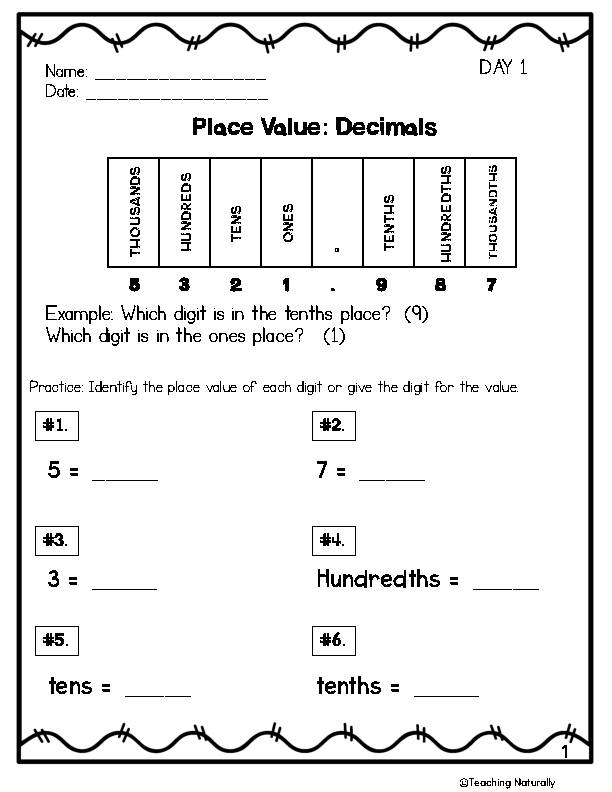
Emergency Math Helper Decimal Place Value PDF
It is 8:30 PM. The kitchen table is covered in eraser shavings, a frustrated child is on the verge of tears, and the math worksheet in front of them is all about decimals. If you are scrambling to understand tenths, hundredths, and thousandths to get through homework tonight, you need a reliable Emergency Math Helper Decimal Place Value PDF. Decimals trip up many students because they require a shift in thinking from whole numbers, moving to the right of the decimal point where values get smaller instead of larger.

This guide serves as your immediate lifeline. We will break down the core concepts of decimal place value, explain how to read and write decimals correctly, and provide actionable tips you can use right now to conquer tonight’s assignment without tears.
Understanding Decimal Place Value Basics
Before jumping into homework problems, it helps to review how the decimal system works. Just like whole numbers, our decimal system is base-10. Every time you move one place to the right, the value of the digit is divided by 10 (or becomes 10 times smaller).
Consider the number 456.789. Each digit has a specific value based on its position relative to the decimal point:
- 4: Hundreds (400)
- 5: Tens (50)
- 6: Ones (6)
- . (And)
- 7: Tenths (0.7 or 7/10)
- 8: Hundredths (0.08 or 8/100)
- 9: Thousandths (0.009 or 9/1000)
Notice that there is no "oneths" place. The decimal places start immediately with tenths. A common mistake students make is thinking the first number after the decimal is the oneths place. Remind your child: "Start with *ths* right after the dot!"
How to Read and Say Decimals Correctly
How we speak math directly influences how we understand it. Many students incorrectly read the number 0.45 as "zero point forty-five." While acceptable in casual settings, this prevents them from understanding the true value of the number.
To build genuine math fluency, follow these verbal rules:
- Read the whole number part to the left of the decimal point normally.
- Say the word "and" wherever you see the decimal point.
- Read the numbers to the right of the decimal point as if they were a whole number.
- Finish by saying the place value name of the very last digit on the right.
Example: 3.25 is read aloud as "Three and twenty-five hundredths." This phrasing immediately connects the decimal to its fraction equivalent (3 and 25/100), making operations much easier down the road.
Emergency Math Helper Decimal Place Value PDF Strategies
If you have access to a printer or a tablet, utilizing a dedicated decimal place value PDF can save the night. Here are three quick-reference exercises you can sketch on a piece of scratch paper or build into a digital document to help your child master the concept right now.
1. The Place Value Chart Method
Draw a simple grid with columns labeled: Hundreds | Tens | Ones | . | Tenths | Hundredths | Thousandths. Have your child write the assigned numbers into the grid. Seeing the physical boundary of the decimal point helps anchor their understanding of where values shift.
2. The Fraction-to-Decimal Bridge
If your child is struggling to see why 0.3 is bigger than 0.03, convert them to fractions. Show them that 0.3 is 3/10 (three big slices of a pizza cut into 10 pieces), while 0.03 is 3/100 (three tiny crumbs of a pizza cut into 100 pieces). Visualizing food or money (dimes vs. pennies) is an instant game-changer for kids.
3. Standard, Expanded, and Word Form Practice
Most decimal homework assignments require students to translate numbers between three forms. Here is a quick cheat sheet for the number 5.14:
- Standard Form: 5.14
- Expanded Form: 5 + 0.1 + 0.04 (or 5 + (1 x 0.1) + (4 x 0.01))
- Word Form: Five and fourteen hundredths
Quick Tips for Tonight's Homework
When patience is wearing thin, use these rapid-fire troubleshooting tips to get through the remaining problems:
- Line up the decimal points: If they are comparing or adding decimals, remind them that the decimal points must always stack vertically, like buttons on a shirt.
- Add placeholder zeros: When comparing 0.4 and 0.38, add a zero to the end of 0.4 to make it 0.40. It is much easier for a child to see that 40 hundredths is greater than 38 hundredths than it is to compare 0.4 and 0.38.
- Use money as an anchor: Think of tenths as dimes ($0.10) and hundredths as pennies ($0.01). It grounds abstract digits in real-world logic.
By breaking decimals down into clear place values, utilizing visual charts, and connecting digits to money or fractions, you can turn a stressful homework session into a successful learning moment. Keep this guide handy, take a deep breath, and you will get through tonight's math assignment together.