Find Your Flow Using Circle Habit Trackers
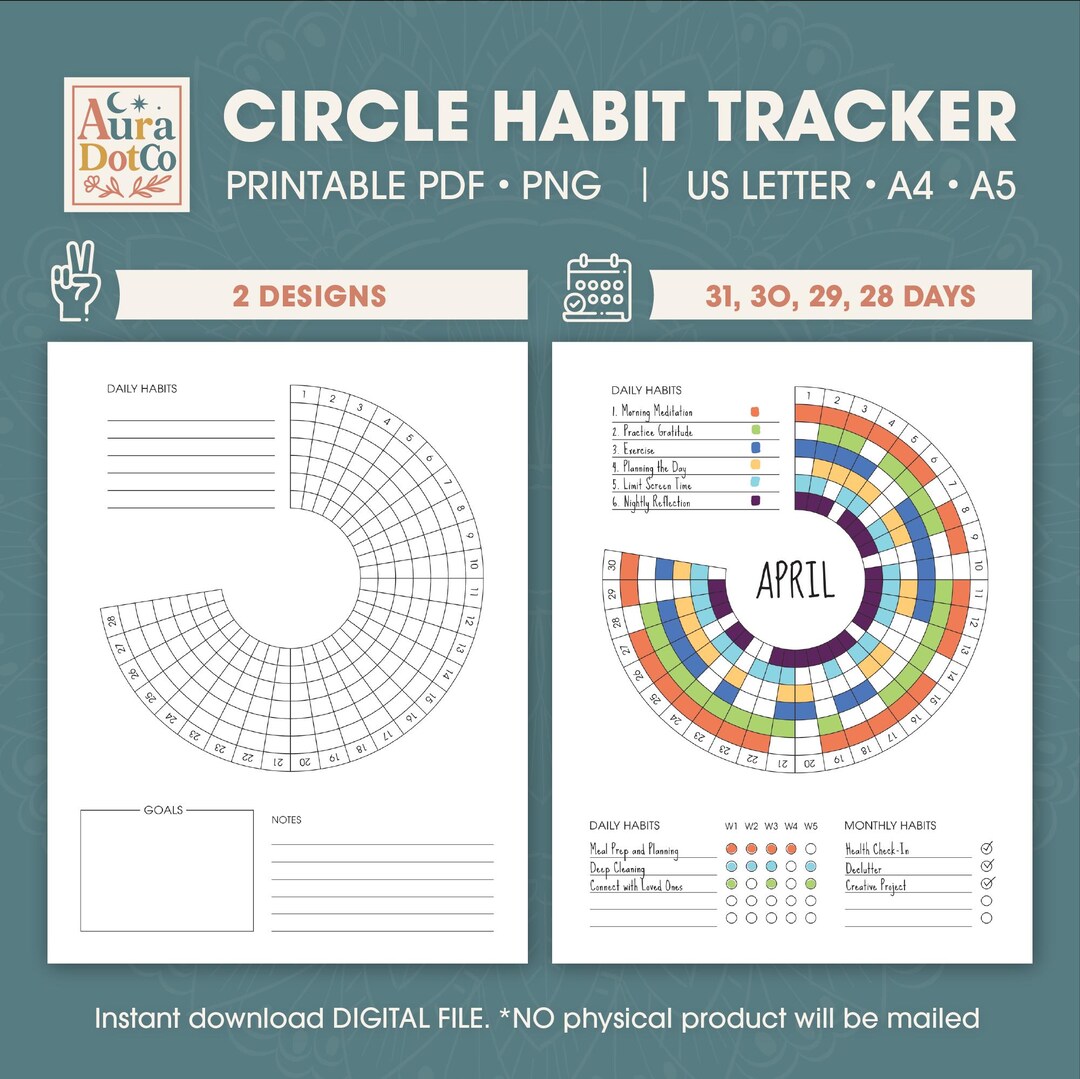
When most people think of habit tracking, they picture rigid grid systems—rows of tiny squares crossed out day after day. While linear trackers work for some, they can often feel clinical, restrictive, and punishing when you miss a day. If you want a more organic way to build consistency and creativity, it is time to find your flow using circle habit trackers.

Radial habit tracking shifts your perspective from a linear race against time to a continuous, holistic cycle. By mapping your habits in a circle, you tap into visual patterns that feel less like a checklist and more like a work of art. Here is a deep dive into why circular trackers work so well and how you can start using them to transform your daily routines.
The Psychology Behind Circular Tracking
Human beings are naturally drawn to curves and mandalas. Unlike linear grids that emphasize strict endpoints and sharp margins, circles represent wholeness, continuity, and balance. When you look at a completed radial habit tracker, you see a complete ecosystem of your month rather than a trail of broken checkboxes.
Traditional linear trackers trigger an all-or-nothing mindset. If you miss three days in the middle of a row, your brain registers failure. Conversely, circular trackers treat each day as a spoke in a wheel. A missing mark is simply a blank space in a larger, beautiful pattern, reducing the anxiety that often derails long-term habit-building efforts.
How to Set Up Your First Radial Tracker
Creating a circle habit tracker requires very few tools—just a blank notebook, a pen, and a compass or a round object to trace. Follow this step-by-step framework to build a layout that works for you.
1. Choose Your Timeframe
Most circular trackers are designed for a single month. This keeps the geometry manageable and prevents the chart from becoming overcrowded. A 30-day or 31-day cycle provides enough data to show genuine behavioral shifts without overwhelming your page.
2. Draw Your Rings and Spokes
Begin by drawing a small central circle. This can be used for the month's name or a central decorative element. Next, draw concentric rings radiating outward—one ring for each habit you want to track. Finally, divide the outer rings into equal segments, matching the number of days in the month (e.g., 30 or 31 slices, like a pie).
- Use a protractor for precise 360-degree divisions if you prefer absolute symmetry.
- Freehand sketching works equally well if you prefer an organic, imperfect aesthetic.
- Limit your tracker to 4 to 6 core habits to avoid cluttering the smaller inner rings.
3. Color-Code Your Habits

Assign a specific color, pattern, or texture to each habit ring. As you complete a habit on a given day, fill in the corresponding segment within that habit's ring. By the end of the month, your tracker will bloom into a colorful, multi-layered mandala that visualizes your exact daily energy distribution.
Tips to Find Your Flow Using Circle Habit Trackers
Building the habit tracker is only the first step. To truly integrate this tool into your daily life and maintain momentum, you need an approach that prioritizes mindfulness over perfectionism.
Keep Daily Logging Low Friction
Friction kills habits. Keep your tracking tools—pens, markers, and your journal—open on your desk or nightstand. Dedicate two minutes every evening to fill in your slices. Treating this ritual as a calming, meditative wind-down helps you reflect on the day rather than rushing through a chore.
Embrace Imperfection and Negative Space
Do not panic if your circle has gaps. In fact, those blank spaces tell a valuable story about your burnout thresholds, busy weekends, or shifting priorities. A circular tracker lets you see the big picture. Even a partially filled wheel represents immense progress compared to where you started.
Experiment with Artistic Variations
If standard geometric slices feel too rigid, lean further into the artistic side of bullet journaling. You can transform your circular trackers into floral petals, sunbursts, or swirling galaxies. When tracking feels like creative play rather than administrative data entry, your consistency will skyrocket naturally.
Conclusion
Productivity does not have to be rigid, cold, or exhausting. By shifting away from traditional linear lists and learning how to find your flow using circle habit trackers, you turn personal growth into a visually rewarding experience. Grab a pen, draw your first wheel, and watch how a simple geometric shift can bring profound balance to your daily routines.