Firing Order for 350 Chevy Small Block: Diagram & Guide
Whether you are dropping a fresh crate motor into a classic muscle car, rebuilding an old truck, or simply replacing worn spark plug wires, knowing the correct firing order for 350 Chevy small block engines is essential. Hooking up even two plug wires incorrectly will lead to rough idling, violent backfires, wasted fuel, and potential valvetrain or piston damage.

The traditional small block Chevy (SBC) 350—produced in various configurations from 1967 through the early 2000s in Gen I and Gen II platforms—uses one of the most famous and widely recognized firing sequences in automotive history: 1-8-4-3-6-5-7-2.
Understanding the Firing Order for 350 Chevy Small Block V8s
Every internal combustion four-stroke V8 must balance power delivery across both cylinder banks to minimize crankshaft twist and operational vibration. Chevrolet engineered the Gen I small block with a sequence designed to alternate pulses between the left and right cylinder banks smoothly.
The sequence progresses through all eight cylinders in a single complete engine cycle (720 degrees of crankshaft rotation):
- Cylinder 1 (Front Driver Side)
- Cylinder 8 (Rear Passenger Side)
- Cylinder 4 (Front-Middle Passenger Side)
- Cylinder 3 (Front-Middle Driver Side)
- Cylinder 6 (Rear-Middle Passenger Side)
- Cylinder 5 (Rear-Middle Driver Side)
- Cylinder 7 (Rear Driver Side)
- Cylinder 2 (Front Passenger Side)
Cylinder Numbering and Bank Layout
Before installing your spark plug wires, you must identify how General Motors numbers the cylinders on a small block V8. Stand at the front of the vehicle looking back toward the firewall:
- Driver Side (Left Bank): Odd numbers — 1, 3, 5, 7 (Cylinder 1 is closest to the radiator; Cylinder 7 is closest to the firewall).
- Passenger Side (Right Bank): Even numbers — 2, 4, 6, 8 (Cylinder 2 is closest to the radiator; Cylinder 8 is closest to the firewall).
Because the connecting rods sit side-by-side on the crankpins, the left bank sits slightly farther forward than the right bank. This makes Cylinder 1 the absolute forward-most cylinder on the block.
Distributor Rotation and Cap Terminal Setup
Unlike Ford V8s, which generally rotate counterclockwise, a standard Chevrolet small block distributor rotates clockwise. If you attempt to wire the cap counterclockwise, the engine will crank continuously without starting, often accompanied by loud pops through the intake or exhaust.
Locating Cylinder #1 on the Distributor Cap
Technically, any post on a distributor cap can serve as Cylinder 1, provided the internal rotor points directly at that terminal when the #1 piston reaches Top Dead Center (TDC) on its compression stroke. However, standard GM factory convention positions the #1 terminal roughly toward the front-driver side corner of the distributor (pointing toward the front left fender).
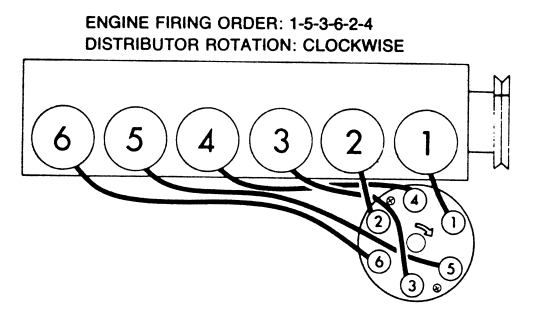
Follow these steps to establish or confirm your #1 position:
- Remove the spark plug from Cylinder 1.
- Bump the starter or turn the crank bolt manually with a breaker bar while holding your finger over the spark plug hole. When you feel air pressure pushing out, the piston is on its compression stroke.
- Rotate the crank until the timing line on the harmonic balancer aligns precisely with the 0° (TDC) mark on the timing tab.
- Remove the distributor cap. The metal tip of the rotor now points directly at the terminal that must be connected to Cylinder 1.
- Mark the distributor housing with a marker directly under that rotor tip, reinstall the cap, and install the wire for Cylinder 1 on that designated terminal.
Wiring the Distributor Cap Step-by-Step
Once you have located terminal #1 on the cap, routing the rest of the plug wires is straightforward. Move clockwise around the distributor cap in the exact firing sequence:
- Connect the wire from Terminal 1 to spark plug #1 (driver front).
- Moving clockwise to the next terminal, connect to spark plug #8 (passenger rear).
- Moving clockwise, connect to spark plug #4 (passenger middle-front).
- Moving clockwise, connect to spark plug #3 (driver middle-front).
- Moving clockwise, connect to spark plug #6 (passenger middle-rear).
- Moving clockwise, connect to spark plug #5 (driver middle-rear).
- Moving clockwise, connect to spark plug #7 (driver rear).
- Moving clockwise to the final terminal, connect to spark plug #2 (passenger front).
Preventing the Cylinder 5 and 7 Crossfire Issue
One critical mechanical detail unique to the 1-8-4-3-6-5-7-2 firing sequence is that cylinders 5 and 7 sit adjacent to each other on the driver-side cylinder head and fire consecutively in the sequence (5 immediately followed by 7).
Because modern high-energy ignition (HEI) systems deliver massive voltage through the spark plug wires, running the 5 and 7 wires directly parallel and zip-tied tightly together creates magnetic field coupling. This phenomenon—known as inductive crossfire—causes the spark jumping across the wire to induce a voltage spike in the adjacent wire. If wire #7 ignites while cylinder #7 is still filling with air and fuel during its compression stroke, pre-ignition and engine pinging occur.
How to Avoid It:
- Use wire separators or looms to keep plug wires organized and spaced at least 1/2-inch apart.
- Never tape or zip-tie wires 5 and 7 tightly alongside one another.
- If wires 5 and 7 must cross paths, cross them at a 90-degree angle rather than running them parallel down the valve cover.
The 4/7 Swap Alternative Firing Order
If you purchase an aftermarket performance camshaft for your 350 Chevy, you may encounter what engine builders call a 4/7 swap. A 4/7 swap camshaft modifies the lobe profile to change the firing order to 1-8-7-3-6-5-4-2.
The goal of this modification is to eliminate the sequential firing of two adjacent cylinders on the same bank (5 and 7), which helps stabilize cylinder temperatures, smooth out crankshaft harmonics, and marginally increase torque on high-RPM drag or circle-track engines. However, standard street engines and factory rebuilds always run the original 1-8-4-3-6-5-7-2 order.
Troubleshooting Common Wiring Mistakes
If your 350 will not fire up or runs poorly after rewiring, inspect these common problem areas:
- Engine is 180 Degrees Out: A four-stroke engine reaches TDC twice per cycle—once on the compression stroke and once on the exhaust stroke. If you set your rotor to #1 while the engine was on the exhaust stroke, the distributor is 180 degrees out of phase. The engine will crank, backfire through the carburetor or throttle body, and refuse to start. Pull the distributor, rotate the crank one full turn back to TDC on compression, and drop the distributor back in.
- Counterclockwise Routing: Re-verify that you wired your cap in a clockwise rotation.
- Swapped 5 and 7 Wires: Swapping cylinders 5 and 7 at the spark plugs or the cap is the single most common mistake on small block Chevys. The engine will run, but it will have a distinct, heavy miss under load.


