Flattest Shooting Deer Rifle: Top Calibers & Guns
When hunting open country, expansive cutovers, or windy mountain ridges, judging distance quickly can make the difference between a clean tag and a heartbreaking miss. That is why so many hunters search for the flattest shooting deer rifle available. A flat-shooting rifle maximizes your point-blank range, minimizes holdover at distance, and gives you a much wider margin for error when a trophy buck steps out across a prairie or canyon.

However, flat trajectory is not purely about muzzle velocity; it is the product of initial speed combined with the aerodynamic efficiency (ballistic coefficient) of the projectile. Below, we break down the calibers that shoot the flattest, evaluate the rifles chambered for them, and examine the real-world trade-offs of hunting with ultra-high-velocity setups.
What Makes a Deer Rifle Shoot Flat?
Trajectory describes the curved path a bullet travels under the influence of gravity and air resistance. Every bullet begins dropping the millisecond it leaves the bore. To make that flight path as horizontal as possible, a rifle system needs two things:
- High Muzzle Velocity: The faster a bullet reaches the target, the less time gravity has to pull it toward the earth. Modern magnum and specialty cartridges push deer-weight bullets between 3,100 and 3,500 feet per second (fps).
- High Ballistic Coefficient (BC): A streamlined bullet cuts through air resistance more effectively. High-BC bullets hold their speed over distance, meaning that while a lighter, hyper-fast bullet might shoot flatter out to 300 yards, a sleeker, heavier bullet will often overtake it and shoot flatter at 500 yards and beyond while shedding less energy.
Top Contenders for the Flattest Shooting Deer Rifle
While the rifle platform dictates ergonomics, action smoothness, and inherent mechanical accuracy, the cartridge dictates the trajectory. Here are the top cartridges reigning supreme for flat-shooting performance on whitetail and mule deer.
1. .257 Weatherby Magnum: The Traditional Speed King
Roy Weatherby introduced the .257 Weatherby Magnum in 1944, and it was famously his favorite hunting cartridge. For pure trajectory inside 400 yards, it remains one of the premier performers on the planet.
Pushing a 100-grain bullet at over 3,550 fps or a 115-grain Partition around 3,300 fps, a rifle chambered in .257 Weatherby shoots remarkably flat. With a 200-yard zero, a 100-grain bullet drops less than 5.5 inches at 300 yards and only about 15 inches at 400 yards. For open-country whitetails and pronghorn, few rounds equal its speed and sudden, hydrostatic terminal impact.
2. 6.5-300 Weatherby Magnum: Extreme Velocity Meets High BC
If you want the absolute flattest production trajectory available in factory deer rifles, the 6.5-300 Weatherby Magnum sits at the peak. Introduced in 2016, this cartridge combines massive powder capacity with the high ballistic coefficients of .264-caliber bullets.
It launches a 127-grain Barnes LRX or 140-grain AccuBond at roughly 3,300 to 3,500 fps. With a 200-yard zero, the drop at 400 yards is often under 14 inches, and it retains lethal terminal energy well past 600 yards. The trade-off is significant: immense muzzle blast, stout recoil, and rapid barrel heating.
3. 7mm Precision Rifle Cartridge (7mm PRC)
While classic Weatherby calibers focus on raw speed, modern cartridge design leans into optimized case geometry and ultra-heavy, high-BC bullets designed to seat in fast-twist barrels. The 7mm PRC is the standout modern choice.
Firing a 175-grain ELD-X bullet at roughly 3,000 fps, the 7mm PRC might post slightly more drop at 300 yards than a hyper-velocity quarter-bore, but its flight curve remains remarkably predictable past 400 yards. More importantly, its high aerodynamic efficiency allows it to resist crosswinds far better than lighter, faster bullets, making it arguably the most consistent long-range deer cartridge available today.
4. .270 Winchester: The Sensible Classic
You do not need an exotic magnum to enjoy a flat trajectory. Jack O'Connor's beloved .270 Winchester firing a 130-grain bullet at 3,060 fps has put meat in freezers for nearly a century. With a 200-yard zero, the drop is typically around 6.5 inches at 300 yards and roughly 19 inches at 400 yards.
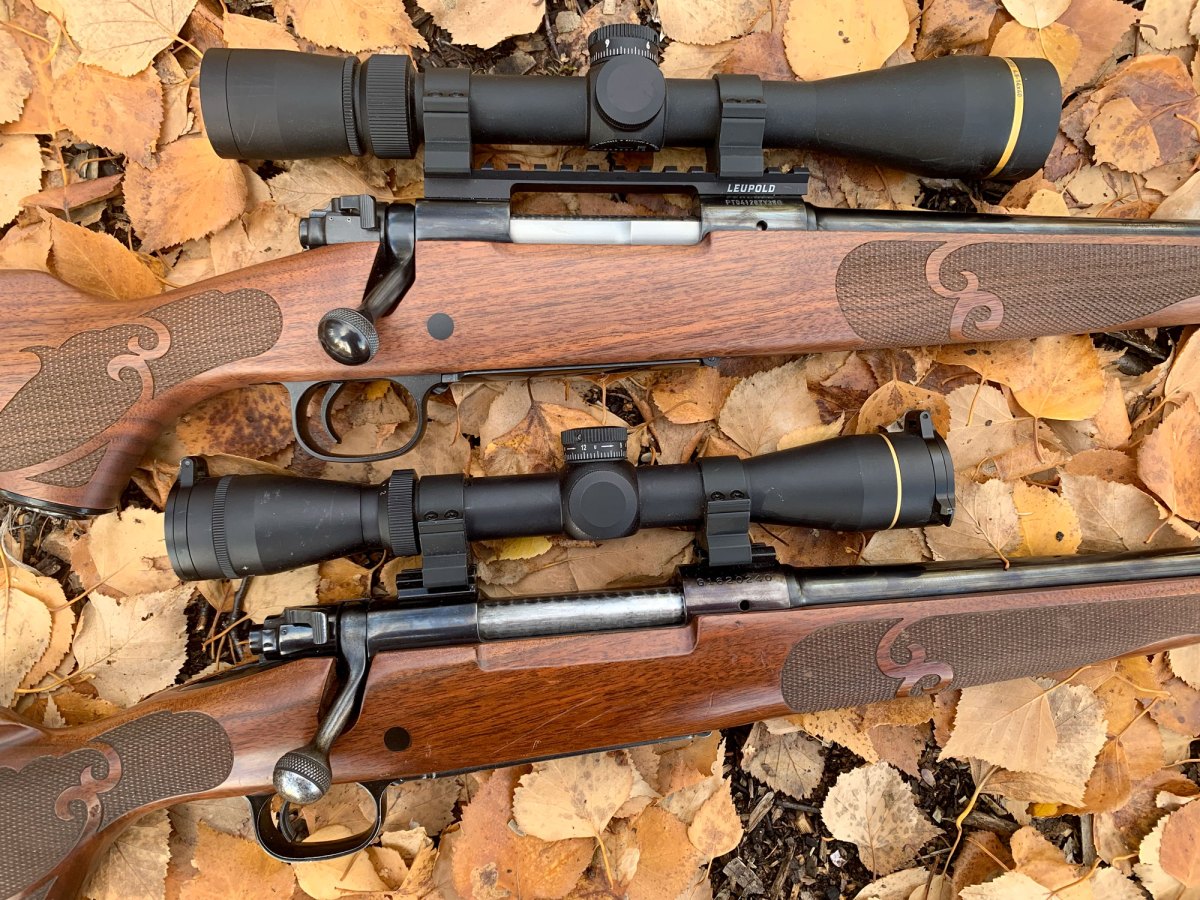
While it drops a few inches more than a magnum at long range, it accomplishes this with modest recoil, extended barrel life, inexpensive factory ammunition, and short-to-standard action rifles available in every gun store in the country.
The Best Factory Rifles for Flat-Shooting Performance
To turn these high-performing cartridges into precision tools in the field, you need a rifle built to harness their pressures and shoot tight groups consistently.
Weatherby Mark V Accumark
If you choose a proprietary speed round like the .257 or 6.5-300 Weatherby Magnum, the Mark V is the gold standard. Built with a 54-degree bolt throw for fast cycling and a robust 9-lug action, the Accumark features a fluted, hand-lapped #3 contour barrel with an integrated muzzle brake. The rigid stock and crisp trigger turn explosive cartridge velocities into repeatable, sub-MOA precision.
Browning X-Bolt Pro
Available in modern flat-shooters like 7mm PRC, 6.5 PRC, and .300 Win Mag, the X-Bolt Pro is an ideal backcountry mountain rifle. Its carbon-fiber wrapped stock keeps weight low, while the heavy sporter barrel with target crown ensures rigidity. The factory-tuned Feather Trigger provides a clean break that helps hunters maximize their ballistic advantage at distance.
Tikka T3x Superlite
For hunters who prefer standard calibers like the .270 Win or 7mm Rem Mag, the Tikka T3x offers arguably the smoothest action and highest out-of-the-box accuracy-to-price ratio in the hunting industry. Its cold-hammer-forged barrel extracts maximum velocity while staying light enough to carry up steep timber all day.
Comparing Trajectories: 200-Yard Zero
Here is how several top deer hunting calibers compare in vertical drop, assuming a standard 200-yard zero in typical hunting conditions:
- .257 Weatherby Mag (100 gr @ 3,550 fps): -5.5 inches at 300 yds; -15.2 inches at 400 yds.
- 6.5-300 Weatherby Mag (130 gr @ 3,475 fps): -5.1 inches at 300 yds; -14.1 inches at 400 yds.
- 7mm PRC (175 gr @ 3,000 fps): -6.8 inches at 300 yds; -18.2 inches at 400 yds.
- .270 Winchester (130 gr @ 3,060 fps): -6.7 inches at 300 yds; -19.5 inches at 400 yds.
- .30-06 Springfield (150 gr @ 2,910 fps): -7.8 inches at 300 yds; -22.9 inches at 400 yds.
The Trade-Offs of Flat-Shooting Rifles
Before buying the fastest rifle on the rack, consider the practical downsides of ultra-high-velocity setups:
- Barrel Erosion: High-capacity cartridges burning 70 to 85 grains of powder through narrow bores (like the 6.5-300 Wby) create intense throat friction and heat. Barrels may show accuracy degradation after 800 to 1,200 rounds, compared to 3,000+ rounds for a standard .270 Win or .308 Win.
- Meat Damage: Bullets impacting thin-skinned whitetails at velocities exceeding 3,100 fps create massive hydrostatic shock and extensive bloodshot meat. Using tough, bonded, or monolithic copper bullets (such as Barnes TTSX or Nosler Partition) is essential to prevent premature bullet fragmentation.
- Recoil and Flinch: Ultra-magnums produce stout recoil that can cause hunters to develop a flinch, eroding practical field accuracy. A reliable muzzle brake or suppressor is often required to tame the shot.
Verdict: Which Setup Should You Choose?
If your sole requirement is the flattest shooting deer rifle across open fields out to 400 yards without relying on dial-up turrets, a Weatherby Mark V in .257 Weatherby Magnum or 6.5-300 Weatherby Magnum remains unmatched.
However, if you want a balance of flat trajectory, excellent wind resistance, reasonable barrel life, and modern bullet performance out past 500 yards, a rifle chambered in 7mm PRC or 6.5 PRC represents the pinnacle of contemporary hunting design. Match your choice to your terrain, your tolerance for recoil, and the distances you realistically hunt.