Future Hall of Famers Still on the Board
Every single year, sports fans watch the draft with bated breath, tracking their favorite team's picks. Yet, when the final selections roll around, analysts shake their heads at the sheer amount of talent still sitting on the board. You look at the remaining pool and catch yourself thinking, "Seriously? These best players left in draft boards are future Hall of Famers."

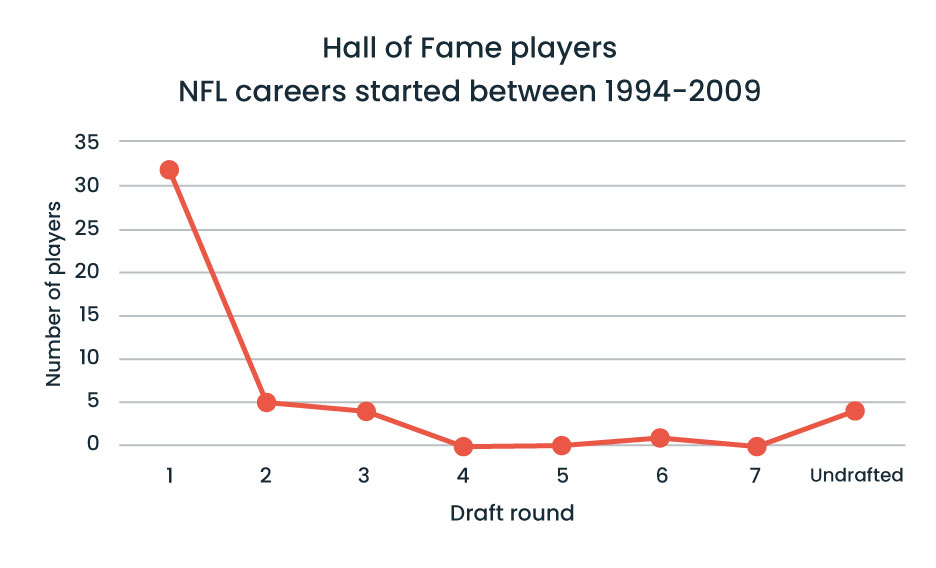
It sounds like hyperbole, but sports history repeatedly proves it true. From Tom Brady going in the sixth round to Nikola Jokic being selected during a commercial break, elite talent routinely slips through the cracks. Understanding why these players are overlooked helps explain how front offices miscalculate potential and how late-round gems rewrite sports history.
Why Elite Prospects Slide Down the Board
Draft boards are not objective science; they are filtered through the subjective biases of scouts, general managers, and coaches. When franchise-altering talents fall deep into the draft, it is rarely because they lack ability. Instead, specific systemic evaluations usually cause them to drop.
Overvaluing Athletic Testing Over Game Tape
Scouting combines physical testing with actual on-field or on-court production. Too often, teams fall in love with a prospect who runs a blistering 40-yard dash or displays incredible vertical leaping ability in a controlled gym setting. Meanwhile, players who consistently produce against elite competition but lack elite combine metrics get pushed down the board. Production usually beats potential, yet front offices continuously gamble on raw physical traits.
Small-School Obscurity and Competition Level
Athletes from smaller collegiate programs face an uphill battle. Scouts question whether a dominant player can replicate their success against major conference opponents. Because of this skepticism, generational talents from mid-majors or Division II schools linger on draft boards while inferior players from powerhouse programs fly off the board early.
Historical Proof: Late-Round Legends Who Defied the Odds

The proof is written permanently in league record books. The players who prove their doubters wrong often develop a profound chip on their shoulder that fuels a Hall of Fame career.
- Tom Brady (NFL): Picked 199th overall in 2000, Brady became the most decorated quarterback in NFL history with seven Super Bowl rings.
- Nikola Jokic (NBA): Selected 41st overall in 2014, the Serbian center transformed into a multi-time NBA MVP and NBA Champion.
- Richard Sherman (NFL): A fifth-round pick in 2011 who became an All-Pro cornerback and the vocal leader of the Seattle Seahawks' Legion of Boom.
- Albert Pujols (MLB): Drafted in the 13th round of the 1999 MLB Draft, Pujols went on to amass over 3,000 hits and 700 home runs.
The Psychology of the Chip on the Shoulder
Draft position dictates immediate financial compensation and early career opportunities, but it does not dictate career longevity. Players selected in the late rounds arrive at training camp with zero job security. They know that a single bad practice could result in an immediate release.
This precarious reality breeds an obsessive work ethic. While high first-round picks often receive guaranteed multi-million dollar contracts and immediate playing grace periods, late-round picks must fight for every single rep. That relentless drive is frequently the separating factor between a good professional athlete and a legendary Hall of Famer.
How Modern Analytics Are Changing the Evaluation Process
Today, front offices rely heavily on advanced analytics to find hidden value. Machine learning models, tracking data, and advanced efficiency metrics help uncover players whose production metrics dwarf their traditional scouting grades. Teams are getting better at identifying market inefficiencies, meaning future Hall of Famers might not slip as far as they used to.
However, the human element of sports can never be fully quantified. Intangibles like leadership, competitive fire, and situational awareness cannot be easily measured by a spreadsheet. As long as human evaluation remains part of the process, draft boards will miss out on elite prospects.
Conclusion: Trust the Tape, Not the Hype
The next time you watch your favorite team pass on a prospect repeatedly, remember that draft day is only the beginning of the story. The labels of "reach" and "steal" fade quickly once the games actually begin. History shows us time and time again that the players who are forced to wait the longest often end up having the loudest, most unforgettable careers.