Georgetown Average ACT: Scores, Policy, and Advice
Securing a spot at Georgetown University means joining one of the most prestigious academic communities in the United States. Situated in Washington, D.C., Georgetown draws tens of thousands of accomplished applicants each admissions cycle. Because the Hilltop attracts exceptional talent from around the world, understanding the georgetown average act score is a critical benchmark for determining where your standardized test scores stand relative to the competitive applicant pool.
Standardized testing plays a significant role in Georgetown’s evaluation process. Unlike many peer institutions that permanently adopted test-optional frameworks or standard Score Choice policies, Georgetown maintains a distinctive approach to admissions testing. Here is a clear breakdown of the numbers, school-specific variations, testing rules, and strategies to help your application succeed.
Understanding the Georgetown Average ACT and Score Ranges
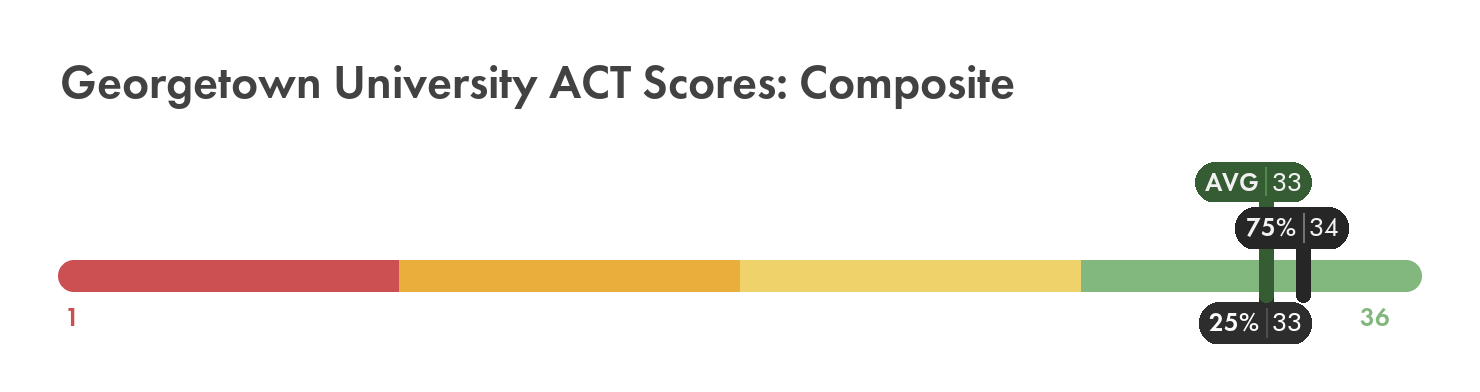
While Georgetown University does not report a single official "average" score as a cutoff, the university regularly publishes the middle 50% score range of its enrolled freshman class. The middle 50% represents the scores between the 25th percentile and the 75th percentile of admitted students.
- 25th Percentile ACT Score: 32
- 75th Percentile ACT Score: 35
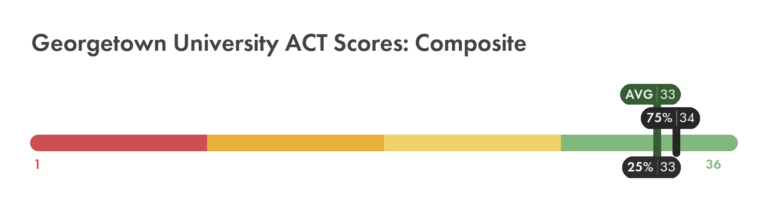
- Estimated Average ACT Score: 33–34
What do these percentiles mean for you? If your composite score is a 32, you scored higher than roughly 25% of Georgetown’s admitted class, placing you on the lower boundary of competitive applicants. If you score a 35, you fall into the top 25% of admitted students. Scoring below a 32 does not mean rejection is certain, but it does mean your academic coursework, extracurricular leadership, essays, and interview must carry heavier weight.
Section-by-Section ACT Expectations
Georgetown evaluates all four sections of the ACT. Competitive applicants typically achieve high percentiles across every discipline, but STEM-heavy programs and humanities programs may emphasize specific sections:
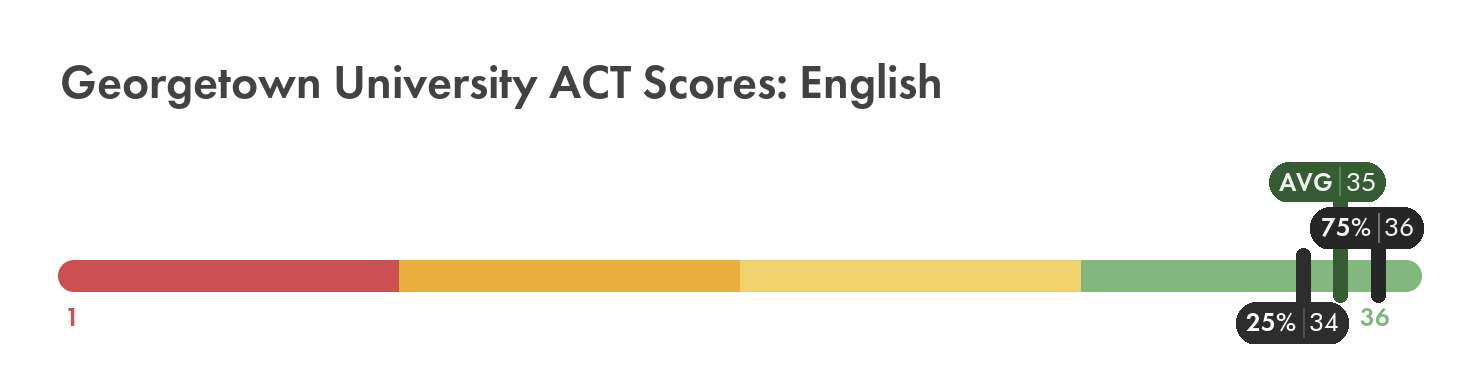
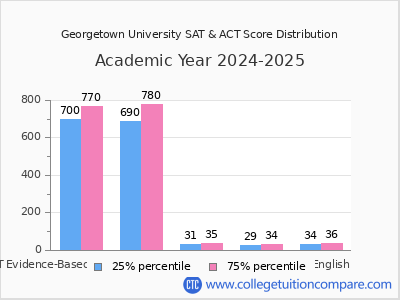
- English: 34–36
- Math: 30–35
- Reading: 33–36
- Science: 31–35
Score Variations Across Georgetown’s Undergraduate Schools
Georgetown University admits students directly into one of its distinct undergraduate schools. While academic standards remain high across the board, admitted profiles can vary depending on the focus of the specific program.
1. Georgetown College of Arts & Sciences
The oldest and largest undergraduate school hosts majors spanning the humanities, social sciences, and natural sciences. The middle 50% ACT range here typically mirrors the university-wide range of 32 to 35, with strong reading and writing subscores common among social science and literature applicants.
2. Walsh School of Foreign Service (SFS)
As one of the world’s foremost institutions for international affairs, the SFS attracts students with exceptional analytical and language aptitudes. Middle 50% composite scores typically hover around 33 to 35, with standout performance on the ACT Reading and English sections.
3. McDonough School of Business (MSB)
McDonough places significant value on quantitative capability. While the middle 50% range is generally 33 to 35, applicants with higher Math section scores (32–36) often stand out favorably in the quantitative evaluation.
Video: Should You Answer “Why Georgetown Law School” Even Though The Application Doesn’t Ask For It?
4. School of Health and School of Nursing
These specialized schools seek students passionate about healthcare, policy, and clinical practice. Middle 50% ranges generally fall between 31 and 34. Strong scores in the Science and Math sections demonstrate readiness for rigorous prerequisites in organic chemistry and human physiology.
Georgetown’s Unique Testing Policy: What You Need to Know
Before registering for another test or submitting your application, you must familiarize yourself with Georgetown’s specific rules regarding standardized tests. Georgetown differs significantly from Common Application schools in several key ways.
1. Requirement to Submit All Scores
Unlike institutions that permit Score Choice, Georgetown expects applicants to submit their complete testing record. If you took the ACT three times, you must report all three test sittings. Admissions officers review your complete testing journey rather than just a single cherry-picked sitting.
2. Does Georgetown Superscore the ACT?
Georgetown does not calculate an official "superscore" composite for the ACT the way some institutions do. However, admissions officers do practice holistic review: they consider your highest subscores across different sittings alongside your highest single composite score. Knowing they see all scores, consistency across multiple attempts is beneficial.
3. The Standalone Georgetown Application
Georgetown does not use the Common Application or the Coalition Application. You must apply through the university’s proprietary application portal. This portal requires you to self-report all testing dates and arrange for official score reports from ACT, Inc. to be sent directly to the admissions office.
How to Build a Competitive ACT Score for Georgetown
Because Georgetown requires all testing sittings to be reported, you want to approach test day with deliberate preparation rather than taking the test cold to "see how you do."
- Prioritize Targeted Diagnostic Testing: Take an official, timed practice exam from ACT, Inc. early in your junior year. Pinpoint whether pacing, content gaps, or test anxiety are pulling down your composite score.
- Master the ACT Science Section: Many students struggle with ACT Science not due to a lack of science knowledge, but because it is a fast-paced data-interpretation test. Practice analyzing graphs, experimental variables, and conflicting viewpoints under strict time limits.
- Address Math Fundamentals: The ACT Math section tests concepts ranging from pre-algebra through basic trigonometry. Ensure you can solve early and mid-level questions rapidly so you have adequate time for multi-step questions at the end.
- Cap Your Sittings: Because Georgetown reviews every score report, aim to take the official exam no more than two or three times. Plan your preparation thoroughly so each sitting demonstrates intentional effort and solid results.
Beyond the ACT: What Else Does Georgetown Look For?
A score of 34 or 35 places you in a comfortable testing bracket, but it does not guarantee admission. Georgetown denies thousands of applicants with top-tier scores each year. To gain admission, your file must excel across several complementary components:
- Curriculum Rigor and GPA: Georgetown values an unweighted GPA near 3.9 or higher within the most demanding curriculum available at your school (AP, IB, or dual enrollment). Admissions officers want to see that you challenged yourself in core academic subjects.
- The Alumni Interview: Georgetown is one of the few elite universities where the alumni interview is a mandatory component for nearly all domestic and international applicants. The interview is an opportunity to discuss your intellectual interests and demonstrate your fit for the university’s Jesuit values.
- School-Specific Essays: Georgetown requires applicants to write a school-specific essay explaining why they are applying to the College, SFS, MSB, or School of Health/Nursing. Specificity about faculty research, courses, and institute resources demonstrates genuine interest.
- Commitment to "Cura Personalis": Rooted in Jesuit heritage, Georgetown values "cura personalis"—care for the whole person—and service to others. Meaningful, sustained engagement in your community often resonates more than a superficial list of club memberships.
Final Thoughts
A competitive ACT score for Georgetown falls comfortably between 32 and 35. If your score sits in or above that window, your standardized testing checks the necessary box, allowing the admissions committee to focus on your essays, recommendations, and personal character. Prepare deliberately, respect the university's full-disclosure testing policy, and present a cohesive, service-oriented narrative throughout your application.