Get Accredited in Colorado: Licensure Options
Whether you are expanding a healthcare practice, launching a vocational school, or establishing a licensed trade business, knowing how to get accredited in Colorado: the ultimate guide to licensure options begins with understanding the state’s specific regulatory structure. Colorado does not use a one-size-fits-all model. Instead, authority is distributed across several specialized agencies, primarily led by the Department of Regulatory Agencies (DORA). Navigating these requirements effectively protects your organization from compliance penalties and establishes immediate credibility with consumers and institutional partners.

Licensure vs. Accreditation: Understanding the Distinction
In regulatory discussions, “licensure” and “accreditation” are often used interchangeably, but in Colorado law, they serve distinct legal functions:
- Licensure: A mandatory state grant of legal authority to practice a profession or operate a regulated facility. Licensure is issued by government entities such as DORA or the Colorado Department of Public Health and Environment (CDPHE). Operating without a required license is illegal.
- Accreditation: A formal verification by an authorized third-party peer-review agency confirming that an institution, program, or facility meets rigorous industry standards. Accreditation is common in healthcare facilities, colleges, and technical academies. In many fields, institutional accreditation is a mandatory prerequisite to obtain state licensure.
Key Colorado Regulatory Authorities
Before applying, you must identify which agency exercises jurisdiction over your specific sector:
1. Colorado Department of Regulatory Agencies (DORA)
DORA’s Division of Professions and Occupations (DPO) oversees more than 50 boards, programs, and commissions representing over 500,000 active professionals. DORA regulates sectors such as behavioral health, nursing, electrical contracting, plumbing, accountancy, and real estate.
2. Colorado Department of Public Health and Environment (CDPHE)
CDPHE licenses healthcare facilities, residential care centers, laboratories, home health providers, and emergency medical service agencies across the state.
3. Division of Private Occupational Schools (DPOS)
Housed within the Colorado Department of Higher Education (CDHE), DPOS regulates private vocational and career schools, ensuring that non-degree vocational training programs meet structural, educational, and financial stability standards.
Get Accredited in Colorado: The Ultimate Guide to Licensure Options
Licensing pathways vary significantly depending on your operating sector. Below are the primary options and industry tracks in the state.
Video: How to Become a Teacher in Colorado | Licensing & Certification Guide

Healthcare and Clinical Practices
Colorado maintains rigorous standards for both individual clinical practitioners and health facilities:
- Individual Practitioners: Physicians, nurses, physician assistants, and allied health professionals must clear credentialing checks through the relevant DORA board. Colorado belongs to several interstate compacts, including the Nurse Licensure Compact (NLC) and the Interstate Medical Licensure Compact (IMLC), expediting endorsement for providers licensed in partner states.
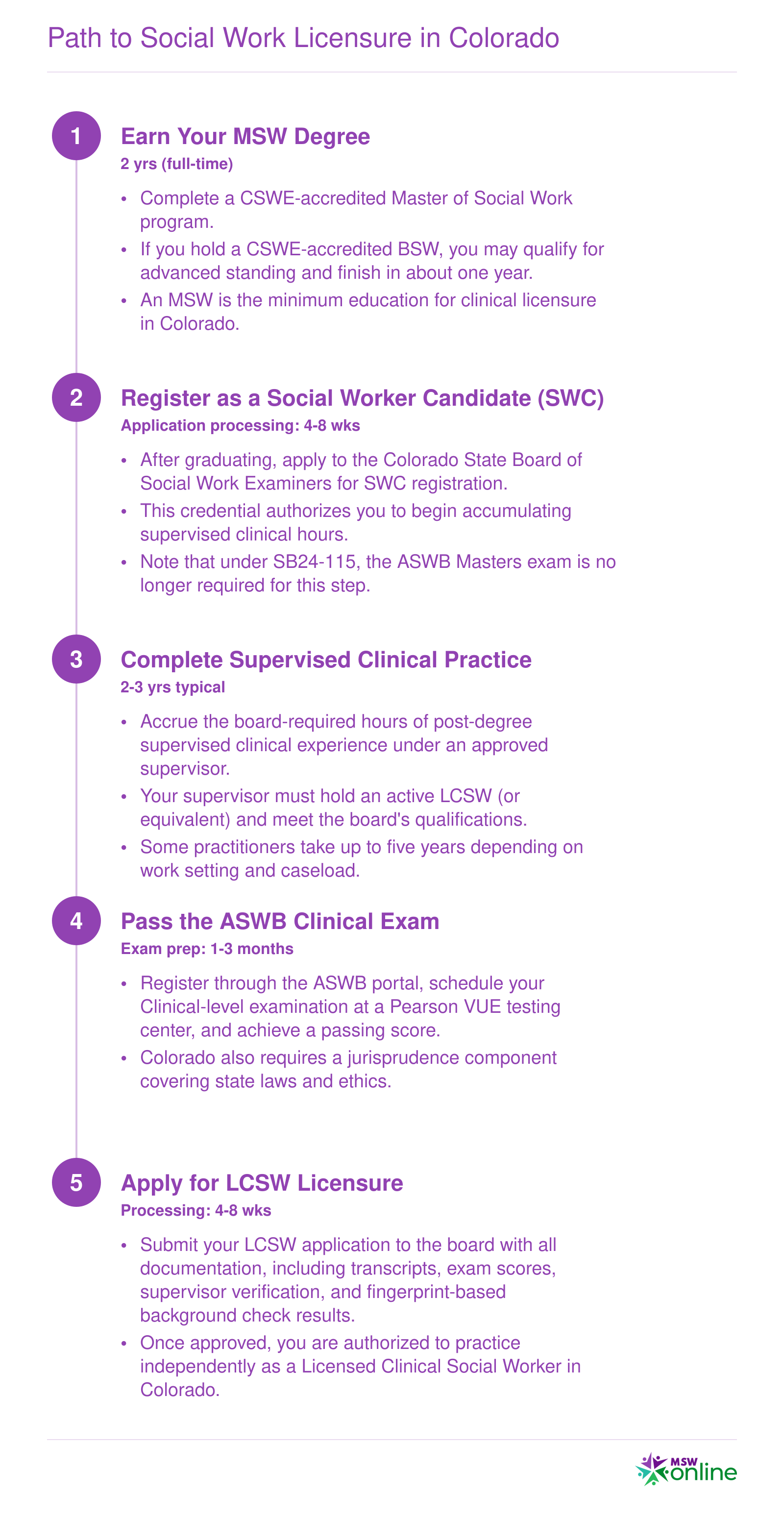
- Mental and Behavioral Health: Administered under the State Board of Licensed Professional Counselor Examiners, Social Work Examiners, and Marriage and Family Therapist Examiners. Applicants need accredited graduate degrees, supervised post-degree clinical hours (typically 2,000 to 3,000 depending on the license), and passage of national exams (such as the NCE or ASWB).
- Healthcare Facilities: Clinics, outpatient surgery centers, and assisted living residences must apply through the CDPHE Health Facilities and Emergency Medical Services Division. State licensure inspections and Life Safety Code assessments must be passed before admission of patients.
Skilled Trades and Construction Services
Colorado regulates electrical and plumbing work at the state level, whereas general contracting is largely delegated to local municipal or county jurisdictions.
- State Electrical Board: Offers licenses for Apprentice, Journeyman, Master, and Electrical Contractor designations. Contractor status requires a designated Master Electrician of record, workers’ compensation compliance, and unemployment insurance verification.
- State Plumbing Board: Issues Residential, Journeyman, Master, and Plumbing Contractor licenses based on verified field hours and practical code examinations.
- General Contractors: Must consult local building departments (such as Denver’s Community Planning and Development or Colorado Springs’ Pikes Peak Regional Building Department) for regional testing, bonding, and municipal licensing.
Private Vocational and Technical Schools
If you plan to launch a vocational program, coding academy, or trade school, you must obtain a Certificate of Approval from the Division of Private Occupational Schools (DPOS) before enrolling students or advertising:
- Curriculum and Faculty Review: Demonstrate that course content, clock hours, and instructor qualifications meet vocational criteria.
- Financial Surety: Post a continuous surety bond or bond alternative based on projected gross tuition income to safeguard student tuition payments.
- Student Protection Policies: Provide standardized enrollment agreements, refund policies, and grievance disclosures aligned with Colorado Revised Statutes Title 23, Article 64.
Professional Service Firms (Real Estate, Accountancy, Architecture)
Corporate entities practicing architecture, landscape architecture, engineering, land surveying, public accountancy, or real estate brokerage must register their firm with the appropriate DORA board alongside maintaining individual licensee registrations. In most cases, an actively licensed Colorado professional must serve as the qualifying broker, managing partner, or engineer of record.
Step-by-Step Roadmap to Colorado Licensure
While industry-specific rules vary, obtaining a business or professional license in Colorado generally follows this step-by-step path:
- Entity Formation: Register your business structure (LLC, PLLC, Corporation) with the Colorado Secretary of State (SOS) and obtain a Certificate of Good Standing.
- Acquire Prerequisite Accreditation: If your field requires institutional or educational accreditation (e.g., higher education or specialized healthcare), secure approvals from national or regional accrediting bodies recognized by the U.S. Department of Education or CHEA.
- Prepare Background Checks and Documentation: Most DORA boards require fingerprint-based criminal history records checks through the Colorado Bureau of Investigation (CBI) and the FBI.
- Submit Online via the DORA Portal: Applications must be submitted through the DORA online services portal, including fee remittance, transcripts, affidavits of eligibility, and proof of required insurance (general liability, malpractice, or workers’ compensation).
- Complete Jurisdiction and Jurisprudence Exams: Several Colorado boards (notably real estate, mental health, and nursing) require an open-book online jurisprudence exam evaluating your knowledge of Colorado statutes and board rules.
Maintaining Compliance: Renewals and Compact Privileges
Colorado operates on strict, multi-year renewal schedules. Most DORA licenses renew on a fixed cycle (annual or biennial) regardless of the date of issuance. Keep the following operational rules in mind:
- Continuing Professional Competency (CPC): Fields such as nursing, professional engineering, and counseling mandate audits of Continuing Education Units (CEUs) or ongoing competency portfolios.
- Interstate Telehealth and Compacts: If you practice via telehealth into Colorado, you must either hold a direct Colorado license, an active compact privilege, or register through the state’s out-of-state healthcare provider system where authorized.
- Address and Name Changes: Licensees are legally required to inform DORA of legal name or primary business address adjustments within 30 days to avoid administrative citations.
By determining your governing body early, securing prerequisite accreditations, and submitting verified credentials through the appropriate Colorado portal, you can secure your credentials without avoidable delays and launch your operations on solid regulatory footing.