GTX 1050 Ti vs RX 570: Budget GPU Showdown
Introduction to Budget Graphics Cards

When building or upgrading a budget gaming PC on the used market, few debates are as classic as the 1050 Ti vs RX 570 matchup. Released in the mid-to-late 2010s, both of these graphics cards became legends in their own right. They powered countless entry-level rigs designed for esports titles and 1080p gaming.
However, while they occupied a similar price bracket when new, they approached performance and architecture from entirely different angles. NVIDIA's GTX 1050 Ti focused on extreme power efficiency, while AMD's RX 570 prioritized raw compute performance and future-proofing through a wider memory bus. Today, understanding how these two cards compare will help you make the right choice for a budget build.
Specifications and Architecture
To understand why these cards perform differently, we need to look under the hood. Their technical specifications reveal stark contrasts in design philosophy.
NVIDIA GeForce GTX 1050 Ti Specs
- Architecture: Pascal (GP107)
- VRAM: 4GB GDDR5
- Memory Bus Width: 128-bit
- CUDA Cores: 768
- TDP (Power Consumption): 75W
- Power Connectors: Usually none (draws power entirely from the PCIe slot)
AMD Radeon RX 570 Specs
- Architecture: Polaris (Ellesmere)
- VRAM: 4GB or 8GB GDDR5 (4GB is most common)
- Memory Bus Width: 256-bit
- Stream Processors: 2048
- TDP (Power Consumption): 150W
- Power Connectors: 1x 6-pin or 1x 8-pin required
Right away, the numbers tell a clear story. The RX 570 features more than double the stream processors and a 256-bit memory bus compared to the 1050 Ti's 128-bit interface. This wider bus gives the AMD card a massive bandwidth advantage, especially at higher settings and resolutions.
Gaming Performance Comparison
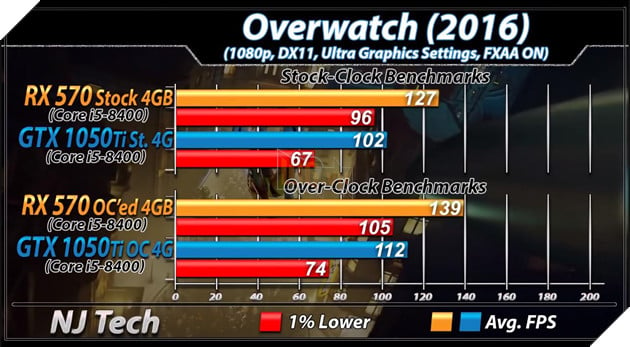
When it comes to actual gameplay, the RX 570 decisively outperforms the GTX 1050 Ti across almost every modern game title. Let's break down how they handle different categories of games at 1080p resolution.
Esports and Older Titles
In lighter esports games like Counter-Strike 2, League of Legends, Dota 2, and Valorant, both cards deliver a great experience. You can easily achieve high refresh rate counts by lowering settings to medium or high. The performance gap here is noticeable, but both GPUs will keep your frame rates well above 60 FPS.
AAA and Modern Games
When you fire up demanding modern titles or recent graphically intense releases, the differences become glaring. The RX 570 typically delivers 30% to 50% higher frame rates than the GTX 1050 Ti depending on the title.
Video: GTX 1050 Ti vs Rx 570 | Biggest Comparison

While the 1050 Ti often struggles to maintain a stable 30-45 FPS on Medium settings in heavy games, the RX 570 can often push past 50-60 FPS with tweaked settings. Furthermore, the RX 570 handles Vulkan and DirectX 12 APIs much better than the aging Pascal architecture of the 1050 Ti, resulting in smoother frame delivery and fewer micro-stutters.
Power Consumption and System Requirements
Performance is only part of the equation. Power efficiency and hardware compatibility are crucial factors, especially if you are working with an older pre-built office PC (like a Dell OptiPlex).
The GTX 1050 Ti Advantage: Plug and Play
The standout feature of the GTX 1050 Ti is its 75W TDP. Because it pulls all of its required power directly from the PCIe slot on the motherboard, it rarely requires a dedicated power supply cable. This makes it the ultimate drop-in upgrade for old OEM desktop systems with proprietary, low-wattage power supplies (such as 240W or 300W units).
The RX 570 Requirement: Better PSU Needed
The RX 570 demands up to 150W of power under load and requires at least a 450W power supply equipped with a dedicated 6-pin or 8-pin PCIe power connector. If you are building a custom PC from scratch, this is rarely an issue. However, if you are trying to upgrade a basic office PC without a standard power supply, the RX 570 will require you to purchase a new PSU as well.
Pricing and Used Market Value
Since both of these graphics cards are long out of production, you will find them primarily on the used market (eBay, Facebook Marketplace, Reddit hardwareswap).
Interestingly, despite its lower performance, the GTX 1050 Ti often commands a similar or even slightly higher price than the RX 570. Why? Because of its low power consumption and high compatibility with old pre-builts. Parents and casual builders snap up the 1050 Ti because they know it will work in almost any computer without changing the power supply.
Conversely, miners heavily targeted the RX 570 during the crypto booms, meaning there is a massive supply of used cards available. If you look closely, you can often find an RX 570 for a bargain price, making its price-to-performance ratio exceptionally high.
Conclusion: Which One Should You Buy?
The choice ultimately depends on your existing hardware setup:
- Buy the AMD RX 570 if: You want maximum gaming performance for your money, your power supply has the necessary 6-pin/8-pin connector, and you are building a standard custom PC. It crushes the 1050 Ti in frame rates and ages much better.
- Buy the NVIDIA GTX 1050 Ti if: You are upgrading a restricted, proprietary pre-built office PC that lacks a power supply connector and has a weak wattage limit. It is the safer, low-wattage drop-in solution.
For pure gaming performance and value, the RX 570 wins the head-to-head battle. Just make sure your power supply is up to the task before buying.