Hasbrouck and Tindal Fluency Norms 2017 Guide
Oral reading fluency (ORF) serves as one of the most reliable indicators of overall reading competence in elementary and middle school students. To evaluate whether a student reads with sufficient automaticity to support comprehension, educators rely on standardized benchmark data. The hasbrouck and tindal fluency norms 2017 update represents the definitive national reference for assessing Words Correct Per Minute (WCPM) across grades 1 through 6, giving teachers and interventionists clear targets for screening and progress monitoring.

Understanding these norms enables educators within a Multi-Tiered System of Supports (MTSS) or Response to Intervention (RTI) framework to quickly identify struggling readers, set ambitious but realistic growth goals, and prevent the misconception that faster reading is always better reading.
Understanding the Hasbrouck and Tindal Fluency Norms 2017 Update
Drs. Jan Hasbrouck and Gerald Tindal first compiled national oral reading fluency norms in 1992 and expanded them in 2006. In 2017, they published a comprehensive revision through Behavioral Research and Teaching at the University of Oregon. This technical report drew on screening data from hundreds of thousands of students using modern assessment platforms such as DIBELS Next and easyCBM.
While the 2006 norms evaluated grades 1 through 8, the 2017 update focused specifically on grades 1 through 6, reflecting where ORF assessments are most frequently administered and psychometrically valid. The updated data reaffirmed earlier findings while refining percentile distributions across Fall, Winter, and Spring screening windows.
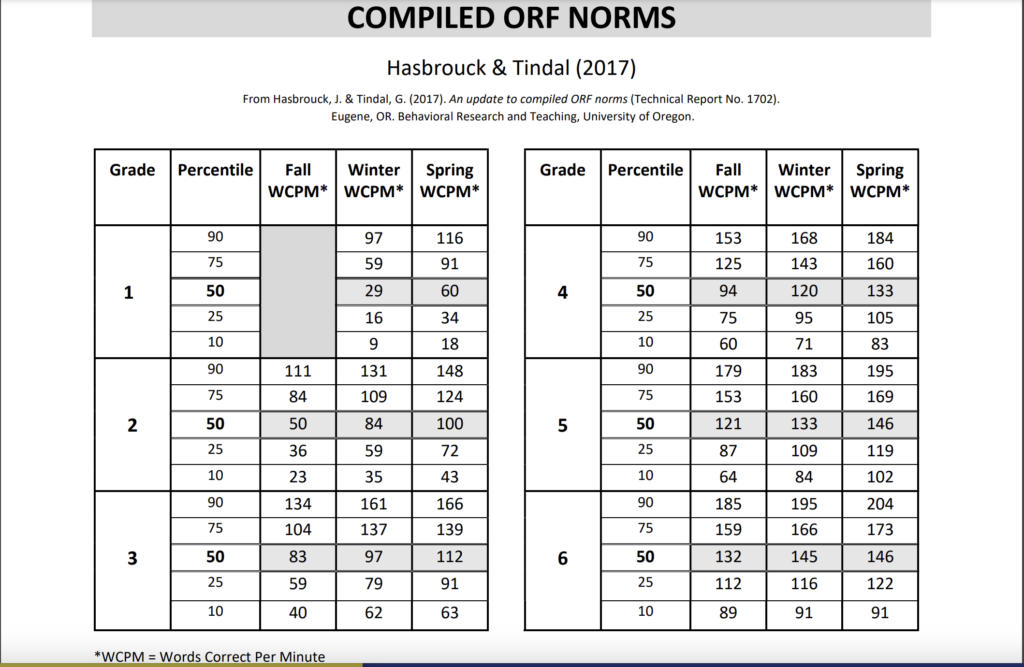
Complete 2017 Hasbrouck & Tindal ORF Norms Chart
The table below summarizes median scores and critical risk percentiles for grades 1 through 6. All scores represent Words Correct Per Minute (WCPM) on unpracticed, grade-level passages read aloud for one minute.
| Grade | Percentile | Fall (WCPM) | Winter (WCPM) | Spring (WCPM) |
|---|---|---|---|---|
| Grade 1 | 75th | — | 47 | 82 |
| 50th (Benchmark) | — | 29 | 60 | |
| 25th (At Risk) | — | 16 | 34 | |
| Grade 2 | 75th | 84 | 111 | 124 |
| 50th (Benchmark) | 50 | 84 | 100 | |
| 25th (At Risk) | 26 | 53 | 70 | |
| Grade 3 | 75th | 104 | 128 | 137 |
| 50th (Benchmark) | 83 | 97 | 112 | |
| 25th (At Risk) | 51 | 69 | 81 | |
| Grade 4 | 75th | 125 | 145 | 156 |
| 50th (Benchmark) | 94 | 120 | 133 | |
| 25th (At Risk) | 66 | 88 | 98 | |
| Grade 5 | 75th | 145 | 166 | 171 |
| 50th (Benchmark) | 121 | 133 | 146 | |
| 25th (At Risk) | 86 | 101 | 111 | |
| Grade 6 | 75th | 157 | 172 | 177 |
| 50th (Benchmark) | 132 | 145 | 146 | |
| 25th (At Risk) | 99 | 112 | 115 |
How to Interpret the Percentiles
Hasbrouck and Tindal emphasize that ORF assessments are screening measures, not comprehensive diagnostic tests. They act like a thermometer: indicating whether a student's reading system is functioning smoothly or experiencing distress.
The 50th Percentile: The Target Zone
Students scoring at or slightly above the 50th percentile demonstrate sufficient automaticity to allocate their cognitive bandwidth toward comprehension. According to Hasbrouck and Tindal, aiming significantly higher than the 50th percentile offers diminishing returns. A student reading at the 90th percentile is rarely a "better" comprehender than one at the 60th; they may simply be rushing through punctuation.
The 25th to 49th Percentiles: Strategic Watch

Students in this band read well enough to access parts of the curriculum, but their decoding is not yet effortless. They benefit from close classroom monitoring, small-group fluency instruction, and targeted partner reading.
Below the 25th Percentile: High Risk
Scores falling more than 10 words below the 50th percentile, or below the 25th percentile threshold, warrant immediate attention. For these students, lack of fluency is almost always a symptom of an upstream decoding, phonics, or phonemic awareness deficit. Providing repeated reading practice alone will not solve the underlying issue; diagnostic phonics assessments should follow.
Administering an ORF Assessment
To produce valid results comparable to the 2017 norms, teachers must adhere to standardized administration procedures:
- Use standardized, unread passages: The student must read grade-level text they have not previously seen or practiced.
- Time exactly one minute: Start timing when the student reads the first word. If the student struggles with a word for 3 seconds, supply it and mark it as an error.
- Calculate WCPM: Subtract the total number of errors from the total number of words read during the 60-second window:
Total Words Read − Uncorrected Errors = WCPM. - Conduct three reads during benchmarking: When conducting universal screening (Fall, Winter, Spring), have the student read three distinct passages and record the median (middle) score to account for passage variability.
What Counts as an Error?
- Mispronunciations or word substitutions.
- Omissions of words.
- Words read out of order.
- Words requiring teacher assistance after a 3-second pause.
Self-corrections made within 3 seconds, insertions, and dialectal variations are not scored as errors.
Three Common Mistakes When Using Fluency Norms
While the Hasbrouck and Tindal norms are straightforward, schools frequently misapply them in ways that harm instructional outcomes:
- Treating fluency as speed reading: Fluency consists of three distinct elements: accuracy, rate, and prosody (expression). Rushing students to beat higher numbers encourages careless guessing and destroys comprehension. If expression and phrasing disappear, fluency has declined, regardless of the raw WCPM score.
- Benchmarking with instructional-level passages: Fluency norms are calibrated exclusively against grade-level passages. Assessing a struggling 4th grader on a 2nd-grade text will show progress on that specific passage, but the resulting WCPM cannot be compared directly to 4th-grade norms.
- Expecting linear growth across all grades: Growth rates naturally flatten as students mature. Second and third graders often gain 1.0 to 1.5 words per week, while fifth and sixth graders typically gain 0.5 words or fewer per week as vocabulary complexity increases and silent reading becomes primary.
Putting the 2017 Norms into Practice
The Hasbrouck and Tindal 2017 fluency norms remain an indispensable baseline for data-driven literacy instruction. When schools anchor their screening in these benchmarks, they eliminate guesswork, direct intervention resources to the students who need them most, and preserve their primary instructional goal: developing fluent, confident, and reflective readers.