How Did Master P’s Net Worth Jump From $100K to $1 Billion?
Introduction

When Percy Miller, known globally as Master P, burst onto the hip-hop scene in the 1990s, the music industry operated under strict major-label rules. Artists signed away their masters, accepted small royalty percentages, and relied heavily on corporate backing to reach audiences. Yet, through sheer tenacity and a revolutionary distribution model, Miller broke the mold. Understanding how Master P’s net worth jump from $100K to $1 billion happened requires looking far beyond standard music royalties. It is a masterclass in independent distribution, brand diversification, and relentless entrepreneurial grit.
To truly grasp this financial evolution, we have to unpack the foundational days of No Limit Records, the strategic business pivots he made outside of music, and the smart investments that turned a self-made millionaire into a billionaire business mogul.
The Humble Beginnings and the First $100K
Before the diamond-encrusted chains, tanks on stage, and multi-platinum albums, Percy Miller was a young entrepreneur from the Calliope Projects in New Orleans. Life in the projects was fraught with poverty, violence, and limited economic mobility. After attending the University of Houston on a basketball scholarship, Miller returned home following the tragic death of his brother.
Starting the Brick-and-Mortar Record Store
In 1989, Miller used a $10,000 malpractice settlement from his grandfather's passing to move to Richmond, California. There, he opened a small record store called No Limit Records. This storefront served as his real-world business school.
By listening closely to what his customers bought, Miller learned what music sold, how retail distribution functioned, and where the gaps in the market lay. Within a few years, that initial capital and the proceeds from the shop pushed his personal liquid worth to around $100,000. While $100K was a life-changing sum for a young man from New Orleans, it was merely the launchpad for an unprecedented commercial empire.
The No Limit Records Revolution
In the mid-1990s, Master P relocated No Limit Records back to New Orleans and shifted focus from retail to recording. Instead of signing with an established label, he engineered a groundbreaking distribution deal with Priority Records in 1996.
While most artists gave up ownership for standard advances, Master P negotiated a deal where No Limit retained 80% to 85% of its profits, while fronting the manufacturing and marketing costs themselves. Priority simply handled the physical shipping to stores. This single contractual coup changed the hip-hop economy forever.
The Volume and Branding Strategy
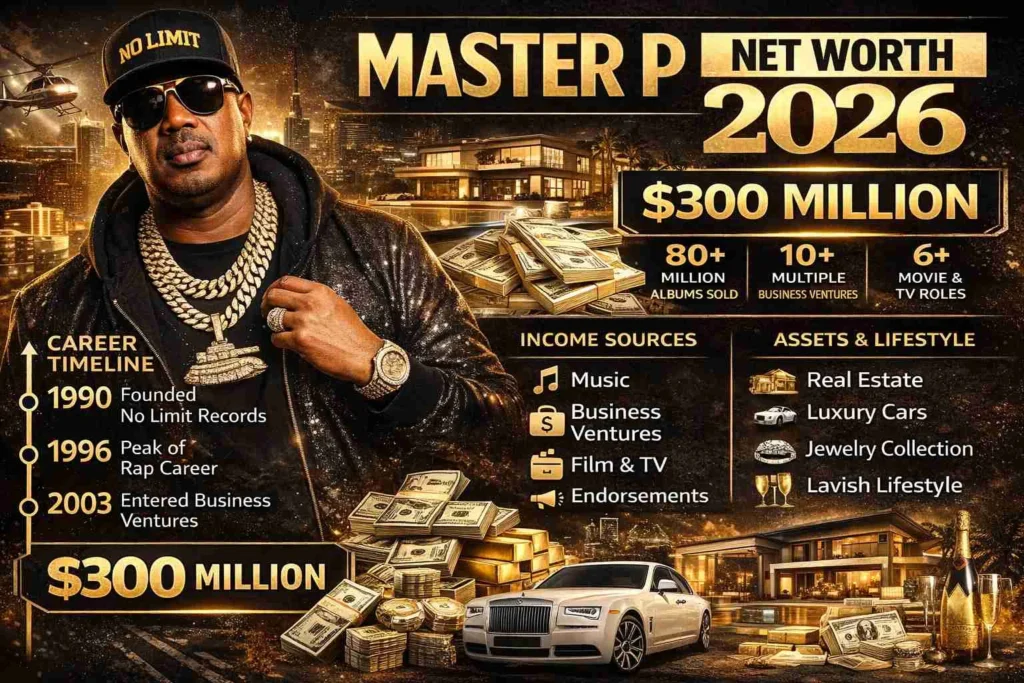
Master P treated hip-hop like a fast-moving consumer goods company. He instituted a prolific release schedule, dropping albums by artists like Snoop Dogg, C-Murder, Silkk the Shocker, and himself almost simultaneously. Fans could always spot a No Limit album thanks to the iconic, chaotic cartoon covers designed by Pen & Pixel.
- High Output: Releasing up to 20 or more albums a year kept the No Limit brand constantly relevant.
- Merchandising: The distinctive tank logo appeared on t-shirts, posters, and hats, turning fans into walking billboards.
- Cross-Promotion: Artists appeared on each other's tracks and videos, building a communal ecosystem that drove massive unit sales.
By the late 1990s, No Limit was generating an estimated $30 million to $50 million annually, pushing Master P’s personal wealth into the tens of millions.
Diversification: Beyond Music and Into the Billion-Dollar Realm
Music was merely the engine that funded Master P’s wider business ambitions. Long before modern tech moguls and rappers began preaching about portfolios and venture capital, Miller was buying up real estate, launching clothing lines, and investing in sports management.
Smart Investments That Scaled the Fortune
The transition from a multi-millionaire music executive to a billionaire businessman required aggressive diversification. Miller understood that music catalogs fluctuate in value, but tangible assets provide lasting security.
- Real Estate: Miller consistently reinvested his music earnings into residential and commercial real estate properties across the American South and California.
- Film and Television: He financed, produced, and distributed independent straight-to-DVD movies through No Limit Films, keeping nearly 100% of the production and distribution revenues.
- Sports Management: He briefly tried out for the NBA (playing preseason games for the Charlotte Hornets and Toronto Raptors) and later launched No Limit Sports, representing professional athletes.
- Consumer Goods: From shoes (Paris Footwear) to telecommunications and cereal, Miller consistently entered consumer markets where everyday people spent their hard-earned cash.
The Cereal Brand and Modern Ventures
One of the most visible steps in Miller's modern business journey is Uncle P’s Louisiana Brand, which includes food products like rice, grits, and cereal. When Miller noticed that major grocery store chains lacked representation from Black-owned food manufacturers, he created a brand designed to feed communities while keeping wealth within them.
Furthermore, Miller has continuously invested in tech startups, film distribution platforms, and finance companies. By leveraging his massive cultural equity alongside traditional venture capital strategies, his cumulative business ventures, trademark portfolios, and enterprise valuations ultimately pushed his net worth into the billion-dollar bracket.
Conclusion
The journey of Percy Miller proves that generational wealth is built through vision, ownership, and relentless discipline. When examining how Master P’s net worth jump from $100K to $1 billion happened, the answer is clear: it was never just about a hit song. It was about turning a $10,000 inheritance into a record store, using that store to launch an independent label, and continuously funneling those profits into real estate, consumer goods, and media ventures. Master P didn't just participate in the American Dream—he rewrote the rules to build his own.