How Edison’s $1 Billion Fortune Was Built
When most people think of Thomas Edison, they picture a lone genius staring into a glowing glass bulb in a dark workshop. Popular culture loves the myth of the solitary inventor striking lightning in a bottle. However, the true story behind How Edison’s $1 Billion Fortune Was Built—The Story of Brilliant Minds! is far more complex, collaborative, and cutthroat than the bedtime stories suggest.

Edison was undeniably a visionary, but his ultimate financial success was the result of industrial systems, aggressive patent strategies, and an elite team of researchers. By adjusting for inflation, Edison's peak net worth and business empire easily translate into the billionaire tier today. Let us pull back the curtain on how this wealth was actually accumulated.
The Menlo Park Invention Factory
Before Edison established his empire, inventors typically worked alone in small, poorly funded spaces. Edison changed the game in 1876 by opening the world’s first industrial research laboratory in Menlo Park, New Jersey. This was not just a workshop; it was an invention factory.
Edison realized that to generate a steady stream of profitable products, he needed division of labor. He recruited top-tier physicists, mathematicians, machinists, and chemists from around the globe. This collective brainpower allowed Edison to run multiple projects simultaneously.
The Power of Collaborative Genius
While Edison provided the overarching vision and financial backing, his 'muckers'—as he affectionately called his staff—did much of the grueling trial-and-error work. Key figures in his inner circle included:
- Francis Jehl: A loyal laboratory assistant who meticulously documented thousands of experiments.
- Charles Batchelor: A master machinist and draftsman who helped turn rough sketches into functioning prototypes.
- Nikola Tesla (briefly): A brilliant electrical engineer whose direct-current vs. alternating-current rivalry with Edison later reshaped the industry.
By leveraging these brilliant minds, Edison could scale his output. He famously stated that his goal was to produce a minor invention every ten days and a big thing every six months.
Monetizing the Bulb and the Grid
Video: The Dark Side of Thomas Edison
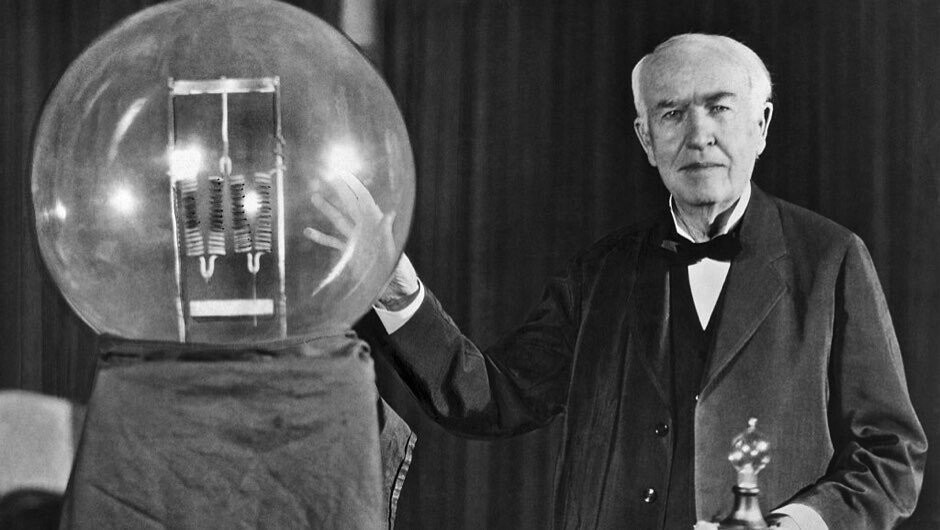
The cornerstone of Edison’s fortune was not just the incandescent light bulb, but the entire ecosystem required to power it. Edison understood that a bulb was useless without electricity, and electricity was useless without a distribution network.
Through the Edison Electric Light Company (which later evolved into General Electric), he patented every component of the electrical grid. He owned the dynamos, the underground cables, the meters, the switches, and the lamps. Consumers did not just buy a product; they subscribed to an entire utility infrastructure. This created recurring revenue streams that cemented his financial dominance.
The Business Tactics of a Titan
Invention was only half of Edison’s formula. The other half was ruthless commercialization. Edison operated much like modern tech moguls, utilizing several distinct business strategies:
- Aggressive Patenting: Edison held 1,093 patents in his lifetime. He patented variations of his inventions to block competitors from entering the market.
- Vertical Integration: By manufacturing his own goods through ventures like the Edison Machine Works, he controlled the supply chain from raw materials to end-user sales.
- Strategic Publicity: Edison was a master of public relations. He orchestrated high-profile public demonstrations to generate media buzz and investor confidence.
If a product could not be manufactured profitably, Edison abandoned it, regardless of its scientific merit. His famous maxim, "Anything that won't sell, I don't want to invent," highlights his pragmatic approach to commerce.
The Legacy of Edison's Empire
The fortune Edison built laid the foundation for the modern corporate research lab and the tech industry as we know it today. Companies like Apple, Google, and Bell Labs trace their operational lineage directly back to Menlo Park.
Ultimately, Edison’s billionaire status was a testament to teamwork, industrial scale, and relentless drive. By surrounding himself with the brightest minds of the 19th and 20th centuries and locking down the commercial infrastructure of electrification, he transformed clever ideas into enduring global wealth.