How His Hometown Fueled Fernando Alonso’s Path to Ferrari Glory
When Fernando Alonso stood atop the podium at Monza in September 2010 draped in Ferrari scarlet, an ocean of passionate Tifosi roared beneath him. Yet scattered across that roaring sea of red were vibrant flashes of sky blue and bright yellow—the colors of Asturias, the rugged region in northern Spain where Alonso was born and raised. To understand the relentless determination that defined his era at Maranello, one must look at how his hometown fueled Fernando Alonso’s path to Ferrari glory. Far from the traditional racing circuits of England or the Mediterranean wealth of Monaco, Alonso’s driving genius was cast in the industrial, damp, and uncompromising landscape of Oviedo.
Oviedo and the Making of an Unlikely Underdog
Born in July 1981 in Oviedo, Fernando Alonso Díaz did not come from motorsport royalty. His mother worked at a department store, and his father, José Luis Alonso, was an amateur kart enthusiast employed as an explosives technician at an industrial manufacturing plant. There were no multi-million-euro sponsorships waiting at the door. In fact, Spain had very little modern Formula 1 culture at the time; the country was obsessed with motorbikes and rally racing, largely viewing Grand Prix racing as an aristocratic foreign pastime.
Alonso’s racing journey began on makeshift terms. José Luis initially constructed a small pedal kart for Fernando’s older sister, Lorena. When she showed little interest, three-year-old Fernando climbed into the seat. His father adjusted the pedals with blocks of wood so the toddler could reach the controls. What began as a backyard hobby quickly unveiled an unprecedented natural talent. However, natural ability alone was never going to be enough to carry an Asturian kid to Formula 1.
Because the Alonso family operated on a shoestring budget, Fernando’s earliest motorsport lessons were grounded in economy, sacrifice, and mechanical necessity:
- Self-Taught Mechanical Ingenuity: Alonso spent his childhood weekends traveling with his father in a modest family car towing a small trailer, spending nights working late under garage lamps to repair secondhand parts.
- Respect for Machinery: Because broken components meant an early end to a racing weekend, Alonso developed a sympathetic driving style that extracted peak speed without destroying tires, brakes, or gearboxes.
- The Value of Every Lap: Every test session was treated as a precious commodity. Unlike wealthy rivals who burned through sets of new tires, Fernando learned to deliver maximum pace on heavily worn rubber.
Rain, Grit, and Improvised Circuits in Northern Spain
The geography of Asturias played an equally critical role in molding Alonso’s racecraft. Bordered by the Cantabrian Mountains on one side and the Atlantic ocean on the other, Oviedo experiences persistent rain, dense morning mists, and notoriously slick asphalt. The local karting tracks—often hastily set up in industrial parking lots or rudimentary regional venues—were unforgiving.
Because the family rarely had the funds to purchase expensive specialized wet-weather tires, young Fernando was frequently sent onto soaked tracks on slick dry tires. What seemed like a severe disadvantage transformed into his greatest superpower. Navigating streaming water on treadless rubber forced Alonso to develop a microscopic sensitivity to grip. He learned to detect the exact microsecond a tire began to slide, mastering subtle steering corrections and delicate throttle modulation that later astonished Formula 1 engineers.
This regional climate instilled a foundational philosophy in Alonso: weather and machinery were never excuses. When track conditions deteriorated, or when your package was slower than the competition, the driver’s duty was to adapt, find alternative grip lines, and out-think the opposition.
How His Hometown Fueled Fernando Alonso’s Path to Ferrari Glory
Video: Alonso/Ferrari - The Unfinished Story

By the time Alonso signed with Scuderia Ferrari for the 2010 season, he was already a two-time World Champion with Renault. Yet his arrival at Maranello marked a brand-new psychological test. Ferrari was recovering from turbulent leadership transitions and found itself locked in battle against the aerodynamic supremacy of Adrian Newey’s Red Bull Racing.
During his five seasons with Ferrari (2010–2014), Alonso rarely possessed the fastest car on the grid. Red Bull dominated qualifying sessions, while McLaren regularly fielded machines with superior straight-line speed. It was precisely here that the Asturian mentality proved decisive in fueling his path to Ferrari glory. Alonso approached driving for Ferrari not as a privileged superstar, but with the unrelenting grit of an industrial worker from Oviedo clocking into a factory shift.
The qualities nurtured on northern Spanish kart tracks manifested directly in Grand Prix masterclasses:
- Relentless Consistency: Alonso extracted 101% from flawed Ferrari designs like the F10, 150° Italia, and the notoriously recalcitrant F2012, turning fourth-place cars into race winners.
- Tactical Cockpit Awareness: Just as he had calculated race strategies from inside his helmet as a boy to save fuel and tires, Alonso possessed the rare bandwidth to analyze entire race scenarios, pit windows, and tire degradation trends at 200 mph.
- Unbreakable Mental Tenacity: Having fought his way up without political backing or family wealth, Alonso never conceded defeat. Even when starting down the grid, he attacked every opening lap with predatory precision.
The Asturian Soul Inside Maranello
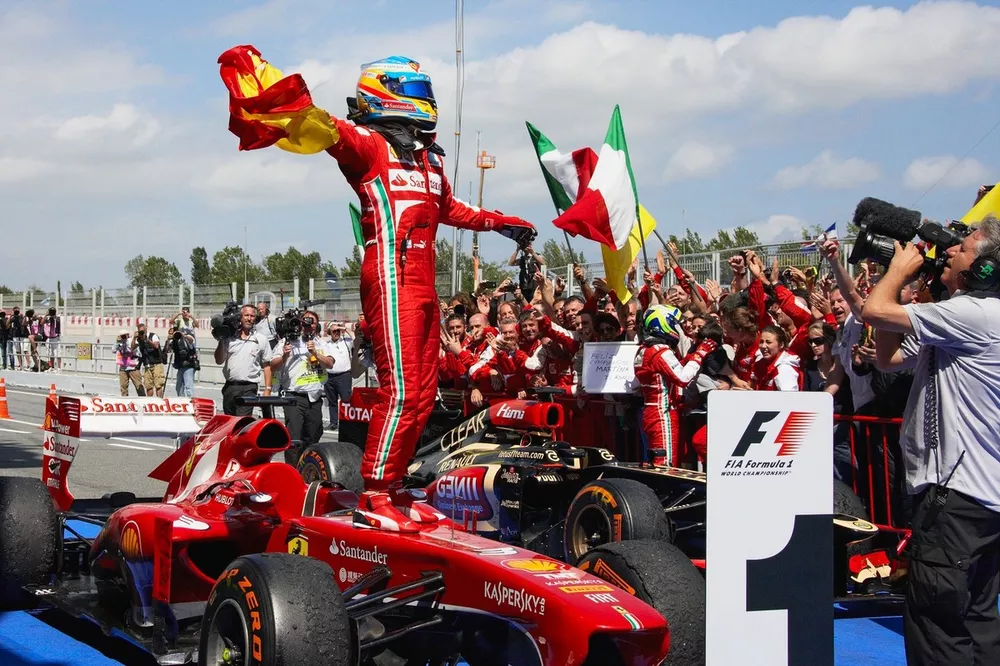
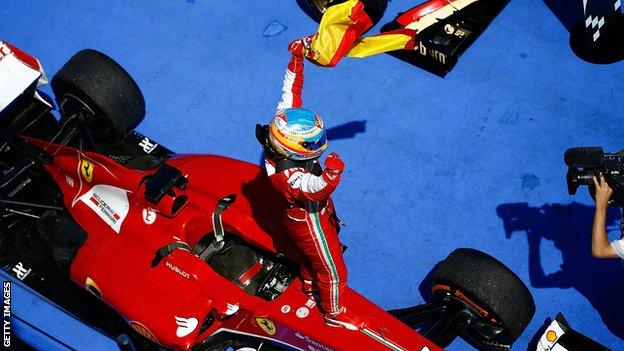
Ferrari fans are notoriously demanding, having witnessed legends from Alberto Ascari and Niki Lauda to Michael Schumacher. Yet the Tifosi fell head over heels for Alonso almost instantly. On his debut at Bahrain in 2010, he drove to an emphatic victory, followed later that autumn by an emotionally charged win at Monza. When he stood on the podium overlooking the main straight, tears streamed down his face as he acknowledged both the Italian tifosi and the Asturian flags waving proudly in the grandstands.
His finest performance in scarlet remains the 2012 European Grand Prix in Valencia. Starting from 11th on the grid, Alonso fought his way through the field with clinical aggression, passing rival after rival to take an improbable, spellbinding victory. On his cool-down lap, overcome with emotion, he stopped his car to celebrate with his home country fans. It was a victory forged entirely on racecraft, tire preservation, and refusal to surrender—the very traits instilled in him thirty years earlier on the damp kart tracks outside Oviedo.
The Enduring Legacy: Returning to Oviedo
Although Alonso narrowly missed securing a third world title with Ferrari in 2010 and 2012 by a handful of points, his tenure in Maranello solidified his status as one of the greatest racing gladiators in Formula 1 history. Even today, Ferrari team personnel speak of his work ethic with profound reverance.
Alonso never forgot where that drive came from. In 2015, just north of Oviedo in Llanera, he officially opened the Circuito y Museo Fernando Alonso. The complex features an FIA-homologated international kart circuit featuring corners inspired by his favorite Grand Prix tracks—including Silverstone’s Maggots-Becketts complex and Suzuka’s Esses. More importantly, it houses his karting school, designed to give Spanish youngsters the training facilities he had to invent for himself as a child.
Fernando Alonso’s legacy is defined by fierce independence, razor-sharp racecraft, and an unyielding will to win. While Maranello provided the stage, the script was written in the rain, grease, and quiet dignity of Oviedo. It was that hometown foundation that transformed a modest mechanic’s son into a motorsport icon whose fighting spirit captured the soul of Ferrari.