How Much Is 28.00 an Hour Annually? Salary Breakdown
If you have recently been offered a job, are negotiating a raise, or are simply budgeting your career goals, you might be asking: how much is 28.00 an hour annually? Earning $28 per hour puts you well above the federal minimum wage in the United States, but understanding what that number translates to in real terms requires a bit of math.

On the surface, converting an hourly wage to a yearly salary seems straightforward. However, your actual take-home pay will depend heavily on how many hours you work each week, whether you take unpaid time off, and how much money is deducted for taxes and benefits.
This guide breaks down everything you need to know about making $28.00 an hour, from gross annual income down to your weekly take-home paycheck.
How Much Is 28.00 an Hour Annually? The Core Calculation
To find out your annual gross salary (the amount you make before taxes), you need to multiply your hourly wage by the total number of hours you work in a year.
A standard full-time work schedule in the United States consists of 40 hours per week, 52 weeks a year. This totals 2,080 hours of work annually.
- Hourly wage: $28.00
- Hours per week: 40
- Weeks per year: 52
- Total annual hours: 2,080
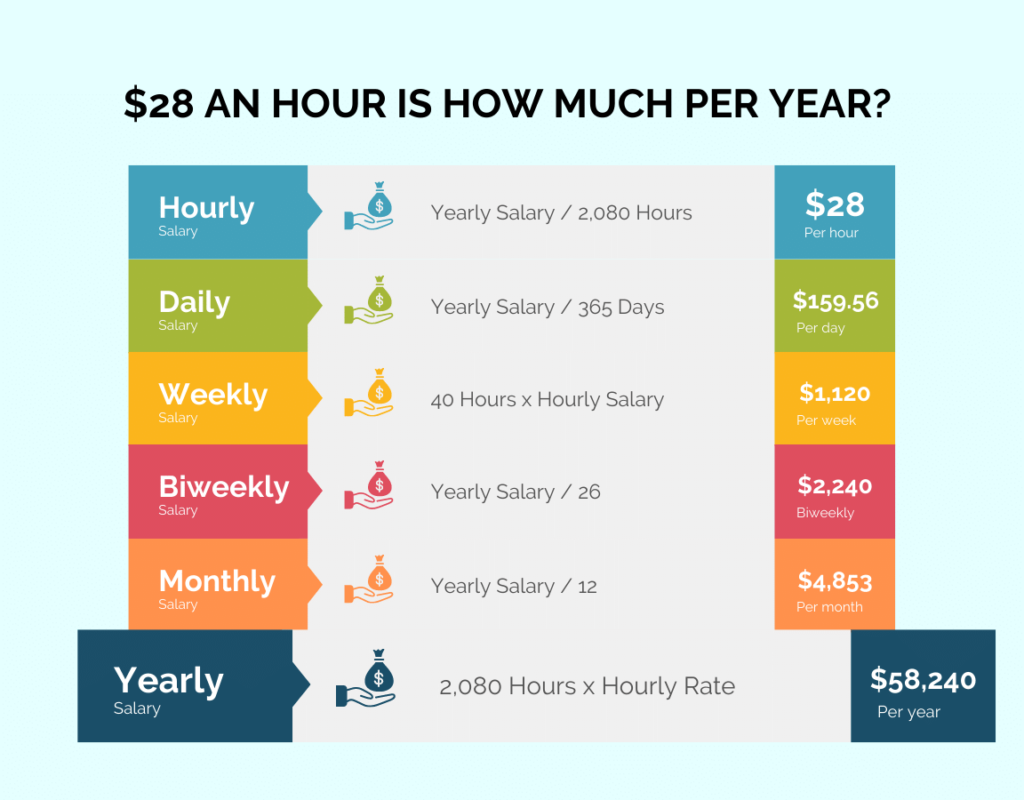
Multiplying $28.00 by 2,080 hours gives you a gross annual salary of $58,240.
Of course, not everyone works a standard 40-hour week. Here is how your annual salary changes based on different work schedules:
- Full-time (40 hours/week, 50 weeks with 2 weeks unpaid vacation): $56,000 per year
- Standard full-time (40 hours/week, 52 weeks): $58,240 per year
- Part-time (30 hours/week, 52 weeks): $43,680 per year
- Part-time (20 hours/week, 52 weeks): $29,120 per year
Breaking Down the Numbers: Monthly, Weekly, and Daily Pay
Before looking at taxes, it helps to see how a $58,240 yearly salary is distributed across different pay periods. This makes budgeting for rent, groceries, and bills much simpler.
Monthly Salary
If you are paid once a month or need to calculate your monthly budget, divide your annual gross income of $58,240 by 12 months. This equals $4,853.33 per month before taxes.
Bi-weekly Salary
Most full-time employees in the U.S. receive a paycheck every two weeks, resulting in 24 or 26 paychecks a year depending on the payroll cycle. Assuming a standard 26 pay-period year, your gross bi-weekly paycheck will be $2,240.00.
Weekly Salary
Working 40 hours a week at $28.00 an hour means you earn $1,120.00 per week before taxes and deductions.
Daily Salary

If you work a standard 8-hour workday, multiplying 8 hours by $28.00 gives you a gross daily income of $224.00.
Understanding Take-Home Pay (After Taxes)
While a gross salary of $58,240 looks great on paper, your actual take-home pay will be lower due to federal, state, and local taxes, as well as payroll deductions like Social Security, Medicare, and employer-sponsored health insurance or retirement plans.
Because tax situations vary wildly depending on where you live and your individual filing status, it is impossible to give a single exact figure for take-home pay. However, we can look at a realistic estimate.
Federal and Payroll Taxes
For a single filer earning roughly $58,000 a year in a state with no income tax (like Texas, Florida, or Nevada), your net take-home pay will look approximately like this:
- Federal Income Tax: Varies by deductions, but typically around 10% to 12% effective rate.
- FICA (Social Security & Medicare): Exactly 7.65% of your earnings.
- State Income Tax: Ranges from 0% to over 9% depending on your state.
In a moderate-tax state, an individual earning $28.00 an hour can generally expect to take home roughly 75% to 80% of their gross earnings after standard taxes and deductions.
Estimated Net Pay Breakdown (Moderate Tax State)
- Gross Annual Income: $58,240
- Estimated Net Annual Take-Home: ~$45,000 to $47,000
- Estimated Net Monthly Take-Home: ~$3,750 to $3,900
- Estimated Net Bi-Weekly Paycheck: ~$1,730 to $1,800
If you contribute to a 401(k) retirement plan or pay for health insurance premiums directly out of your paycheck, your take-home pay will be lower, but your long-term financial security and benefits will increase.
Is $28.00 an Hour a Good Living Wage?
Earning $28.00 an hour—or roughly $58,240 a year—is well above the national median individual income in the United States, which hovers around $40,000 to $45,000 for full-time workers depending on the source data.
Whether this wage provides a comfortable lifestyle depends heavily on your geographic location:
- High-Cost-of-Living Areas (e.g., New York City, San Francisco, Boston): In major metropolitan areas with high rent and steep living expenses, $58,240 is considered a modest income. You may need a roommate or a strict budget to live comfortably.
- Low-to-Moderate-Cost-of-Living Areas (e.g., parts of the Midwest, South, or rural areas): In regions with affordable housing, $28.00 an hour goes a long way. This salary can easily support a comfortable single lifestyle, pay for a mortgage, and allow for regular savings.
How to Increase Your Annual Earnings at $28/Hour
If you want to push your annual income higher than $58,240 without necessarily finding a brand-new job, you have a few options available:
- Work Overtime: Under the Fair Labor Standards Service (FLSA), non-exempt employees who work more than 40 hours in a workweek must be paid overtime at a rate of 1.5 times their regular hourly rate. At $28.00 an hour, your overtime rate is $42.00 an hour. Working just a few hours of overtime a week can significantly boost your yearly take-home pay.
- Negotiate a Raise: If you have gained new skills, taken on extra responsibilities, or performed well over the past year, use your $58,240 baseline to negotiate a bump to $30 or $32 an hour. Moving up to $30 an hour increases your gross annual salary to $62,400.
- Pick Up Side Hustles: Utilizing your skills outside of your 9-to-5 job through freelancing, consulting, or part-time work can add thousands of dollars to your annual total.
Conclusion
Earning $28.00 an hour translates to a gross annual salary of $58,240 based on a standard 40-hour workweek. While taxes and deductions will reduce your actual take-home pay to roughly $45,000 to $47,000 per year, this wage provides a solid, respectable income that beats the national median. By understanding your gross and net earnings, you can budget effectively, plan for savings, and make informed decisions about your career path.