How to Choose the Right 54 Ceiling Fan for Your Home
When selecting fixtures for your home, scale and performance must work together. While a 52-inch model was long considered the standard default, the 54 ceiling fan has surged in popularity among homeowners and interior designers alike. This blade span offers a subtle boost in airflow and visual presence, bridging the gap between modest bedroom fixtures and dramatic great-room centerpieces.
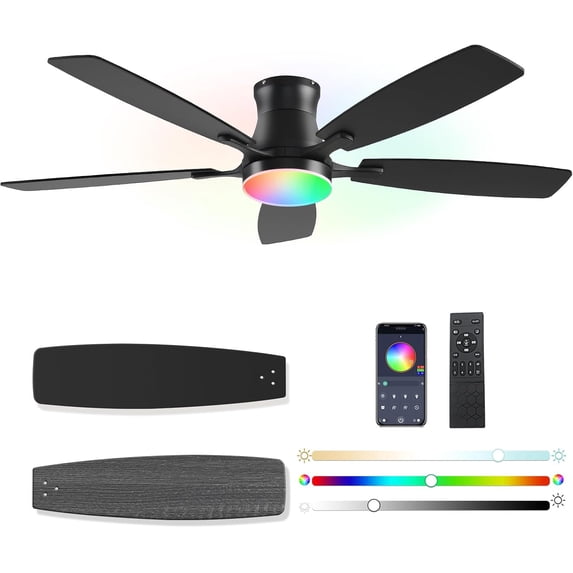
Choosing the right fixture requires understanding how blade span interacts with square footage, ceiling height, and motor efficiency. Here is everything you need to know before investing in a 54-inch ceiling fan.
Ideal Room Dimensions for a 54 Ceiling Fan
A ceiling fan's diameter directly dictates its airflow footprint. If a fan is too small, it spins frantically without circulating air effectively. If it is too large, it overwhelms the visual layout and can create an uncomfortable draft tunnel.
A 54-inch fan typically performs best in spaces measuring between 250 and 400 square feet (roughly 16x16 feet up to 20x20 feet). Common applications include:
- Master Suites: Primary bedrooms with king beds and sitting nooks need more airflow distribution than smaller secondary bedrooms.
- Open-Concept Living Areas: Medium-sized living rooms that flow into dining nooks benefit from the wider reach.
- Covered Outdoor Spaces: Screened porches, lanais, and standard verandas where open-air dissipation demands broader blade coverage.
- Bonus Rooms and Basements: Finished recreation areas often require broad, low-profile air movement across broad seating arrangements.
For safety and optimal performance, keep at least 18 to 24 inches of clearance between the tips of the fan blades and any adjacent walls, cabinets, or tall furniture.
Airflow Metrics: Understanding CFM and Efficiency
Blade span alone does not guarantee a cool breeze. Airflow performance is measured in Cubic Feet per Minute (CFM), which reflects the volume of air the fixture displaces at top speed.
When evaluating a 54-inch fan, use these CFM benchmarks:
- Under 4,500 CFM: Below average. Suitable primarily for decorative purposes or very mild air movement.
- 4,500 to 6,000 CFM: Standard performance. Adequate for indoor bedrooms and closed living rooms.
- 6,000 to 8,000+ CFM: High performance. Ideal for warmer climates, outdoor patios, and spaces with high ceilings.
Motor Technology: DC vs. AC
The motor powering your fan determines its noise level, energy consumption, and longevity. Today’s fixtures generally use one of two motor types:
- DC Motors (Direct Current): Highly efficient, using up to 70% less electricity than standard AC motors. They operate almost silently, generate less heat, and typically feature 6 distinct speed settings along with built-in reverse functions on the remote control.
- AC Motors (Alternating Current): The traditional choice. They are cost-effective up front and durable, but typically offer only 3 speeds, consume more power, and can produce a faint electrical hum over time.
If your budget allows, opting for a brushless DC motor is almost always worth the investment for a master bedroom or frequently used living room.
Blade Pitch and Aerodynamics
Video: 54" Westerleigh Ceiling Fan Installation Guide

Another critical performance factor is blade pitch—the angle at which the blades tilt relative to horizontal. Standard fans often feature a pitch between 10 and 12 degrees. High-efficiency 54-inch fans usually feature a pitch between 13 and 16 degrees.
A steeper pitch displaces more air per revolution, provided the motor is powerful enough to handle the aerodynamic drag. Be cautious of fans with steep blade pitch paired with weak, entry-level AC motors; these combinations can strain the internal components and lead to premature failure.
Regarding blade count: whether a fan has 3, 4, or 5 blades is largely an aesthetic choice. While fewer blades create slightly less drag (enabling faster rotation), modern engineered blades deliver comparable airflow across most 3-blade and 5-blade configurations.
Hanging Height and Downrod Selection
Proper elevation ensures both safety and maximum air displacement. Building codes require fan blades to hang at least 7 feet above the finished floor, with 8 to 9 feet serving as the sweet spot for optimal air velocity.
Use the following downrod guidelines based on your ceiling height:
- 8-foot ceiling: Flush-mount (hugger) or low-profile install with a 2- to 3-inch downrod.
- 9-foot ceiling: 6-inch downrod.
- 10-foot ceiling: 12-inch downrod.
- 12-foot ceiling: 24-inch downrod.
- 14-foot ceiling: 36-inch downrod.
If you have vaulted or cathedral ceilings, verify that the fan’s canopy accommodates the angle of your slope. Most standard brackets support slopes up to 15 or 20 degrees, but steeper angles usually require a separate sloped-ceiling adapter kit.
Indoor vs. Outdoor Ratings (UL Ratings)
Before installing a 54-inch ceiling fan on a patio or porch, check its Underwriters Laboratories (UL) or Intertek (ETL) environmental rating:
- Dry-Rated: Designed strictly for indoor spaces with no exposure to moisture or humidity (bedrooms, living rooms, hallways).
- Damp-Rated: Engineered to withstand moisture and condensation, but not direct water exposure. Perfect for covered patios, screened porches, bathrooms, and laundry rooms.
- Wet-Rated: Built with sealed motor housings, weather-resistant wiring, and waterproof materials (such as ABS composite blades). These can handle direct rainfall, snow, and garden hose washdowns, making them essential for open pergolas and exposed gazebos.
Lighting and Smart Control Options
Modern fixtures do much more than circulate air. Integrated features can significantly enhance everyday usability:
- CCT-Tunable LED Light Kits: Correlated Color Temperature (CCT) settings allow you to switch the fixture’s light output between warm white (2700K), soft white (3000K), and daylight (4000K–5000K) to complement existing room lighting.
- Smart Integrations: Wi-Fi-enabled fans connect with platforms like Apple Home, Google Assistant, and Amazon Alexa. These allow for voice commands, automated scheduling based on room temperature, and remote operation via smartphone apps.
- Seasonal Reversibility: Running blades counterclockwise pushes cool air downward during the summer. In the winter, reversing the blades to rotate clockwise at low speed pulls cool air upward, forcing the warm air pooled at the ceiling down along the walls without creating a chilly breeze.
Buyer's Pre-Purchase Checklist
- Measure the room: Confirm your space is roughly 250 to 400 square feet for a 54-inch diameter.
- Check vertical clearance: Ensure you have at least 7 feet of headroom under the blades.
- Review the CFM rating: Target at least 5,000 CFM for living spaces and 6,000+ CFM for outdoor environments.
- Confirm the location rating: Use damp- or wet-rated fans anywhere moisture is present.
- Select motor type: Choose DC for whisper-quiet efficiency or AC for lower upfront cost.
By prioritizing proper sizing, motor efficiency, and mounting height, a 54-inch ceiling fan provides year-round climate comfort while serving as a well-proportioned architectural accent in your home.


