How to Find Kite Area: Formulas and Step-by-Step Guide
Understanding the Geometry of a Kite

In geometry, a kite is a quadrilateral with two distinct pairs of equal-length adjacent sides. Unlike a square or a rhombus, its opposite sides are not necessarily equal. However, just like a rhombus, its diagonals always intersect at a right angle (90 degrees). Understanding these properties makes learning how to find kite area straightforward, whether you are solving a math homework problem or cutting fabric for a real-world flying toy.
Most people encounter kite area calculations in school geometry classes, but the principles apply to architecture, design, and crafts. Depending on the information you have been given—such as diagonal lengths, side measurements, or internal angles—you can choose from a few different formulas to get your answer.
How to Find Kite Area Using Diagonals
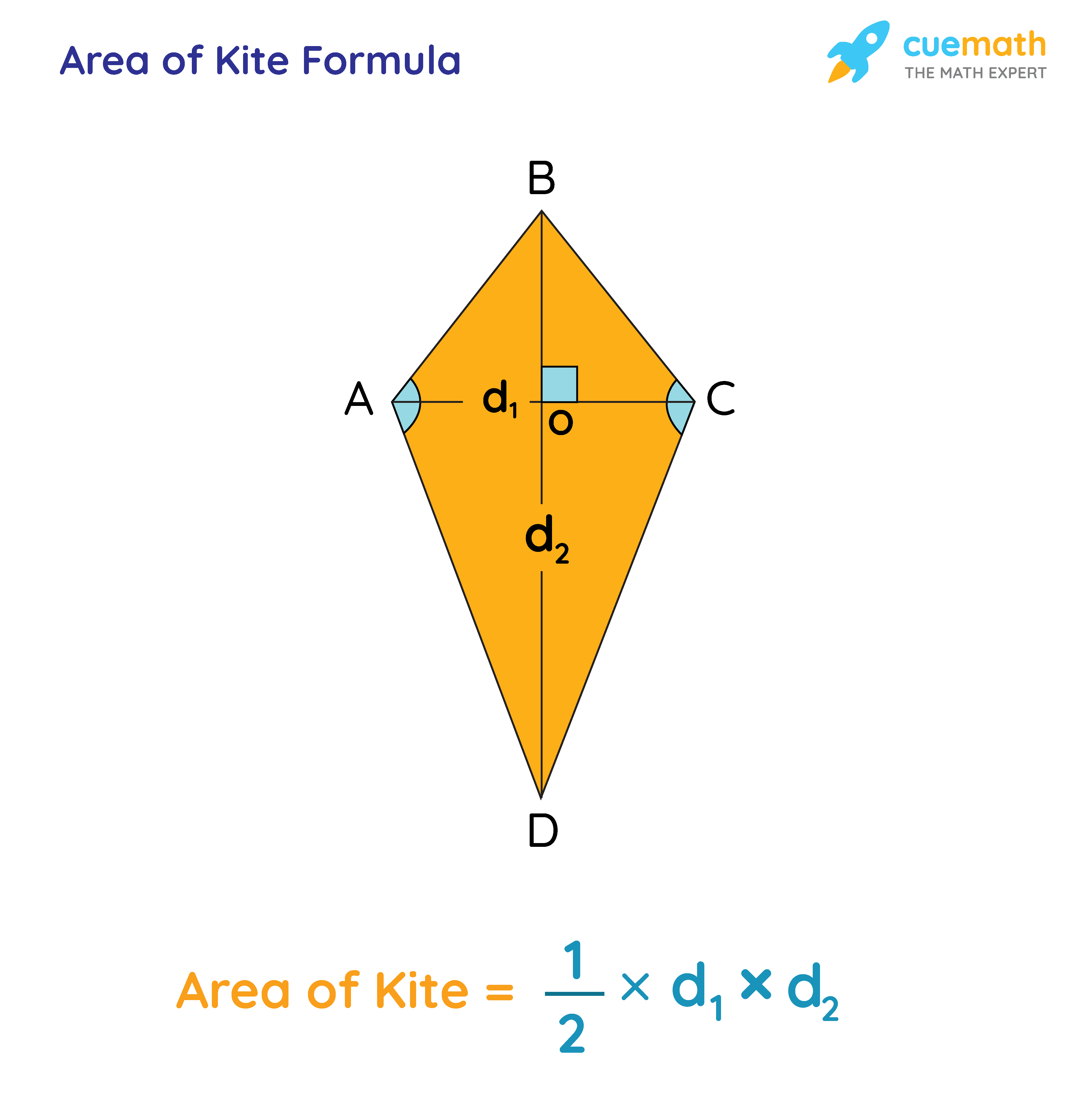
The most common and easiest method to calculate the area of a kite relies on its diagonals. A diagonal is a straight line connecting opposite corners (vertices) through the center of the shape. Because the perpendicular diagonals of a kite divide it into four right-angled triangles, a neat mathematical shortcut emerges.
The Diagonal Formula
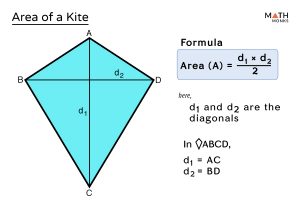
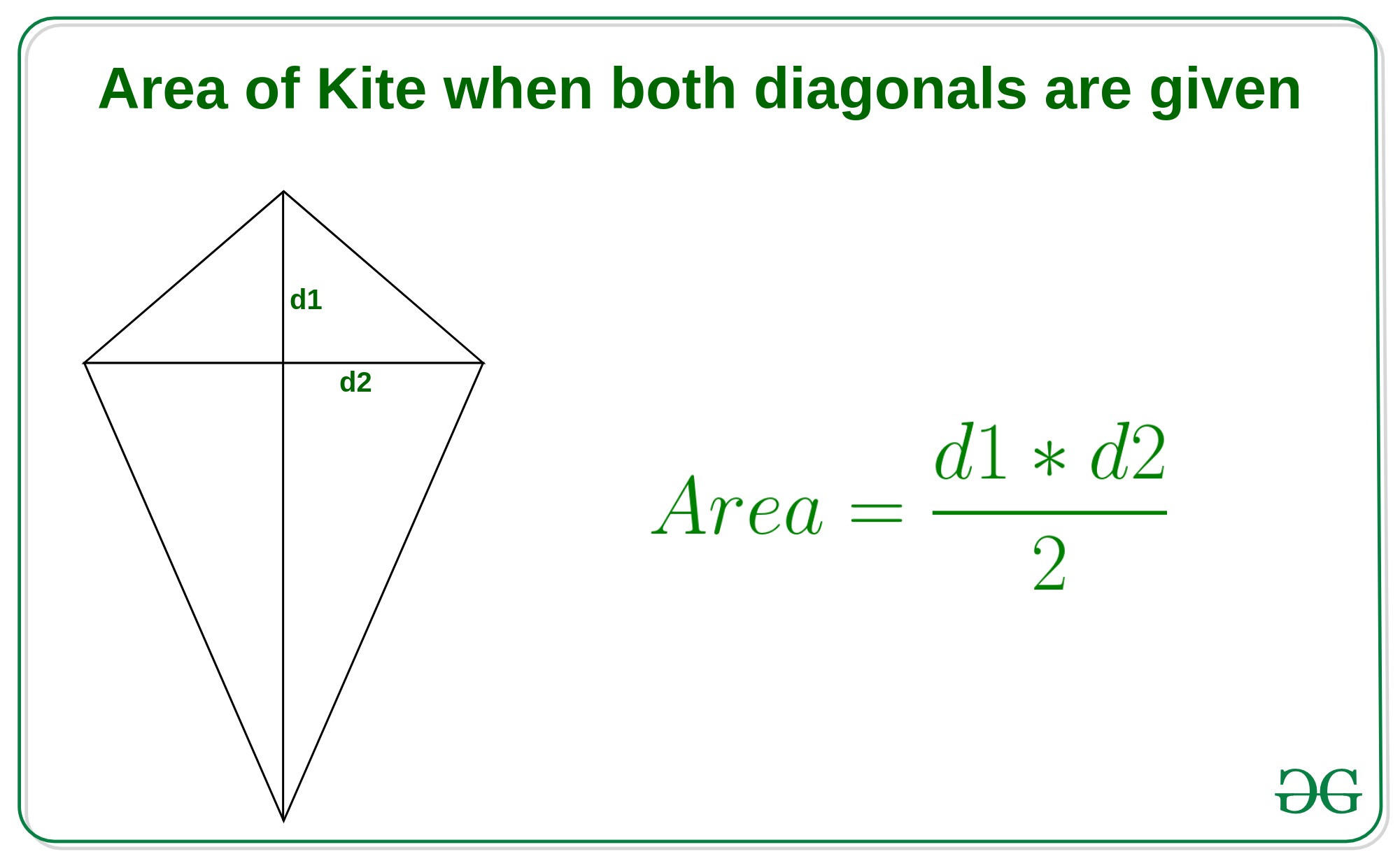
To find the area ($A$) of a kite using its diagonals ($d_1$ and $d_2$), you multiply the lengths of the two diagonals together and then divide the result by two:
$A = \frac{d_1 \times d_2}{2}$
Or, expressed another way: $A = \frac{1}{2} \times d_1 \times d_2$.
Step-by-Step Calculation Example
Imagine you have a kite where the main vertical diagonal ($d_1$) measures 10 inches, and the horizontal cross diagonal ($d_2$) measures 6 inches. To find the area:
- Multiply the two diagonal lengths together: $10 \times 6 = 60$.
- Divide that product by 2: $\frac{60}{2} = 30$.
- Add your units of measurement squared: The total area is 30 square inches.
How to Find Kite Area Using Side Lengths and Angles
Sometimes, math problems or practical projects do not give you the lengths of the diagonals. Instead, you might only know the lengths of the outer sides and the angle between them. Because a kite is symmetrical along its main diagonal, it is composed of two identical triangles sharing a base.
Video: Area of a Kite
The Trigonometric Formula

If you know the lengths of two unequal adjacent sides ($a$ and $b$) and the included angle ($\theta$) between them, you can use trigonometry:
$A = a \times b \times \sin(\theta)$
Note that because a kite has two pairs of equal sides, you calculate the area of one half (two identical triangles) and multiply by two, which simplifies the formula to multiplying the two different side lengths by the sine of the angle between them.
Step-by-Step Calculation Example
Suppose you are building a physical kite. Side $a$ is 5 feet long, side $b$ is 7 feet long, and the angle between these two sides is 30 degrees.
- Identify your values: $a = 5$, $b = 7$, and $\theta = 30^\circ$.
- Find the sine of 30 degrees. Using a calculator, $\sin(30^\circ) = 0.5$.
- Multiply the side lengths together: $5 \times 7 = 35$.
- Multiply that result by the sine value: $35 \times 0.5 = 17.5$.
- Your total kite area is 17.5 square feet.
Alternative Method: Splitting the Kite Into Triangles
If you forget the standard formulas, you can always revert to basic geometry by breaking the shape down. The main diagonal cuts the kite into two identical triangles. The length of the main diagonal serves as the base ($b$) for both triangles, and the halves of the cross diagonal act as the respective heights ($h_1$ and $h_2$).
- Area of Triangle 1 = $\frac{1}{2} \times \text{main diagonal} \times \text{half of cross diagonal}$
- Area of Triangle 2 = $\frac{1}{2} \times \text{main diagonal} \times \text{other half of cross diagonal}$
- Total Area = Area of Triangle 1 + Area of Triangle 2
When you factor this out algebraically, you end up right back at the standard diagonal formula ($\frac{d_1 \times d_2}{2}$), proving just how reliable the shortcut is.
Practical Applications for Kite Area Calculations
Knowing how to calculate this specific geometric area is useful outside of the classroom. Here are a few practical scenarios:
- Crafting and Building: When buying ripstop nylon, plastic, or paper to build a flying kite, you need to know the exact area to purchase enough material without excessive waste.
- Landscaping and Design: Garden beds, paving stones, and yard layouts are sometimes cut into kite shapes for aesthetic symmetry. Area calculations help determine mulch, soil, or tile requirements.
- Architecture: Modern roof designs, glass panels, and decorative wall tiles frequently utilize kite geometry for structural stability and unique visual appeal.
Common Mistakes to Avoid
To ensure your calculations are always accurate, watch out for these frequent pitfalls:
- Forgetting to divide by 2: When using the diagonal method, it is very common to multiply $d_1$ and $d_2$ and forget the final division step, resulting in an answer that is twice as large as it should be.
- Mixing up units: Ensure both diagonals or side lengths use the same unit of measurement (e.g., inches to inches, meters to meters) before running the formula. Never multiply inches by feet directly.
- Confusing diagonals with sides: Double-check that the numbers you are plugging into the diagonal formula stretch entirely from corner to corner, rather than just tracing the outer perimeter.
By keeping these simple formulas and tips in mind, calculating the area of any kite becomes a quick and stress-free process.