How to Find the Missing Side Length in a Right Triangle
Understanding Right Triangles
Geometry problems frequently ask a simple question: what is the missing side length in this right triangle? Whether you are studying for a standardized test, completing homework, or working on a practical DIY project, finding an unknown side of a triangle is a fundamental mathematical skill. Fortunately, as long as you know the lengths of two sides, finding the third is a straightforward process.
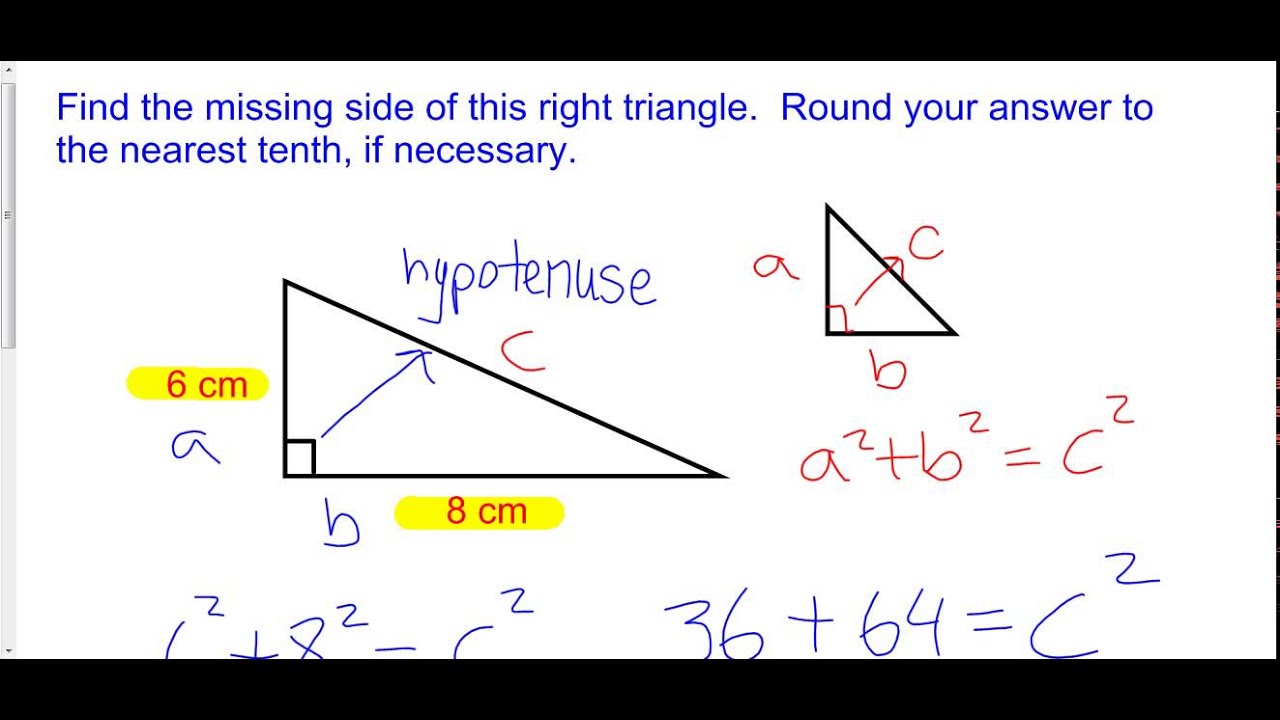
Before diving into the calculations, it helps to understand the anatomy of a right triangle. A right triangle is defined by having one 90-degree angle, which is usually marked with a small square in the corner. The sides that form this right angle are called the legs. The side directly opposite the right angle is called the hypotenuse. The hypotenuse is always the longest side of the triangle.
The Pythagorean Theorem Formula
The golden rule for solving right triangle measurements is the Pythagorean theorem. Named after the ancient Greek mathematician Pythagoras, this formula states that in any right triangle, the square of the length of the hypotenuse equals the sum of the squares of the lengths of the two legs.
Mathematically, it is written as:
a² + b² = c²
Here is what each variable represents in the equation:
- a: The length of the first leg
- b: The length of the second leg
- c: The length of the hypotenuse (always the longest side, opposite the right angle)
No matter which two sides a geometry problem provides, you can plug those values into this equation to find the missing measurement.
Finding the Hypotenuse (When 'c' is Missing)
The most common scenario you will encounter is when you are given the lengths of both legs ($a$ and $b$) and need to calculate the length of the hypotenuse ($c$). Let's walk through a step-by-step example.
Video: Find Missing Lengths within Right Triangles
Imagine a right triangle where leg $a$ measures 3 inches and leg $b$ measures 4 inches. You need to answer: what is the missing side length in this right triangle?
- Write down the formula: $a^2 + b^2 = c^2$
- Substitute the known values: $3^2 + 4^2 = c^2$
- Square the numbers: $9 + 16 = c^2$
- Add the numbers together: $25 = c^2$
- Take the square root of both sides: $\sqrt{25} = c$
- Final answer: $c = 5$
The length of the hypotenuse is 5 inches. This specific triangle (3-4-5) is a classic example of a Pythagorean triple, which are sets of whole numbers that fit the theorem perfectly.
Finding a Missing Leg (When 'a' or 'b' is Missing)
Sometimes, the problem gives you the hypotenuse and one leg, asking you to find the other leg. The algebra changes slightly, but the core formula remains identical.
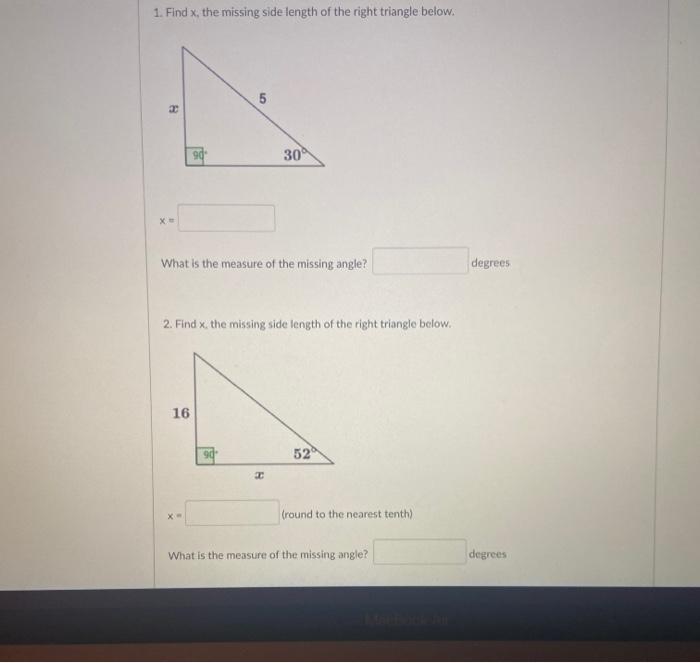
Suppose your right triangle has a hypotenuse ($c$) of 13 centimeters and one leg ($a$) of 5 centimeters. You need to find the missing leg ($b$).
- Write down the formula: $a^2 + b^2 = c^2$
- Substitute the known values: $5^2 + b^2 = 13^2$
- Square the numbers: $25 + b^2 = 169$
- Isolate the unknown variable ($b^2$): Subtract 25 from both sides. $b^2 = 169 - 25$
- Simplify the subtraction: $b^2 = 144$
- Take the square root of both sides: $\sqrt{144} = b$
- Final answer: $b = 12$
The length of the missing leg is 12 centimeters.
Common Mistakes to Avoid
Even though the Pythagorean theorem is simple, it is easy to make careless errors if you rush. Keep these tips in mind to ensure accuracy:
- Always identify the hypotenuse first: The variable $c$ must always represent the hypotenuse (the side across from the 90-degree angle). Mixing this up will ruin your calculation.
- Don't forget to square the numbers: Beginners often add the raw numbers together (e.g., $3 + 4 = 7$) instead of squaring them first ($9 + 16 = 25$).
- Remember to take the square root: Finding $c^2$ or $b^2$ is not the final step. You must calculate the square root of that result to find the actual linear length of the side.
Real-World Applications
Knowing how to calculate right triangle dimensions goes far beyond passing a math test. Carpenters use this math to ensure building frames are perfectly square. Painters use it to figure out how far the base of a ladder needs to be from a wall to reach a specific window safely. Navigation systems use coordinate geometry based on these exact same distance formulas.
The next time you look at a geometry problem and wonder what is the missing side length in this right triangle, just remember to square the two known sides, add or subtract them depending on whether you need a leg or a hypotenuse, and take the square root. Practice a few problems, and this process will become second nature.